
Recommended Free Tools
Smart speakers hear commands in noisy rooms by capturing sound with microphones, filtering and separating speech from interference, detecting a wake word, then recognizing and interpreting the request. Multiple microphones can help the device focus on speech from a particular direction, while noise reduction and echo cancellation tackle different kinds of unwanted sound. Results still depend on the room, the noise, the speaker’s placement and whether it is playing audio.
How a smart speaker processes a voice command
Voice recognition is a pipeline, not a single act of “hearing.” A typical far-field system captures sound, improves the audio, checks for a wake word and then processes the command. The exact split between on-device and cloud processing varies by product. Amazon’s published architecture is one example, not a description of every brand.
- Microphones capture the room. One microphone or an array picks up the user’s voice along with music, appliance noise, reflections and, if the speaker is playing, its own output.
- An audio front end improves the signal. Systems may use beamforming, noise reduction, de-reverberation and acoustic echo cancellation. These techniques address different problems: beamforming favors sound from a direction, noise reduction targets ambient interference, de-reverberation reduces the effect of reflected sound, and echo cancellation helps separate the user from the device’s playback.
- A wake-word detector listens for the trigger. The device first looks for a phrase such as “Alexa.” This is a distinct task from transcribing and understanding the full request. Published research on on-device wake-word detection describes the challenge of distinguishing a trigger from background speech, music and noise while working with limited computing resources.
- Speech recognition and language processing interpret the request. In Amazon’s described architecture, audio processing and wake-word detection come before cloud-side automatic speech recognition (ASR) and natural-language understanding (NLU). Other systems may divide these tasks differently.
Amazon’s far-field speech recognition system diagram illustrates the stages from multichannel microphone input through audio-front-end processing and wake-word detection to ASR and NLU.
How multiple microphones help in a noisy room
A microphone array gives a device spatial information that a single microphone does not. Beamforming uses differences in the sound arriving at multiple microphones to emphasize speech from a desired direction and suppress interference arriving from other directions. It does not make the room quiet or guarantee that the speaker will understand every voice.
#1 Best Overall

- Your favorite music and content – Play music, audiobooks, and podcasts from Amazon Music, Apple Music, Spotify and others or via Bluetooth throughout your home.
- Alexa is happy to help – Ask Alexa for weather updates and to set hands-free timers, get answers to your questions and even hear jokes. Need a few extra minutes in the morning? Just tap your Echo Dot to snooze your alarm.
- Keep your home comfortable – Control compatible smart home devices with your voice and routines triggered by built-in motion or indoor temperature sensors. Create routines to automatically turn on lights when you walk into a room, or start a fan if the inside temperature goes above your comfort zone.
- Do more with device pairing – Fill your home with music using compatible Echo devices in different rooms, or create a home theatre system with Fire TV.
- Say goodbye to drop-offs and buffering - With eero Built-in, Echo Dot doubles as a mesh wifi extender, adding up to 1,000 sq. ft. of wifi coverage to your existing eero network.
Amazon’s Alexa acoustic-certification guidance defines beamforming as a technique for multi-microphone arrays that emphasizes speech from a desired direction while suppressing sound from other directions. The same guidance recommends at least two microphones to improve the signal-to-noise ratio; that is advice for device makers, not a minimum microphone count shared by all consumer speakers.
Microphone count alone does not determine performance. Array design, signal processing, room reflections, the speaker’s location and the kind of interference all matter. Amazon’s historical account of the original Echo describes a seven-microphone array and techniques including beamforming, noise reduction and echo cancellation, but that device-specific description is not a specification for current smart speakers.
Rank #2

- Your favorite music and content – Play music, audiobooks, and podcasts from Amazon Music, Apple Music, Spotify and others or via Bluetooth throughout your home.
- Alexa is happy to help – Ask Alexa for weather updates and to set hands-free timers, get answers to your questions and even hear jokes. Need a few extra minutes in the morning? Just tap your Echo Dot to snooze your alarm.
- Keep your home comfortable – Control compatible smart home devices with your voice and routines triggered by built-in motion or indoor temperature sensors. Create routines to automatically turn on lights when you walk into a room, or start a fan if the inside temperature goes above your comfort zone.
- Do more with device pairing – Fill your home with music using compatible Echo devices in different rooms, or create a home theatre system with Fire TV.
- Say goodbye to drop-offs and buffering - With eero Built-in, Echo Dot doubles as a mesh wifi extender, adding up to 1,000 sq. ft. of wifi coverage to your existing eero network.
Why a speaker can miss a wake word—or activate by mistake
The wake-word detector has to balance two errors. A false rejection happens when someone says the wake word and the device does not respond. A false acceptance happens when the device activates even though nobody intended to address it, such as during unrelated conversation. More sensitivity may help catch quieter or distant calls, but can also increase unintended activations; a stricter detector may avoid some false activations but miss more real ones.
Background speech is particularly difficult because it resembles the kind of sound the system is trying to recognize. Music and steady household noise can also obscure a trigger. Research on two-stage on-device wake-word detection discusses these background sounds, the false-alarm and false-reject trade-off, and the limits of processing on a device.
The Tool Desk
Outbyte PC Repair FREERepair Windows errors before they cause bigger problemsFix Now →Outbyte Driver Updater FREEScan for outdated or missing drivers - takes under a minuteDriver Scan →Rank #3
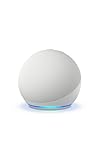
- Your favorite music and content – Play music, audiobooks, and podcasts from Amazon Music, Apple Music, Spotify and others or via Bluetooth throughout your home.
- Alexa is happy to help – Ask Alexa for weather updates and to set hands-free timers, get answers to your questions and even hear jokes. Need a few extra minutes in the morning? Just tap your Echo Dot to snooze your alarm.
- Keep your home comfortable – Control compatible smart home devices with your voice and routines triggered by built-in motion or indoor temperature sensors. Create routines to automatically turn on lights when you walk into a room, or start a fan if the inside temperature goes above your comfort zone.
- Do more with device pairing – Fill your home with music using compatible Echo devices in different rooms, or create a home theatre system with Fire TV.
- Say goodbye to drop-offs and buffering - With eero Built-in, Echo Dot doubles as a mesh wifi extender, adding up to 1,000 sq. ft. of wifi coverage to your existing eero network.
What happens while the speaker is playing audio
A device that listens while playing music or a response must distinguish a person’s voice from sound coming from its own speaker. Acoustic echo cancellation estimates and reduces that device-generated audio in the microphone signal. This can help with barge-in—interrupting playback with a new command—but it does not remove unrelated room noise, and success still depends on the audio, room and device.
Amazon’s description of far-field voice technology discusses beamforming, noise reduction, echo cancellation and wake-word recognition in Alexa devices. It is useful as an example of how those components can work together, not as a universal account of smart-speaker internals.
Rank #4
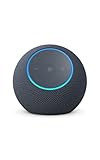
- Meet Echo Dot Max: Experience rich room-filling sound that automatically adapts to your space and fine-tunes playback. Features a built-in smart home hub and Omnisense technology for highly personalized experiences.
- Music to your ears: With nearly 3x the bass versus Echo Dot (2022 release), it fits beautifully in any space, delivering your personal sound stage with deep bass and enhanced clarity. Listen to streaming services, such as Amazon Music, Apple Music, Spotify, and SiriusXM. Encore!
- Do more with device pairing: Connect compatible Echo smart speakers and smart displays in different rooms, or pair with a second Echo Dot Max to enjoy even richer sound. Pair your Echo Dot Max with compatible Fire TV devices to create a home theater system that brings scenes to life.
- Simple smart home control: Set routines, pair and control lights, locks, and thousands of smart home devices that work with Alexa without needing a separate smart home hub. With Omnisense technology, you can activate routines via temperature or presence detection.
- Say goodbye to drop-offs and buffering - With eero Built-in, Echo Dot Max doubles as a mesh wifi extender, adding up to 1,000 sq. ft. of wifi coverage to your existing eero network.
Why “across the room” is not a fixed distance
There is no universal recognition distance or accuracy figure for smart speakers in background noise. A command may be easy to recognize in a quiet room and difficult in a reverberant room with music, even at the same distance. The direction of the speaker, the type and level of noise, and whether the device is playing audio also change the conditions.
Amazon’s developer guidance recommends evaluating devices under multiple conditions, including near-field and far-field use, silence, playback and background noise. That describes useful test dimensions; it does not rank current consumer speakers or establish a distance that applies to all rooms and products.
Best Value

- Alexa can show you more - Echo Show 5 includes a 5.5” display so you can see news and weather at a glance, make video calls, view compatible cameras, stream music and shows, and more.
- Small size, bigger sound – Stream your favorite music, shows, podcasts, and more from providers like Amazon Music, Spotify, and Prime Video—now with deeper bass and clearer vocals. Includes a 5.5" display so you can view shows, song titles, and more at a glance.
- Keep your home comfortable – Control compatible smart devices like lights and thermostats, even while you're away.
- See more with the built-in camera – Check in on your family, pets, and more using the built-in camera. Drop in on your home when you're out or view the front door from your Echo Show 5 with compatible video doorbells.
- See your photos on display – When not in use, set the background to a rotating slideshow of your favorite photos. Invite family and friends to share photos to your Echo Show. Prime members also get unlimited cloud photo storage.
- False rejection rate: How often the device misses a spoken wake word.
- False acceptance rate: How often it activates when it should remain idle.
- Distance and room: Whether testing is near-field or far-field, and what room setup is used.
- Sound conditions: Whether tests include silence, speech, music, appliance noise or the device’s own playback.
- Interruptions: Whether the test checks commands issued while the speaker is playing audio.
What to check when your smart speaker does not hear you
Use the processing chain to narrow down the likely cause rather than assuming that every missed command is a speech-recognition failure:
- If the device does not respond to the wake word, consider whether noise, distance or playback is masking the trigger.
- If it responds to the wake word but gets the request wrong, the trigger was detected; the full command may have been difficult to recognize or interpret.
- If it struggles mainly while playing audio, echo cancellation and the playback conditions may be relevant.
- If performance changes by location, room reflections, speaker direction and placement may be affecting the captured signal.
- If it activates during unrelated speech, that is a false acceptance rather than a failure to transcribe a requested command.
These are diagnostic clues, not proof of a particular fault. The algorithms and processing locations differ by product, and a user-facing symptom alone cannot reveal which stage failed.
Quick Recap
Product prices and availability are accurate as of the date/time indicated and are subject to change. Any price and availability information displayed on Amazon at the time of purchase will apply.

