
What’s actually slowing this PC down?
Pick the symptom - the matching free tool is one click away.
Sandpaper grit numbers describe how coarse or fine an abrasive is: within the same grading system, a lower number is coarser and a higher number is finer. The number alone is not a universal particle-size measurement, so check the grading-system mark—such as the “P” in P80—before comparing products.
How to read a sandpaper grit number
Grit is an abrasive grade, not a direct measure you can compare across every sandpaper label. Within one system, the practical rule is simple: lower numbers indicate coarser abrasives that remove material more aggressively; higher numbers indicate finer abrasives used later for a smoother surface.
For example, 80 grit is coarser than 120 grit when both numbers use the same grading system. That does not mean every product marked 80 is precisely equivalent to another brand’s 80 if the systems differ.
What does the “P” mean in P80?
The “P” identifies a FEPA grading. Mirka’s 2018 abrasive guide notes that FEPA grades use the P mark, as in P80, and lists P80 at 201 microns, P120 at 125 microns, and P220 at 68 microns. Those micron entries are values in Mirka’s chart, not universal conversion promises. Mirka 3C Solutions brochure (© 2018)
Quick wins for a faster PC:
Clear out junk files and repair common Windows errorsFree Scan →Fix the driver behind crashes, sound loss and screen glitchesFind Drivers →Repair Windows errors before they cause bigger problemsFix Now →#1 Best Overall

- Multi-Stage Sandpaper Assortment: This Shineboc 9x3.6 inch sandpaper pack includes 21 sheets with 7 grits (120/220/400/600/800/1000/2000), 3 sheets per grit, suitable for all sanding stages from rough to fine
- Premium Material: Crafted from high-quality silicon carbide, it is electrostatically coated to ensure an uniform distribution of grit. This results in long-lasting performance and high resistance to damage
- Wet and Dry Use: It can be utilized for both wet and dry sanding. Wet sanding helps reduce the occurrence of scratches and minimizes dust emissions, while dry sanding offers faster material removal and convenience
- Anti-Clogging: With excellent anti-clogging properties, it resists the accumulation of dust and debris. This guarantees a sharp cutting edge and less frequent replacement
- Tear-Resistant: A reinforced backing layer is incorporated, which prevents the sanding sheets from tearing under high pressure or when used on irregular surfaces
Other labels may use ANSI/CAMI, GOST, Japan JIS, or micron references. Mirka’s 2022 chart, for instance, puts 82 microns alongside US CAMI 180, FEPA P180, and JIS 150; at a finer point, it shows 22 microns alongside CAMI 400, FEPA P800, and JIS 700. The differing labels make clear why a bare number is not enough for exact cross-system matching. Mirka USA Product Catalog 2022
Can you compare grit numbers between brands?
Compare the grading system first. Mirka cautions that standards are not directly comparable, so a chart can help orient you but should not be treated as a guarantee that two grades are interchangeable. Look for the system prefix or product documentation; when the system is not stated, avoid assuming that its unprefixed number matches a FEPA P grade exactly.
Rank #2
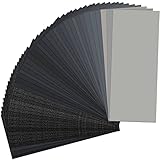
- Premium Silicon Carbide: Electrostatically coated for uniform grit distribution; anti-static reinforced waterproof backing resists tearing, clogging; delivers consistent cutting performance for extended use
- Wet & Dry Dual Use: Dry sanding removes material fast with less loading; wet sanding reduces scratches and dust for smooth finishes; works with sanding blocks and pneumatic tools
- User-Friendly Design: Precut 9 x 3.6 inch sheets trim to any size; grit numbers clearly printed on the back for quick identification; flexible backing conforms to curved and irregular surfaces
- Wide Application Scenarios: Ideal for wood furniture refinishing, auto body paint repair, metal rust removal, resin art, 3D print smoothing, jewelry buffing, glass detailing, drywall repair
- Complete 16-Grit Assortment: Three sheets each of 120/150/180/220/240/320/400/600/800/1000/1200/1500/2000/2500/3000/5000 grit; covers rough shaping to ultra-fine polishing; all-in-one variety sanding kit for workshops & DIY
What grit should you use?
Choose based on how much material needs to come off and how smooth the surface needs to be. Coarser abrasive is suited to more aggressive removal; finer grades are used to refine a surface. The right starting and finishing grades depend on the material, its condition, and the intended finish, so a single grit recommendation does not fit every wood, paint, metal, plastic, or coating.
Removing paint or rust
As one manufacturer example, 3M describes its 60-grit general-purpose sheet as coarse and lists paint and rust removal, deburring, and blending among its uses. That is a product-specific example, not a rule that 60 grit is right for every removal job. The sheet is also listed for hand use, a sanding block, or cutting to fit a power-tool sander. 3M General Purpose Sanding Sheets, 60 grit
Free tools Windows power users keep installed
One-click scans. No signup required.
Rank #3

- Use it by hand, on a sanding block, or cut it to size for a power tool sander
- Aluminum oxide mineral
- Sands paint, wood, or metal
- Tough and durable
- 5/Pack
Smoothing wood with a sequence
When a surface needs progressively finer sanding, move through a sequence rather than jumping straight from coarse to very fine. For wood, 3M advises sanding with the grain and not skipping more than one grit between sanding steps. This is the manufacturer’s guidance for its general-purpose sheets; follow the directions for the abrasive and job in front of you.
Wet sanding
“Wet/dry” describes how a sheet may be used, not a different definition of its grit number. 3M’s Wetordry sheets include a 220A-grit product; the manufacturer says water or cutting oil can reduce clogging and extend abrasive life, and identifies uses including lacquers, primers, sealers, plastics, and paints. Check the specific product directions before using liquid. 3M Wetordry Sanding Sheets 5pk
Quick Recap
Best Value

- Premium Sandpaper Sheets Assortment:80/120/180/220/320/400 Grit (2 sheets of each) silicon carbide sand paper,easily cuts into 1/4,1/3,or 1/2 sheets to fit any sanding block or tool.Suitable for woodworking, metalworking, crafting, and DIY projects.
- Versatile Applications: This multi-grit assortment (80-400) is ideal for efficient material removal, surface leveling, and intermediate smoothing. Perfect for stripping coatings, removing imperfections from wood/metal surfaces, and preparing substrates for priming or final finishing.
- Wet & Dry Sanding Performance: In dry use, it cuts with remarkable speed. In wet use, it prevents grit from clogging and cools the working surface.Ensuring optimal sanding performance across diverse conditions.
- Excellent Performance: Engineered with premium silicon carbide abrasives and an advanced latex paper backing, it combines a flexible design for seamless curved surface sanding.
- What You Get: BMOTL 12 pcs full size sheets sandpaper(9 x 11 in). These sandpaper sheets deliver exceptional durability and performance. Whether you need coarse grits for heavy-duty tasks or ultra-fine grits for a smooth, polished finish, this variety pack has it all
Rank #4

- What You Get: This all-in-one sanding kit includes a compact micro sanding block and 180 sandpapers in 9 grits 80/120/180/220/320/400/600/800/1000
- 3-Color Grit System: Red (coarse), yellow (medium), grey (fine) – grab the right grit instantly, no more guessing
- Quick-Change Hook & Loop Backing: Tool-free backing lets you change sandpapers in seconds for uninterrupted work
- Ergonomic Mini Sander: Measuring just 3.5 x 1.1 inches, this compact PU foam hand sander glides effortlessly into corners and grooves. The lightweight ergonomic design reduces hand fatigue
- Premium Material: Made with durable aluminum oxide abrasive, these sandpapers resist tearing, clogging, and crumbling. Built to last on wood, metal, plastic, and painted surfaces
What else matters besides grit?
- Grading system: Check whether the label is FEPA P, ANSI/CAMI, JIS, GOST, or a micron value before comparing numbers.
- Job and finish: Match the abrasive’s coarseness to the amount of removal required and the smoothness you want.
- Use method: Sheet format and backing affect whether it suits hand sanding, a block, or a compatible sander.
- Wet or dry use: Use water or cutting oil only when the product is documented for that method.
Product prices and availability are accurate as of the date/time indicated and are subject to change. Any price and availability information displayed on Amazon at the time of purchase will apply.

