
The Tool Desk
Outbyte Driver Updater FREEFix the driver behind crashes, sound loss and screen glitchesFind Drivers →Outbyte PC Repair FREEClear out junk files and repair common Windows errorsFree Scan →Short answer: x402 is an open protocol for attaching payments to HTTP requests; it does not set one universal transaction fee or settlement time. Stripe’s machine-payments service supports x402 and documents a 1.5% fee per successful charge, rounded to the nearest cent, with funds settling in fiat to a Stripe balance. Choose between implementations by comparing all-in costs, supported payment rails, client compatibility, settlement needs, and merchant operations—not by treating x402 and Stripe as equivalent products.
Are x402 and Stripe direct alternatives?
Not at the same layer. The x402 v2 specification defines the core protocol for internet-native payments: a server can request payment over HTTP, and a compatible client can respond with payment information. The protocol leaves important details to the selected payment scheme, network, and implementation.
Stripe, by contrast, documents a managed machine-payments service for agent-facing payments. It supports x402 while providing Stripe-side payment handling and fiat settlement. In practice, a team might use x402 as the request-payment interface and Stripe’s service as part of the payment path, subject to the product’s eligibility and supported payment options.
What are the fees for x402 compared with Stripe?
| Option | Documented fee or cost basis | What to include in a real estimate |
|---|---|---|
| x402 | x402.org describes the protocol fee as zero and says nominal network fees may still apply. That statement is about the protocol fee layer, not every facilitator or integration. | Network charges, any facilitator or service charges, and the cost of building and operating the integration. These vary by implementation; x402 has no single universal all-in price. |
| Stripe machine payments | Stripe documents 1.5% per successful charge, rounded to the nearest cent. Stripe also says it does not charge gas or other network fees for this machine-payments product. See Stripe’s machine-payments documentation. | The documented machine-payment fee, plus any other costs applicable to the merchant’s wider Stripe setup. Do not assume this price applies to every Stripe product. |
The fee comparison is therefore not simply “free versus 1.5%.” Stripe publishes a product-specific charge, while x402’s protocol fee does not account for the network, facilitator, or implementation costs that can arise around a particular deployment. Price an actual scheme-and-network combination against the Stripe product terms that apply to the merchant.
#1 Best Overall

- Use the, easy-to-use, and customizable POS to get started.
- Accept contactless payments, chip cards, Apple Pay, and Google Pay from anywhere, with improved connectivity, extended battery life, and enhanced security. Pay one low rate for every tap or dip.
- No long-term commitments or contracts, no monthly fees- and with offline payments, keep taking payments for up to 24 hours.
- Safely and securely accepts payments anywhere. Plus, get data security, 24/7 fraud prevention, and payment-dispute management at no extra cost.
- Use the, easy-to-use, and customizable POS to get started.
How does settlement work for x402 payments?
x402 separates core message data from scheme- and network-dependent payment behavior. Its settlement step is not necessarily equivalent to broadcasting a single blockchain transaction or to the point at which a charge is irrevocably final. Depending on the scheme, settlement can establish a durable payment commitment through a ledger update, bind prepaid proof to a request, or establish escrow or another defined state. The specification explicitly allows settlement to occur before the final charge.
That distinction matters when evaluating timing and risk: identify when the buyer’s asset moves, what the server treats as sufficient proof to deliver the resource, and what event the implementation considers final. A settlement description for one x402 scheme should not be generalized to all x402 payments.
Rank #2

- iPad to POS in Minutes: Slide in an iPad and download the included Square point of sale app to get started. No training or service visits needed.
- Your entire business in one place: Power every part of what you do, all on one device. That’s payments, your website, daily reporting, and so much more.
- No extra readers required: Super fast built-in payments mean far fewer cords, zero fears of disconnecting, and a cleaner counter from here on out.
- Keep selling, even offline: Keep taking payments with offline payments even when your Wi-Fi or connectivity is down. Just reconnect to the internet within 24 hours to upload transactions. Terms and conditions apply.
- Stay powered even without power: if you need to unplug or if you lose power, Square Stand can run off a full iPad battery. iPad-powered mode only on USB-C compatible version.
Common x402 payment patterns
exact: a fixed-amount transfer.upto: authorization up to a stated limit, with the seller settling the actual usage amount up to that cap.- EVM batch settlement: escrow and off-chain vouchers can be used so that smaller charges are redeemed in batches; timing and costs follow that implementation rather than every x402 transaction.
Stripe documents a different settlement destination for its machine-payments service: funds go into a Stripe balance in fiat. Stripe says reporting and multi-currency payouts work as for other Stripe payments. The documentation does not give a universal settlement-time figure for this comparison, so payout timing should be checked against the merchant’s applicable Stripe terms and configuration.
What does the buyer or API client experience?
x402: a payment challenge and retry
- The client requests an API resource.
- If the request lacks acceptable payment, the server responds with HTTP 402 and payment requirements.
- The client selects an accepted scheme and network and creates the required payment payload.
- The client retries the request with that payload.
- The server or facilitator verifies the payment. Once verification succeeds, the server fulfills the request and settles according to the chosen scheme.
- The server returns the resource and settlement information on success.
This makes a browser checkout unnecessary as the defining interaction: a compatible software client can pay at request level. But the client must understand the server’s accepted options and be able to produce the needed wallet or signing payload. A 402 response alone does not make an arbitrary API client payment-capable.
What’s actually slowing this PC down?
Pick the symptom - the matching free tool is one click away.
Rank #3

- Product Dimensions: You will receive 5 USB-C connector. Current: Maximum support 3A current; dimensions approximately 0.98x0.39 inches/25x10mm. The quantity is ample and sufficient for your daily needs.
- Reliable Materials: The USB-C adapter is made of plastic and brass, providing insulation. The metal construction is robust and stury for long-term use. It is for powering devices only and not for data transfer.
- Practical Design: This USB-C breakout features a solderless design, requiring no soldering tools. It's simple to use; a screwdriver is all you need for easy wiring, saving installation time and effort. Disassembly is also very convenient.
- Easy DIY: The loose USB-C port fix charging plug is clearly marked with positive "+" and negative "-" for easy soldering. It is compatible with USB interfaces and Type-C adapter boards.
- Versatile Use: This USB-C male to male adapter can be used to repair most USB-C devices, such as mobile phones, game consoles, tablets, speakers, LED lights, small household appliances, etc.
Stripe machine payments: Stripe-managed handling
Stripe positions the product for agent payments and provides a Stripe-side balance, reporting, payout, and refund path. Its documentation lists USDC on Base and says an individual charge can be as low as 0.01 USDC. Stripe also says each payment gets a unique deposit address as a privacy measure. Stablecoin refunds return to the token transfer’s “From” wallet address; refunds are available through the API and Dashboard. These are documented details of this machine-payments product, not guarantees about all Stripe products or networks.
Stripe’s general PaymentIntents API reference describes a payment-collection lifecycle with multiple statuses and at most one successful charge per PaymentIntent. That general reference does not, by itself, establish the internal flow of Stripe’s x402 integration.
Rank #4
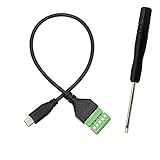
- Type C Male With Screw Terminal Block Cable can extend the length of the USB cable and DIY high-quality cables for data transmission and charging. The cable is 30cm long.
- USB-C Solderless terminal is fixed with screws, no soldering required. You only need to use stranded or solid wires and a small screwdriver (give screwdriver) to create custom wiring jigs. Simple and convenient, saving time and effort.
- This typec cable of 5 Pin pluggable screw terminal can connect a shielded wire, made cable has shielding function, can effectively shield the interference of external signals.
- This Type-c terminal cable plug is USB2.0, the bandwidth is 480MB/S, theoretically it can transmit 60MB of data per second (actual speed is about 20MB-60MB/S according to different cable lengths), the signal is stable and safe.
- Compact design and reliable connection are compatible with wide, suitable for mobile phones, tablets, computers and other devices with USB Type-C interfaces.
Which option fits your API?
| Decision factor | x402 | Stripe machine payments |
|---|---|---|
| Payment model | Open HTTP protocol; available schemes and behavior depend on the implementation. | Managed Stripe machine-payments service that supports x402. |
| Cost | Zero protocol fee according to x402.org; network, facilitator, and implementation costs can still apply. | 1.5% per successful charge, rounded to the nearest cent; Stripe says it charges no gas or other network fees for this product. |
| Settlement destination | Depends on the chosen scheme, network, and facilitator; verify the implementation’s commitment and finality semantics. | Fiat into a Stripe balance; Stripe documents reporting and multi-currency payouts as for other Stripe payments. |
| Buyer readiness | The caller must handle the HTTP 402 challenge and support the accepted scheme, network, asset, and signing or wallet flow. | Agent-facing integration into Stripe’s payment service; the documented product lists USDC on Base. |
| Geographic eligibility | Not a single protocol-wide eligibility rule; capabilities depend on the selected rails and facilitator. | Stripe documents availability for developers with a US legal entity and operations in all states except New York and Texas. Confirm current merchant eligibility with Stripe. |
| Refunds and operations | Refund, reconciliation, and dispute handling depend on the selected implementation; verify them before launch. | Stripe documents refunds through API or Dashboard, with stablecoin refunds sent to the original transfer’s “From” wallet address. |
Use x402 directly when the implementation matches your requirements
Consider an x402 implementation when request-level HTTP payments suit the API and you can support the specific scheme, network, wallet or signing mechanism, and facilitator. Model total costs and decide what payment evidence is sufficient to serve a request. The protocol’s flexibility can accommodate different payment patterns, but it also means the integration details matter.
Consider Stripe when its managed operations and eligibility fit
Stripe may suit a team that wants Stripe balance settlement, reporting, payouts, and documented refund operations and whose legal entity and operations meet the stated US eligibility limits. Check supported assets and current product availability; the documented machine-payment option here is USDC on Base, not a claim of support for every asset or network.
Questions to resolve before choosing
- What is the complete per-request cost, including network and facilitator charges where applicable?
- When is payment considered committed, when does the buyer’s asset move, and when can the seller use or withdraw proceeds?
- Can the actual API caller answer the payment challenge using the required asset, network, and signing setup?
- How will refunds, reconciliation, reporting, and dispute handling work for the selected implementation?
- Does the merchant meet geographic and product eligibility requirements, and are the required rails currently supported?
What do the published x402 usage figures show?
When accessed on October 4, 2026, x402.org displayed live dashboard figures for the preceding 30 days: 75.41 million transactions, $24.24 million in volume, 94.06 thousand buyers, and 22 thousand sellers. These are figures reported by the project’s site, not independently audited totals; the reviewed page did not establish the counting methodology. Treat them as a dated snapshot, not permanent adoption statistics.
Quick Recap
Product prices and availability are accurate as of the date/time indicated and are subject to change. Any price and availability information displayed on Amazon at the time of purchase will apply.

