
Free tools Windows power users keep installed
One-click scans. No signup required.
The right Nginx UI alternative depends on what you need to manage. For editing an existing Nginx installation, Nginx UI is the closest fit; for routing services through a reverse proxy, consider Nginx Proxy Manager. Hosting panels such as aaPanel and CloudPanel manage broader web stacks, Cockpit administers the Linux host, and F5 NGINX Instance Manager targets fleets. These tools overlap, but they are not interchangeable.
Choose by the job you need done
| Your task | Options to evaluate | Why they fit |
|---|---|---|
| Edit and operate an existing Nginx installation | Nginx UI | Its documented features include website configuration editing, logs, metrics, certificate renewal, configuration testing, reloads, and mirroring across nodes. |
| Create routes to web services behind a proxy | Nginx Proxy Manager | Its documented workflows cover proxy hosts, redirects, streams, certificates, and access lists. |
| Manage websites and their hosting stack | aaPanel or CloudPanel | Both cover more than Nginx configuration, including application or runtime management. |
| Administer the Linux server generally | Cockpit | It provides web-based tools for host services such as storage, networking, logs, containers, and accounts—not a dedicated visual Nginx editor. |
| Manage NGINX instances centrally across a fleet | F5 NGINX Instance Manager | It is designed for centralized configuration, monitoring, and certificate management. |
| Operate Nginx within cPanel & WHM | cPanel NGINX Manager | It manages NGINX and reverse-proxy caching within that hosting environment. |
These descriptions reflect product documentation, not independent comparative testing. The documentation does not establish a universal best choice, benchmark winner, or safety ranking.
Manage an existing Nginx installation: Nginx UI
If your goal is to work with Nginx already installed on a server, Nginx UI is the closest match to the phrase “Nginx UI alternative”—though it may be the tool you want rather than an alternative. The project documents website configuration editing, configuration history and restore, node mirroring, encrypted configuration export, server statistics, logs, Let’s Encrypt renewal, configuration tests, and reloads. See the Nginx UI project documentation for its described feature set.
Check the configuration layout before installing
Nginx UI’s Getting Started guide follows the Debian web-server convention: site configurations live in sites-available, with enabled sites linked through sites-enabled. On other Linux distributions, the Nginx configuration may not include that layout by default, so the guide says adjustments may be needed. Do not assume that installing a web UI automatically makes your existing configuration compatible.
#1 Best Overall

- Save valuable floor space: 6U wall mount server cabinet Dimensions: 13.78" H x21.65" W x17.72" D.Maximum mounting depth is 14.2"
- Keep critical network equipment secure: glass door and side panels are lockable to prevent unauthorized access. Front door can be installed on either side of the front of the cabinet to satisfy your door swing orientation preference
- Easy equipment configuration: Fully adjustable mounting rails and numbered U positions, with square holes for easy equipment mounting with top and bottom punch-out panels for easy cable access
- Durability: Made of high quality cold rolled steel holds up to 110lb (50kg) (Easy Assembly Required)
- PCI & HIPPA and EIA/ECA-310-E compliant
The guide lists installation routes including a Linux script, Docker, Kubernetes, Homebrew, Winget, OpenWrt, Unraid, and a manual executable. It specifically recommends a different installation method when the aim is managing host Nginx, and recommends the Linux installation script for that case. Review the Nginx UI setup guide against your host and deployment model.
Route services through a reverse proxy: Nginx Proxy Manager
Nginx Proxy Manager is aimed at operating a reverse-proxy gateway for web services, rather than serving primarily as a general editor for an existing host’s Nginx setup. Its guide documents forwarding domains, redirects, streams, 404 hosts, Let’s Encrypt or custom certificates, access lists, basic HTTP authentication, advanced Nginx configuration, user permissions, and an audit log. The documented quick setup uses Docker Compose and exposes the admin interface on port 81. See the Nginx Proxy Manager guide for the current setup instructions.
Rank #2

- Universal 19” Rack Mount Compatibility – Perfect for pro audio, video, IT, and network gear. Compatible with mixers, routers, patch panels, servers, power amps, and more.
- Heavy-Duty Load Capacity – Built to support up to 550 lbs. Ideal for studio gear, DJ setups, server equipment, and AV components that demand serious stability.
- Robust Steel Frame & Design – Made with 1.5mm thick steel and weighs 36 lbs for maximum durability, reduced vibration, and long-term reliability in any setting.
- Mobile & Secure – Preinstalled with 3” industrial-grade caster wheels (lockable), making it easy to move and position your rack exactly where you need it.
- All-In-One Setup Kit Included – Comes with 34 rack screws (5mm & 6mm), a 1U blank spacer, and an assembly tool—ready for fast installation out of the box.
Account for DNS challenge plugin dependencies
The project uses Certbot for certificate handling. It notes that DNS challenge plugins are independently maintained, and their dependency compatibility and support quality can vary; using multiple DNS providers in one instance may also create Python dependency conflicts. This is a specific caveat about DNS plugins and combinations, not evidence that certificate automation generally fails. Consult the project’s DNS challenge guidance if your certificate workflow depends on a provider plugin.
Manage websites and a broader hosting stack: aaPanel or CloudPanel
A hosting control panel is a better category to compare when the task includes creating websites, choosing application runtimes, or managing more than Nginx. The listed capabilities below are product-described features, not independent evaluations.
Recommended Free Tools
Rank #3

- ADJUSTABLE DEPTH: 4- Post 22U 19" server rack enclosure with 4 vertical rails and adjustable mounting depth 5.7" to 33.0" (14,4cm to 83,8cm); IT rack is compatible with various servers / switches / data / video / AV and other IT networking equipment
- EASY SHIPPING AND ASSEMBLY: Enclosed 22U data rack cabinet ships compact flat-packed to avoid damage and facilitate installation; Include wheels & levelling feet to offer more stability; Home server rack cabinet is only 46.6in (118,3cm) in height
- DESIGN AND VENTILATION: Half height server rack cabinet has lockable and removable door and side panels with vented top allowing airflow; 4 Post 19" rack with 1764lb (800kg) weight capacity (stationary); Computer cabinet rack is EIA/ECA-310-E Compliant
- HARDWARE INCLUDED: Rolling home network rack includes rack mounting and equipment mounting hardware, such as 20 M6 cage nuts / screws, PVC cup washers; Front/rear doors and side panels Keys, 2x allen keys; Rack assembly hardware; Casters and leveling feet
- THE IT PRO'S CHOICE: Designed and built for IT Professionals, this 22U IT Server Cabinet is backed for life, including free lifetime 24/5 multi-lingual technical assistance
aaPanel
aaPanel describes support for Nginx, Apache, OpenLiteSpeed, and Tomcat, as well as one-click LEMP/LAMP setup, multiple PHP versions, website settings, SSL, reverse proxy, load balancing, and security controls. That breadth may suit someone choosing a panel for a hosting stack rather than just an Nginx configuration interface. Check its official product information for the current feature and platform details.
CloudPanel
CloudPanel documents support for PHP, Node.js, static websites, reverse proxies, and Python applications. Its v2 introduction lists quick-launch support for providers including AWS, DigitalOcean, Donweb Cloud, Hetzner Cloud, Hostinger, Google Compute Engine, Azure, Oracle Cloud, and Vultr. A provider appearing on that list establishes documented launch or compatibility support; it does not establish an affiliate relationship. See the CloudPanel v2 introduction for the product’s stated scope.
Rank #4
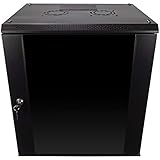
- DURABLE BUILD: Constructed from high-quality Cold Rolled Steel, the NavePoint Consumer Series 12U network cabinet boasts a sturdy, welded frame. Fitting EIA standard 19” networking equipment, this server cabinet confidently supports up to 110 lbs, providing a resilient base for your vital IT gear and equipment
- CONVENIENT DESIGN: This 12U cabinet features a reinforced, heat-treated, tempered glass front door with a security lock. Perfect for applications requiring both security and accessibility, its compact design of 17.72"L x 21.65"W x 24.42"H offers a practical solution for space-constrained settings.
- EASY & CUSTOMIZABLE EQUIPMENT SET UP - The 12U IT cabinet, with removable side panels and security locks, offers customization at its finest. Whether it's for an efficient device or cable management, this data cabinet ensures secure, adaptable configurations that suit your networking server requirements
- ENHANCED VENTILATION & SECURITY - Built-in fans and flow-through ventilation work to prevent overheating, ensuring optimal operation of your equipment. The reinforced, lockable tempered glass front door not only boosts security but also facilitates easy monitoring of installed equipment.
- SAFETY & COMPLIANCE - All NavePoint products are built to industry standards.
Administer the Linux host: Cockpit
Cockpit is a web-based Linux server administration interface, not a direct replacement for a visual Nginx site editor. The project lists controls and views for networking and firewall configuration, storage, virtual machines, containers, logs, hardware, software upgrades, performance, user accounts, and systemd services. It is relevant if Nginx is one part of a server you need to administer more broadly. The Cockpit project site reported version 366, released 13 August 2026, and describes a two-week release cadence; check its site for the current release.
Manage a fleet or an existing cPanel environment
F5 NGINX Instance Manager for centralized fleet management
F5 NGINX Instance Manager is designed for centrally managing NGINX Open Source and NGINX Plus instances. Its documentation describes grouping instances, staging, versioning and publishing configurations, monitoring metrics and logs, and managing certificates. Evaluate it when coordinated fleet-level controls matter; its scope is distinct from a UI for a single personal server. See the NGINX Instance Manager documentation.
cPanel NGINX Manager for cPanel & WHM
If you already operate cPanel & WHM, its NGINX Manager may be the relevant option inside that environment. The documentation covers installing, uninstalling, and managing NGINX with reverse-proxy caching. It also notes that, in the described setup, NGINX takes Apache’s primary web-server role and documents configuration caveats. This is a cPanel-specific fit, not a general recommendation for unrelated Linux servers. Consult the cPanel NGINX documentation for compatibility and setup details.
What to verify before choosing
- Scope: Decide whether you need an Nginx configuration UI, a proxy gateway, a hosting panel, general Linux administration, cPanel integration, or fleet management.
- Deployment model: Confirm whether the product manages host Nginx or runs as a bundled or containerized service. A proxy gateway and a host configuration manager can serve different purposes even when both use Nginx.
- Configuration compatibility: Check your operating system’s Nginx file layout and any required includes before pointing a UI at an existing installation.
- Certificate workflow: Check whether you need issuance, renewal, custom certificates, or a DNS challenge, and whether the required provider plugin is supported and maintained.
- Operational controls: Match the tool to the number of nodes and the controls you need, such as logs, configuration history, access permissions, metrics, or centralized publishing.
- Hosting requirements: If you also need site creation, PHP versions, or support for Node.js, Python, or static sites, compare the hosting-panel scope rather than only the Nginx interface.
For any candidate, verify current versions, supported operating systems, packaging, and compatibility in its official documentation before deployment. The cited documentation describes capabilities; it does not provide hands-on comparative results, independent benchmarks, or a pricing comparison.
Quick Recap
Product prices and availability are accurate as of the date/time indicated and are subject to change. Any price and availability information displayed on Amazon at the time of purchase will apply.

