
Free tools Windows power users keep installed
One-click scans. No signup required.
There is no single, universal “nuclear blast radius.” A distance on a map applies to a particular effect—such as pressure damage, burns, or fallout exposure—under specified assumptions. Blast and heat effects are often drawn as rough circles; fallout usually travels in an irregular downwind pattern. None of those outlines is a precise safety boundary. For an actual emergency, use current official instructions, not a generic calculator or distance estimate.
What a “blast radius” actually measures
A blast estimate describes an expected effect at a distance, not one all-purpose boundary around an explosion. Response maps may divide damage into severe, moderate, and light zones. Those labels summarize likely conditions and response challenges; they do not mean every person or building within a zone will experience the same outcome.
Blast effects come from shock waves and pressure changes. Their reach depends on the device’s yield and burst height, as well as terrain and the surrounding built environment. Structures and terrain can reflect blast waves, adding further variation.
A 10-kiloton example—not a general prediction
FEMA’s 2022 planning guidance gives approximate zones for a hypothetical 10-kiloton ground-level detonation: severe damage to about half a mile from ground zero, moderate damage from about one-half to one mile, and light damage from about one to three miles. These are scenario illustrations, not a forecast for an unspecified device or location. FEMA also notes that damage maps are unlikely to be perfectly symmetrical and that zone borders are less distinct in reality. FEMA, Planning Guidance for Response to a Nuclear Detonation, Third Edition (2022)
What’s actually slowing this PC down?
Pick the symptom - the matching free tool is one click away.
#1 Best Overall

- 【Nuclear radiation detector】GQ GMC-800 is the latest upgraded model of USA GQ Electronics Geiger Counters. Portable, personal & group use. Detect ionizing nuclear radiation Beta, Garma, X-ray. Quick, sensitive, precise & Easy-to-use. Simply power-on, reading instantly shows at screen. One press shortcut key transit among four function screens. Readable under the sun, suitable indoor & outdoor.
- 【Multifunctional】Traditional Geiger counter function to find the instantaneous radiation flux on a location/spot; Real-time & timeframe measuring function to display radiation data; Dosimeter function to obtain the real-time & accumulated radiation on human body; Radiation monitoring function to monitor radiation over time at a location.
- 【The measurement accuracy】is ensured via compliant design meets USA national standard (NIST & NRC). The calibration is done to further strengthen the accuracy and data quality. Easy access rechargeable & replaceable battery. Type C data transfer & charging cable. Light, thin & anti-drop. Handheld, stand on both sides, or lay down at the surface.
- 【Five types of radiation alarms】Visual LED, Audio, Vibration, Voice. Four alarm types provide everyone including vision-impaired & hearing-impaired users. The alarm level threshold can be set by users. Exclusive Advanced Features are integrated in. Built-in Clock, Memory for data storage up to 10 years. Free data processing software & firmware updates & open protocol & online data storage & history data preview. Navigate menu & submenu to explore.
- 【User Friendly Interface UI】Shorten learning curve, easy- to-navigate. The larger clear TFT color LCD display. Fast speed, immediate reading. Main screen simultaneously show reading in dosimeter units. User selectable color change scheme, customized light/dark mode for user preferences & visual comfort; Graphic, large font mode.
How thermal radiation differs from blast damage
Thermal radiation is heat energy from the fireball. Depending on the scenario and the threshold being mapped, it may cause burns or ignite fires at distances that do not match the severe blast-damage zone. For higher-yield devices, heat damage can be a primary initial concern.
A thermal distance is an estimate for a defined injury or damage threshold—not a guarantee that everything inside the line will be affected identically or that everything outside it will be unaffected. Yield and burst conditions matter, as do intervening buildings, terrain, and visibility. The HHS Radiation Emergency Medical Management (REMM) blast-damage reference describes these effects and their scenario dependence.
Rank #2

- All-in-One Detection: RT-100S 3-in-1 EMF Reader measures Electric (EF), Magnetic (MF), and Radio Frequency (RF) fields to monitor radiation in your home, office, or outdoors.EF (Electric Field): Detects radiation from appliances like microwaves, refrigerators, and power lines.MF (Magnetic Field): Measures magnetic radiation from devices like motors, microwaves, and refrigerators.RF (Radio Frequency): Monitors radiation from Wi-Fi routers, cell phones, and 5G signals.It’s also great for paranormal investigations, detecting EMF changes linked to ghostly activity.
- Easy to Use: ERICKHILL Radiation Detector ready to measure instantly upon powering on—no complicated setup required. All three field strengths display directly on the screen, letting you see electric, magnetic, and RF readings at a glance. Ideal for users of all experience levels.
- Clear Color-Coded Screen: The large display features a three-color backlight indicator (green, orange, and red) that changes based on radiation levels, giving you instant visual feedback on EMF exposure to easily assess low, moderate, and high radiation zones.
- Triple Alarm Modes: Equipped with sound, screen, and light alerts that help you identify areas with higher radiation levels, this EMF meter ensures you’re always aware of your environment. You can easily turn off the sound alerts if preferred, while the visual and light indicators will still highlight areas with higher radiation, making it ideal for both indoor and outdoor use.
- Convenient and Energy-Saving Design: Our emf detector equipped with unit switching for customized readings, a Type-C charging port for fast, easy charging, and an automatic shutoff feature to save battery, this EMF detector is portable, energy-efficient, and made for frequent use.
Why fallout does not have a simple radius
Fallout forms when radioactive fission products mix with dust and debris drawn into the detonation cloud and later settle. Unlike prompt blast and thermal effects, deposited fallout generally forms an irregular footprint downwind. Winds near the surface and higher in the atmosphere can differ, and weather and burst conditions affect where material travels and deposits. Fallout can reach areas beyond the main blast-damage zone.
CDC says a dangerous radiation zone may extend 10–20 miles downwind in some scenarios. That planning description refers to areas where fallout exposure is above 10 roentgens per hour; it is not a fixed fallout radius, a universal maximum, or a boundary that applies to every event. Such a zone can overlap light or moderate damage zones. CDC, Nuclear Detonation
Do these 3 things before closing this tab:
1Clear out junk files and repair common Windows errors2Fix the driver behind crashes, sound loss and screen glitches3Repair Windows errors before they cause bigger problemsRank #3

- ✅【Rechargeable EMF Detector】TEMIRUP radiation meters are compact and portable, allowing users to carry them conveniently. This portability enhances their usability, making them suitable for travel, outdoor activities, or simply moving around different areas within a home or office. TEMIRUP EMF devices empower users to assess and mitigate potential risks associated with prolonged exposure to electromagnetic fields, It helps you with room layout and avoids placing you in high-radiation environments
- ✅【Accurate Measures All Emfs】Emf Meter measures magnetic with optional units mG/µT, electric with unit V/m, and radio frequency radiation with unit uW/cm²; RF mode can detect WiFi signals, 5G signals (30MHz ~8GHz), and microwave radiation from appliances like microwave ovens. ELEC and MAG modes can measure electromagnetic radiation emitted by household appliances such as televisions, induction cookers, rice cookers, refrigerators, computers, and power lines. If you care about EMF radiation in your home, you need to be able to measure all types of radiation
- ✅【User-Friendly & Versatile Utility】EMF Meter equipped with a built-in electromagnetic radiation sensor, which can display the radiation value on an Large Colour LCD Screen after processing by the micro-control chip; Auto Power Off after 15 minutes without operation; Unit switch (℃/℉); The meter can test average or peak value (Maximum) reading and Hold the data for a view with a single key;Low Battery Indication so you never accidentally run out of juice
- ✅【Informative Display & Audio Alarm】Sound and the analog display warnings to remind you of the safe range, you can determine actual EMF radiation levels of certain things and locate EMF radiation sources; 3 Colors analog display Alarm Reminder, Hold the instrument in hand, and slowly close the probe to the radiation source. When the radiation value is displayed on the screen and the analog display reaches the yellow area, the instrument starts to give an audible alarm prompt, indicating that the radiation exceeds the standard, please take protective measures or keep it away from the radiation source
- ✅【What you get】1 * EMF Meter, 1 * charging cable, 1 * Emf meter carry bag and 1 * User manual; If you have any questions, please feel free to contact us, our professional team will solve your problem in time
Fallout radiation decreases as radionuclides decay. REMM states that fallout releases more than half its energy in the first hour and over 80% in the first day. These are decay-curve figures, not a clearance schedule: they do not show whether a specific place is safe at a particular time. Local radiation levels and deposited material require event-specific assessment. REMM, Nuclear Detonation
Why estimates and maps differ
Two maps may show different distances because they model different effects, thresholds, or conditions. A pressure-damage contour is not directly comparable to a burn threshold, prompt-radiation area, fallout dose rate, or accumulated dose. A circle for prompt effects and an elongated fallout plume describe different physical patterns, not competing measurements of the same radius.
Rank #4
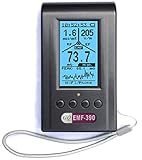
- Multiple high sensitivity sensors installed for detecting Power line, Smart meter, Cell phone, Microwave etc.
- Identify/recognize the common possible sources, such as Power line, Cell Tower, Microwave, Static etc.
- Safety suggestion lets you understand current situation instantly.
- Detects 5G network signal and RF up to 10Ghz
- Built-in RF Spectrum analyzer and GQ RF Browser for real time RF monitoring.
Before comparing estimates, check the map legend and scenario inputs:
- Effect and threshold: pressure damage, thermal burn, prompt radiation, fallout dose rate, or integrated dose.
- Yield and burst height: including whether the scenario is a surface or near-surface burst rather than an air burst.
- Weather assumptions: wind direction and speed, weather conditions, and the time they represent.
- Place and timing: terrain, urban environment, and time since detonation.
- Units and legend: what each contour means and how the estimate is expressed.
Maps may also change as fallout deposits and radiation decays. FEMA’s guidance notes that radiation zones can overlap blast zones, initially grow as fallout deposits, and later contract as radiation levels decrease. Operational models can incorporate physics, weather, topography, and monitoring data, but their estimates may be updated as observations arrive. LLNL’s National Atmospheric Release Advisory Center (NARAC) describes modeling prompt overpressure, thermal radiation, ionizing radiation, and fallout ground-shine. LLNL NARAC, What We Do
The Tool Desk
Outbyte Driver Updater FREEFix the driver behind crashes, sound loss and screen glitchesFind Drivers →Outbyte PC Repair FREEClear out junk files and repair common Windows errorsFree Scan →Best Value

- Detects: Magnetic fields, electric fields, and RF (20 MHz–6 GHz; includes most 5G but not experimental millimeter waves). Does not detect radioactivity.
- Displays EMF fluctuations fully: bars update instantly for fast digital signals, while RF and number averages refresh 4 times per second. Other meters over-average or filter field peaks, giving slower, less complete readings.
- Features: 3-axis magnetic, single-axis electric (with standard or weighted frequency responses), and single-axis RF readings (unweighted). Weighted readings emphasize effects on the human body.
- Measures: 4G and 5G cell phones, cell towers, WiFi routers, Bluetooth, AC Powerlines, and Smart Meters. The TF2 responds to RF very fast compared to other meters.
- Includes: Trifield TF2 meter, 9V battery, Quick-start Card, Detailed Instruction Manual, and soft-shell, zipper carry case.
What to do during a real emergency
A general-purpose map or online calculator cannot establish whether your exact location is safe. Follow local emergency instructions and updated public information. FEMA’s public guidance emphasizes “Get Inside, Stay Inside, Stay Tuned”: seek shelter in a basement or the middle of a large, dense building, then monitor radio, television, cellphone, or internet updates as available. Do not use a modeled radius by itself to decide when or where to move. FEMA, Planning Guidance for Response to a Nuclear Detonation, Third Edition (2022)
Quick Recap
Product prices and availability are accurate as of the date/time indicated and are subject to change. Any price and availability information displayed on Amazon at the time of purchase will apply.

