
Free tools Windows power users keep installed
One-click scans. No signup required.
Smart glasses, body-worn cameras, and phones solve different parts of delivery work. Glasses can put route and package information in a hands-free display and may also capture proof of delivery; body cameras are purpose-built recording systems with evidence-management needs; phones provide a familiar app-based workflow but typically require the worker to look at or hold the device. No independent head-to-head delivery study establishes one as the best overall choice. The practical decision is which tool fits the task—and what recording, privacy, and access controls the work requires.
How the three tools fit into delivery work
Smart glasses: a hands-free delivery interface with a camera
Amazon describes its delivery glasses as guiding selected steps after a driver has safely parked: displaying delivery information, helping locate a package, providing walking directions, capturing proof of delivery, and surfacing pet alerts. The system Amazon describes includes a vest-mounted controller, a swappable battery, an emergency button, prescription and transition lens support, and a hardware privacy switch. These are company-described capabilities, not independently verified performance results. Amazon’s announcement
That design could reduce the need to switch attention between a phone, parcel, and surroundings. Amazon presents that as a reason for the product; it is not independent evidence of a measured safety or productivity improvement. Glasses also make camera use less obvious than raising a phone, which creates a separate need to make recording visible to people nearby.
Body-worn cameras: a recording and evidence system
A body-worn camera (BWC) is more than the camera mounted on a person. The U.S. Bureau of Justice Assistance describes typical systems as including a camera, microphone, and battery pack. Its procurement guidance also considers docking and charging, storage, evidentiary controls, and privacy-redaction functions. This makes a BWC a purpose-built capture-and-evidence setup, but law-enforcement guidance does not establish that a police configuration is suitable for delivery routes or that every device records continuously. BJA body-worn camera resources
#1 Best Overall
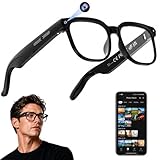
- 【AI Real-Time Translation & ChatGPT Assistant】AI glasses break language barriers instantly with AI real-time translation. The built-in ChatGPT voice assistant helps you communicate, learn, and handle travel or business conversations smoothly—ideal for conferences, overseas trips, and daily use.
- 【4K Ultra HD】 Smart glasses feature 4K resolution for clear, detailed visuals, making them suitable for travel, outdoor activities, everyday moments, and daily use.
- 【Bluetooth Music & Hands-Free Calls 】Smart glasses provide Bluetooth music and crystal-clear hands-free calls with an open-ear design. Stay aware of your surroundings while listening—comfortable for long wear and safer for commuting, cycling, and outdoor use.
- 【IP65 Waterproof & Long Battery Life】 AI glasses are designed for daily wear with IP65 waterproof protection against sweat, rain, and dust. The built-in 290mAh battery provides reliable performance for workdays and travel—no anxiety when you’re on the go.
- 【Smart App Control & Object Recognition】Smart glasses connect to the companion app for easy setup, file management, and feature control. They support AI object recognition to help identify items and improve your daily efficiency—perfect for travel exploration and a smart lifestyle.
Phone-based delivery tools: an app workflow on a multipurpose device
Here, “phone-based tools” means delivery information and functions shown in a phone app—such as navigation, package details, and proof-of-delivery capture where the particular app supports them. Capabilities vary by app; there is no basis for assuming every phone workflow offers the same functions or recording controls. Amazon frames its glasses as reducing reliance on a phone for several delivery tasks, but it does not publish a controlled comparison against named phones or apps.
| Option | Primary role | Typical interaction | Recording and system considerations |
|---|---|---|---|
| Smart glasses | Delivery information and selected capture tasks in the wearer’s field of view | Hands-free display; Amazon’s described setup also uses a vest-mounted controller | May capture images or video; make recording status and any audio capture clear. Amazon says its system has a hardware privacy switch. |
| Body-worn camera | Dedicated recording and evidence capture | Worn on the body; operating controls depend on the system | May involve camera, microphone, battery, docking, storage, evidence access, and redaction controls. |
| Phone-based tools | Delivery app functions on a multipurpose device | Often requires looking at or holding the phone to follow instructions or take a picture | Capture, storage, and access depend on the specific app, phone, and organization’s settings. |
What each option captures—and who may notice
Any camera worn on the face or body can capture people at close range during doorstep or indoor interactions. The UK Information Commissioner’s Office (ICO) says body-worn video can be more intrusive than conventional CCTV because it records from close range in places such as homes, shops, or transport settings. Its guidance warns that continuous recording can be excessive without strong justification. Audio can add another layer of intrusion; the ICO recommends considering separate controls for audio and video so irrelevant information is not collected. ICO guidance on body-worn video
Recording visibility differs by form factor. A person raising a phone to take a picture may be easier for a bystander to recognize than subtle glasses recording. Australia’s eSafety Commissioner recommends a clear recording indicator that cannot be disabled or easily obscured as a safety-by-design measure. That is Australian guidance, not a universal legal rule. eSafety Commissioner guidance on smart glasses
Rank #2

- 【8MP HD Camera & EIS Stabilization】Osawalla smart glasses let you capture first-person photos and 1080P HD video with the built-in 8MP camera. EIS anti-shake support helps keep footage smoother during travel, outdoor activities, and daily use. Selectable clip lengths include 15s, 30s, 1 min, 3 min, 9 min, and 12 min
- 【AI Object Recognition & Real-Time Translation】These AI glasses with camera have "Hey Cyan" AI voice assistant (built-in ChatGPT model) and object recognition (recognizes objects, menus, landmarks, plants in real time). They also support 139+ language translation and voice-assisted Q&A—perfect for international travelers, students to break language barriers during travel, study and work
- 【Bluetooth Music & Phone Calls】Osawalla smart glasses connect via Bluetooth 5.4 for music playback, phone calls, and voice assistant control. The open-ear design lets you enjoy everyday listening while staying more aware of your surroundings during walks, commuting, travel, and daily use. Touch controls make it easy to adjust volume, answer calls, and manage playback
- 【Ultra-Light 40.8g (0.09lb) for All-Day Comfort & Long Battery Life】Lightweight camera glasses with TR90 frame, ABS temples, and PMMA material for zero nose pressure. IP65 waterproof design resists daily splashes. 290mAh battery supports up to 7 hours of music playback and 7 days of standby, ideal for travel and daily use
- 【Photochromic Lenses】These smart sunglasses with camera have photochromic lenses that automatically darken in sunlight for effective UV protection. Note: Lenses may darken slower in inside or winter due to weaker UV rays. If you have any questions, feel free to contact us—we are always here to provide satisfactory service
Smart glasses can also collect or share location information. Sweden’s privacy authority, IMY, says filming with smart glasses is like filming with a mobile phone camera, and notes that businesses using glasses must comply with GDPR. That is guidance from the Swedish authority in its jurisdiction; it does not settle the rules elsewhere. IMY guidance on smart glasses
What Amazon’s delivery-glasses figures do—and do not—show
Amazon says more than 500 delivery associates tested its glasses on real delivery routes, completing more than 275,000 customer deliveries during the tests. Those are company-reported figures about test scale. They do not establish a rate of safety improvement, time saved, accuracy, customer satisfaction, or an advantage over phones or body cameras. Amazon also says participation is voluntary for delivery-service partner owners and delivery associates and that the glasses have a hardware privacy switch; these are statements about Amazon’s own system, not independent evaluations. Amazon’s announcement
Independent reader supportYour contribution helps us test, update, and keep practical guides available for everyone.Privacy, worker trust, and deployment controls
Recording policy matters as much as device choice. In UK guidance, the ICO says an organization should define its monitoring purpose, consider less intrusive ways to meet it, balance its interests against workers’ rights, and carry out a data protection impact assessment (DPIA) before processing likely to create high risk. Its body-worn-video guidance also addresses necessity, proportionality, retention and disposal, controlled access, and privacy information. It says sensitive settings such as homes, schools, and care homes require stronger justification. The ICO says its guidance is under review following the Data (Use and Access) Act, so UK organizations should check the current guidance before deployment. ICO worker-monitoring guidance ICO body-worn-video guidance
Rank #3
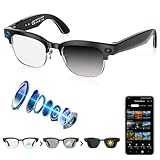
- 【4K Camera with EIS Stabilization】Smart glasses with camera feature a built-in 4K camera with EIS stabilization for clearer and steadier image performance during sports, cycling, travel, outdoor activities, and everyday use.
- 【Open-Ear Speakers & Clear Bluetooth Calling】Camera glasses feature built-in open-ear speakers for music and clear Bluetooth calls while helping you stay aware of your surroundings. Noise-reduction microphones provide clearer voice pickup and a comfortable listening experience for everyday use.
- 【AI Real-Time Translation & Voice Assistant】AI glasses support real-time translation in 139+ languages to make communication easier across different languages. The built-in AI voice assistant helps you access information and interact more efficiently—ideal for work, study, travel, and daily use.
- 【Photochromic Lenses & Lightweight Comfort】Smart sunglasses with camera feature photochromic lenses that respond to changing sunlight conditions for comfortable indoor and outdoor use while helping reduce UV exposure. The lightweight 35g frame provides a comfortable fit for extended everyday wear.
- 【IP66 Water Resistance & 290mAh Battery】AI sunglasses with camera feature IP66 water resistance for added protection against sweat, rain, and dust during active daily use. The built-in 290mAh battery provides convenient power for travel, outdoor activities, work, and everyday use.
These principles also apply to glasses and phone-based recording used to monitor workers. The ICO cautions: “Just because a form of monitoring is available, does not mean it is the best way to achieve your aims.” A camera’s presence or a device’s technical capability is not, by itself, a reason to record.
The U.S. Government Accountability Office (GAO) reports that stakeholders identified cameras, microphones, geolocation, tracking applications, and worn devices among workplace surveillance tools. Stakeholder views about effects on productivity and well-being were mixed; some said perceived constant observation could damage trust and morale. Those are stakeholder perspectives summarized by GAO, not settled causal findings about delivery workers specifically. GAO report on workplace surveillance
Questions to settle before choosing or deploying a device
- Purpose: What specific task requires a recording, and could it be completed without one?
- Capture: Is recording opt-in or event-triggered? Can audio be turned off separately? What tells workers and customers that capture is active?
- Access and retention: Where do footage and location data go? Who can retrieve, redact, or share recordings, and how long are they kept?
- Worker safeguards: Can workers pause capture in sensitive places? What notice and consultation will they receive?
- Local rules: Do applicable privacy requirements or site policies restrict cameras, wearables, or recording in particular locations?
These are operational questions drawn from the cited guidance, not a claim that one answer is legally required everywhere. Requirements depend on jurisdiction, purpose, device, and setting.
Which tool fits which delivery need?
- Consider smart glasses when hands-free access to delivery information and selected camera tasks are central, and when recording visibility, worker choice, and privacy controls can be addressed. Amazon’s product description is a delivery-specific example, not proof that the format works best for every route or worker.
- Consider a body-worn camera when the operational requirement is dedicated recording and the organization can manage the associated evidence workflow, including charging, storage, controlled access, retention, and redaction. A BWC is not automatically appropriate just because it can record.
- Consider a phone-based workflow when the existing delivery app meets the task and workers can use it safely in the relevant conditions. The trade-off is that interaction may require looking down or holding the device; no universal performance comparison establishes how large that trade-off is.
The available evidence does not establish which option is cheapest, most comfortable through a full shift, best in all weather, or most effective at reducing delivery time or injuries. Those questions require product-specific and independent evidence.
Quick Recap
Product prices and availability are accurate as of the date/time indicated and are subject to change. Any price and availability information displayed on Amazon at the time of purchase will apply.

