
Anti-aliasing smooths jagged edges, anisotropic filtering keeps textures clearer on surfaces viewed at an angle, and texture quality controls the detail available in a game’s textures. They affect different parts of the image, so the best setting depends on what looks wrong and how that particular game implements its options.
At a glance: what each setting changes
| Setting | What it targets | Where you are most likely to notice it |
|---|---|---|
| Anti-aliasing | Jagged edges caused by rendering geometry on a pixel grid | Silhouettes, railings, wires, and other defined edges |
| Anisotropic filtering | Texture detail lost when a surface is viewed at an oblique angle | Roads, floors, and ground that recede into the distance |
| Texture quality | The detail or resolution of textures, as defined by the game | Close-up surfaces such as walls, clothing, and terrain |
What anti-aliasing does
A game draws geometry onto a grid of pixels. When an object’s edge crosses that grid, the edge may appear as a staircase of jagged pixels. Anti-aliasing reduces this geometric aliasing so edges look smoother.
One technique is multisample anti-aliasing (MSAA). Microsoft describes MSAA as a way to reduce geometric aliasing and improve image quality. Its Direct3D documentation gives 1x, 2x, 4x, 8x, and 16x as example sample counts; those are documented possibilities, not a promise that every game or graphics adapter offers all of them. Microsoft Learn’s Direct3D 12 explanation of MSAA also notes that supersampling with MSAA can improve quality at a higher performance cost.
“Anti-aliasing” in a game menu may refer to MSAA or to another technique, such as a temporal or post-process method. The label alone does not tell you exactly how that option works or what it will cost in performance. Results depend on the game and its implementation.
#1 Best Overall

- 【INTEGRATED SPEAKERS】Whether you're at work or in the midst of an intense gaming session, our built-in speakers provide rich and seamless audio, all while keeping your desk clutter-free.
- 【EASY ON THE EYES】 Protect your eyes and enhance your comfort with Blue-Light Shift technology. This feature reduces harmful blue light emissions from your screen, helping to alleviate eye strain during long hours of use and promoting healthier viewing habits.
- 【WIDEN YOUR PERSPECTIVE】Our sleek minimal bezel design ensures undivided attention. The nearly bezel-free display seamlessly connects in a dual monitor arrangement, delivering an unobstructed view that lets you focus on more at once, completely distraction-free.
What anisotropic filtering does
Textures can lose clarity when they cover surfaces angled away from the screen. A road stretching toward the horizon, for example, occupies a distorted footprint in the image: the texture is compressed more in one direction than another. Anisotropic filtering is designed to improve texture sampling under this kind of distortion, making distant portions of the surface clearer.
It is a texture-sampling option, not an edge-smoothing option. Microsoft’s Direct3D documentation on anisotropic texture filtering describes anisotropy as distortion in texels on a surface oriented at an angle to the screen, and notes that anisotropic filtering can be used with linear or mipmap filtering.
Rank #2

- QHD Resolution (2560 x 1440) has 1.7 times the pixel density of Full HD for incredibly detailed pinsharp images
- HDR10 provides brighter highlights and nuanced shadow for added depth - making every scene feel more vivid and realistic
- The 180Hz refresh rate minimizes lag for gameplay with ultra-smooth action. Plus, the 1ms response time helps capture your moves in real-time, allowing you to react fast for gaming precision
- AMD FreeSync reduces choppiness, screen lag and image tearing, ensuring that your fast-paced, complex in-game action is stable with minimal stutter
- Ergonomic stand allows for tilt, pivot and height adjustments to maximize gaming comfort
What texture quality does—and how it differs from filtering
Texture quality usually controls the amount of detail or resolution available in a game’s textures. A higher-quality texture may preserve finer surface detail, while a lower-quality one may look less detailed, particularly up close. However, “Texture Quality” is a game-menu label, not a setting with one universal implementation; what it changes depends on the game.
Filtering determines how texture information is sampled to produce the color of each screen pixel. It is different from the detail stored in the texture itself. Microsoft’s texture-filtering overview explains that magnification and minification create different sampling challenges: when a texture is enlarged, one texel can cover several screen pixels and look chunky; when it is reduced, one screen pixel can represent many texels, which can look blurry or aliased if sampling is inadequate.
Rank #3
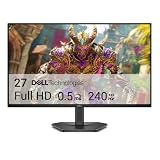
- Smooth motion: 240Hz refresh rate and fast 0.5ms response time provide crisp visuals and fluid movement with less input lag.
- Seamless gaming: FreeSync Premium and HDMI VRR eliminate tearing for smooth, responsive PC and console gameplay.
- Fast IPS: Faster 0.5ms response with excellent color accuracy across wide IPS viewing angles.
- Rich color: 99% sRGB color coverage delivers vivid, detailed imagery with strong accuracy.
- Eye comfort: TÜV Rheinland 3‑star certified display lowers blue light while preserving color quality.
Mipmaps are lower-resolution versions of a texture used at different viewing scales. Filtering methods can select or blend texture samples, including with mipmaps, to render textures at those scales. Microsoft’s Direct3D 9 filtering reference describes nearest-point, bilinear, anisotropic, and mipmap filtering. That older API reference explains the concepts; it does not guarantee identical behavior in every current game.
How to choose settings based on what you see
- Look for jagged object edges. If silhouettes or thin geometry look stair-stepped, try the available anti-aliasing options. Compare the same scene, since different techniques can produce different results.
- Check angled surfaces for blur. If a road, floor, or stretch of ground becomes indistinct as it recedes, try changing anisotropic filtering.
- Inspect close-up surfaces. If walls, clothing, or other textures lack fine detail even when viewed nearby, check the game’s texture-quality setting.
- Change one option at a time. Revisit the same scene after each change and watch both image quality and frame rate or smoothness. This makes it easier to see which setting addresses the issue without assuming every game behaves alike.
Will these settings affect frame rate?
There is no universal performance ranking for anti-aliasing, anisotropic filtering, and texture quality across all games and devices. The cost depends on the technique, the game’s implementation, and the graphics hardware. For MSAA specifically, more samples involve more sampling work; Microsoft’s example discusses a higher performance cost for supersampling with MSAA. Direct3D support and quality levels can also vary with the adapter, texture format, and requested sample count, as described in Microsoft’s CheckMultisampleQualityLevels documentation. These implementation-specific details do not establish that one of the three menu settings is always the most demanding.
Quick Recap
Best Value

- 1800R curve monitor the curved display delivers a revolutionary visual experience with a leading 1800R screen curvature as the images appear to wrap around you for an in depth, immersive experience
- Hdmi, VGA & PC audio in ports
- High refresh rate 75Hz.Brightness (cd/m²):250 cd/m2
- Vesa wall mount ready; Lamp Life: 30,000+ Hours
- Windows 10 Sceptre Monitors are fully compatible with Windows 10, the most recent operating System available on PCs.Brightness: 220 cd/M2
Rank #4

- 27” 240Hz 1500R Curved FHD 1080P Gaming Monitor for Game Play.
- Prioritizes Gaming Performance: Up to 240Hz high refresh rate, more immersive 1500R Curvature, FreeSync, MPRT 1ms Response Time, Black Level adjustment(shadow booster), Game Modes Preset, Crosshair.
- Cinematic Color Accuracy: 130% sRGB & DCI-P3 95% color gamut, 4000:1 contrast ratio, 300nits brightness, HDR, Anti-flicker; Anti-Glare.
- Plug & Play Design: HDMI & DP1.4 & Audio Jack(No built-in speakers), durable metal stand, tilt -5°~15, VESA 100*100mm compatible.
- Warranty: Money-back and free replacement within 30 days, 1-year quality warranty and lifetime technical support. Pls contact SANSUI service support first if any product problem.
Product prices and availability are accurate as of the date/time indicated and are subject to change. Any price and availability information displayed on Amazon at the time of purchase will apply.

