
Windows Errors? Fix Them Before They Spread
Repair common Windows errors and clear accumulated junk for a smoother, more stable PC - no reinstall needed.Free scan · no reinstallCrashes, No Sound, or Screen Glitches?
Random freezes, missing sound and display glitches usually trace back to one bad driver. Find and replace yours safely.Free scan · under a minuteUse smart meter readings to forecast a specific quantity over a specific period—such as tomorrow’s half-hourly electricity import or next month’s bill—then test the forecast against later readings. Clean, time-aligned data and a simple baseline are the right starting point; no model can guarantee a particular accuracy or household saving.
Choose what you need to forecast
A useful forecast starts with a decision, not a model. Specify the quantity, interval and horizon first. Electricity import, electricity export, gas use and total bill are different targets; a forecast that helps schedule an EV charge may not answer whether you can cover next month’s bill.
| Decision | Forecast target | Useful horizon |
|---|---|---|
| Plan tomorrow’s electricity use | Half-hourly electricity import | Next day |
| Understand near-term household demand | Daily electricity or gas consumption | Next week |
| Estimate solar sent to the grid | Electricity export, forecast separately from import | Next day or another period relevant to your decision |
| Prepare for an upcoming bill | Expected use priced against the applicable tariff and relevant charges | Billing period |
If cost is the question, consumption alone is not enough: include the tariff schedule and relevant charges. Where readings distinguish import and export, forecast them separately rather than treating a net figure as a complete account of both.
Get readings and check what they mean
Access depends on your meter and supplier
In the UK, possible routes include your supplier’s data tools or request process, an in-home display, and a consumer access device connected to the meter’s Home Area Network (HAN). The Department for Energy Security and Net Zero (DESNZ) says UK smart-meter equipment can store at least 13 months of half-hourly consumption and at least 24 months of daily consumption. Smart electricity meters can store at least three months of half-hourly export readings. Electricity consumption and tariff data can be made available over the HAN at least every ten seconds. These are stated capabilities, not a guarantee that every supplier interface or device exposes every reading in a convenient downloadable format.
#1 Best Overall
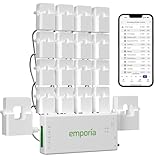
- SAFETY YOU CAN TRUST WITH UL CERTIFICATION: With Emporia Energy, your home energy monitoring is safe, reliable, and certified. The Emporia Vue is UL Listed, meaning it has met rigorous safety standards for electrical products in the U.S. and Canada. This certification ensures that every component has been thoroughly tested to prevent hazards, such as overheating, short-circuiting, or fire, offering you peace of mind as you manage your home’s energy consumption.
- INSTALLS IN CIRCUIT PANEL of most homes with clamp-on sensors. Supports Single phase, Single-split phase, and 2-wire systems. 3-wire systems; 3-phase, 4-wire Wye systems with earthed (TN or TT) neutral (no-Delta) are supported with an additional 200A sensor (sold separately).
- 24/7 ENERGY MANAGEMENT AND MONITORING: Automate, manage and control your home's real power anywhere, anytime to prevent costly repairs, conserve energy, and save costs. Monitor solar / net metering. PROTECTED BY A 1-YEAR WARRANTY.
- LOWER YOUR ELECTRIC BILL: Configure settings in the Emporia Energy App to automate energy management for time of use, peak demand, excess solar, and rewards programs. You can even see live reporting and invaluable savings opportunities instantly. Gauge real-time spending and get actionable notifications and automated energy management to help you reduce costs.
- REAL-TIME ENERGY DATA: REQUIRES 2.4 GHz WIFI WITH AN INTERNET CONNECTION to monitor energy use with iPhone / Android / Web app. Vue sensors collect energy data and are accurate from ±2%. The Vue is UL and CE Listed for your safety. 1 second data is only available in the app (when actively open) and retained 3 hours. Minute and hour data are retained in the cloud. 1 minute data is retained 7 days, 1 hour data is retained indefinitely. Export cloud data whenever you want in the app.
Check with your supplier whether your meter and communications hub support the access method you are considering, whether data is historical or near-real-time, and whether it can be exported in a usable format. The cited UK guidance describes access routes but does not certify particular third-party devices or supplier interfaces.
Audit the data before forecasting
Keep a note of how you obtained the readings and what access permission you granted. Detailed interval consumption can be personal data. DESNZ’s UK smart-meter framework says consumers control access for relevant purposes, with exceptions for regulated purposes; explicit consent is required for certain detailed data access. Review what a third-party service collects and why before sharing readings.
- Confirm the interval length, units, time zone and whether timestamps mark the start or end of an interval.
- Inspect daylight-saving transitions, where local-clock days may contain a different number of half-hour intervals.
- Find duplicate or missing readings, and check dates when the meter was replaced or the account changed.
- Verify whether each series represents import, export, gas or a net flow; do not infer the meaning from a column label alone.
- Plot consumption across days and hours to spot gaps, spikes or a shift in routine before fitting a model.
Build a forecast in stages
1. Set aside a later period for validation
Keep observations in time order. Train on earlier readings and validate against a later period, rather than randomly shuffling intervals; random splits can let information from the future influence a simulated forecast of the past. If practical, repeat the test from several forecast dates so one unusual week does not decide whether an approach works.
Rank #2

- 【Multifunctional Energy Meter】Multifunctional electricity meter is designed to monitor electricity consumption. Equipped with a large LCD display, showing voltage, current and energy. Users can easily configure over/under voltage, current limit, leakage current alarm and reconnect time.
- 【Remote Control & Voice Control】 You can control your home devices without time and distance limits via smartphone. App to check device power consumption at any time. The voice control function can be used in the Smart Life app as it is compatible with Alexa and Google Home.
- 【Timer and Scheduling Functionality】Turn on/off/timer/countdown the home appliance automatically according to your daily schedule.
- 【Energy value storage】This device has memory function, when the power is cut off, the device can memorize the value of Kwh, overvoltage, undervoltage and overcurrent.
- 【Voltage Current Leakage Protection】When the rated current, voltage or circuit leakage current exceeds the predetermined value, the switch will automatically cut off the power supply and continue to try to restore the power supply after waiting for the "reconnection time".
2. Establish a simple baseline
Compare a proposed model with straightforward rules such as using the previous day, the corresponding weekday, or a recent seasonal average. A baseline helps reveal whether a more elaborate model adds value and can expose data or time-alignment problems. Choose the comparison to match the forecast horizon: a next-day estimate and a monthly bill projection are not interchangeable tasks.
3. Add information available when the forecast is made
Calendar patterns, weather and tariff periods may explain changes in demand, especially for temperature-sensitive loads or decisions about when to use electricity. Add them only when they are available at the forecast issue time. For a realistic back-test, a day-ahead forecast should use weather information that would have been available the day before—not the subsequently observed weather.
There is no established feature set that is best for every household. Compare additions on the same chronological validation periods as the baseline; keep a feature only if it helps the decision you are forecasting for.
Rank #3

- EM16P MODEL & LOCAL CONTROL & DATA PRIVACY: Access your home energy monitor data locally via Built-in Web UI, Open API, and MQTT without relying on cloud services. Unlike cloud-dependent monitors, Refoss ensures your data stays within your home network. Direct local access protects your privacy while giving you 100% full control of your home energy system.
- NATIVE HOME ASSISTANT & OPENCLAW AI: Experience seamless Native Home Assistant integration right out of the box—no firmware flashing or complex coding required. Featuring ✨NEW✨ OpenClaw Support, it enables AI-driven automation for smarter, real-time energy management and seamless smart home control.
- MAXIMIZE SOLAR & ZERO FEED-IN AUTOMATION: Designed for solar homes, the power monitor works with the Refoss app and Home Assistant to automatically use surplus solar power. Appliances like EV chargers, washing machines, and water heaters are powered during midday peaks, maximizing solar self-consumption and reducing low-value electricity feed-in to the grid. Optimizes usage and reduces bills.
- REAL-TIME MONITORING & ±1% ACCURACY: Monitor voltage, current, active power, and power factor of major appliances. Provides ±1% accuracy (200A: 2–200A; 60A: 1–60A) and ±2% at low current. Daily data stored up to 5 years and exportable. With no subscriptions or hidden fees, you get deep historical insights to help you identify every energy-saving opportunity and save 10–20% on monthly bills.
- SMART ALERTS & CIRCUIT-LEVEL CONTROL: Set usage targets for each individual circuit and receive instant alerts when appliances exceed normal consumption. Refoss app supports automation and peak management to optimize schedules, reduce peaks, and improve efficiency. Real-time electricity usage monitor for circuit-level insights.
4. Compare methods on the same test periods
The 2024 IEECP report reviews linear regression, ARIMA-family methods, Prophet and neural methods, and emphasizes preprocessing, relevant covariates, validation and comparison on the dataset. A Cambridge thesis review notes that individual household loads fluctuate as appliances switch on and off, making them more variable and harder to predict than aggregated demand. These sources do not establish a universally superior method for an individual home.
| Approach | What it offers | What to check |
|---|---|---|
| Simple baseline | A transparent reference point based on recent or comparable readings | Whether it captures the relevant weekday, seasonal or routine pattern |
| Linear regression or ARIMA-family method | Established statistical approaches reviewed in the IEECP report | Whether the method and inputs suit your series and forecast horizon |
| Prophet or neural method | Additional approaches reviewed in the IEECP report | Whether added complexity improves results on the same later-period test data |
The table identifies methods discussed in the report, not a ranking or a guarantee of performance. Model complexity alone is not evidence of a better forecast.
Do these 3 things before closing this tab:
1Fix the driver behind crashes, sound loss and screen glitches2Clear out junk files and repair common Windows errors3Scan for outdated or missing drivers - takes under a minuteMeasure error in terms that fit the decision
Compare predictions with actual readings at the same interval and for the same target. Average absolute error expresses the typical miss in energy units, which is often easier to interpret than a percentage. Percentage error can become misleading when actual use is near zero. The reviewed sources support evaluating methods but do not prescribe one metric for every household.
Rank #4

- ⚡ EASY INSTALLATION: Installs in circuit panel of most homes with clamp-on sensors. Supports single-phase up to 240VAC line-neutral; single, split-phase 120/240VAC; and three-phase up to 415Y/240VAC (no Delta). The branch lines can automatically match different phases and have no restrictions in terms of quantity and voltage.Panels with access only to busbars will need flexible sensors available from SEM-Meter.
- ⚡ ENERGY MONITORING ANYTIME, ANYWHERE: Monitor your home's real power anywhere, anytime to prevent costly repairs, conserve energy, and save costs. Monitor solar / net metering. Light commercial 3 phase option available as a separate bundle. Protected by a 1-year warranty.
- ⚡ VARIOUS ELECTRICAL APPLIANCE MONITORING: Comes with 16 50A sensors to accurately monitor your air conditioner, furnace, water heater, washer, dryer, range, etc.
- ⚡ LOWER YOUR ELECTRIC BILL: SEM-Meter measures real-time spending and gets actionable notifications to understand where savings can be made, both to lower your electric bill and to conserve energy and protect the planet’s resources. Be an environmentalist.
- ⚡ REAL-TIME ENERGY DATA: Connect SEM-Meter device via 2.4GHz WiFi to monitor energy usage, with an accuracy range of 1%. View usage in real time through Android/Apple software. Statistics of power usage in now/day/week/month/year format: the validity period of hourly exported data is 90 days, and the exported data of day/month/year data is permanent, available at any time Export from application.
If you report an accuracy or error figure, state the evaluation period, interval, forecast horizon, target, metric and baseline alongside it. The reviewed sources do not provide a general accuracy percentage for a single household forecast, so there is no evidence-based universal figure to promise.
Independent reader supportYour contribution helps us test, update, and keep practical guides available for everyone.Use the forecast, then learn from the misses
Apply the result to the decision you chose: prepare a range for expected use, compare tariff scenarios, or schedule a flexible load. UK smart meters support time-of-use tariffs and demand shifting; DESNZ says basic shifting—such as changing when a washing machine runs or an EV charges—does not require specialist equipment. Whether shifting saves money depends on the actual tariff and what the household can move to a different time.
After the forecast period, compare the estimate with actual readings and record unusual changes such as guests, a holiday, an appliance replacement, a heat-pump installation or a change in occupancy. Revisit the inputs and baseline when the household’s routine or equipment changes.
Quick wins for a faster PC:
Clear out junk files and repair common Windows errorsFree Scan →Scan for outdated or missing drivers - takes under a minuteDriver Scan →Best Value

- Control Your Appliances and Devices: Control lights, fans, lamps, humidifiers, and any other appliances or electronics that plug into 120V outlets with a 10A Maximum Continuous Load (15A Max Peak Load for up to 1hr/day)
- Monitor Your Home Energy Like a Pro: Emporia smart plugs let you stay on top of energy used by your devices and appliances. Eliminate wasteful stand-by power, save on electricity, and extend product life.
- Smart Scheduling for Maximum Control: With built in on/off scheduling capability, use your smart plugs to automatically switch on and off appliances and devices. Want freshly brewed coffee at 7am? Just schedule it with an Emporia plug!
- Remote Control. Anytime, Anywhere. Control your home remotely using the Emporia App on your phone. Leave the lights on? Forget to turn off an appliance? Check the real-time status and toggle it on or off anytime, anywhere!
- Requires 2.4GHz Wifi Connection to control your devices remotely from your phone with an internet connection. 5.0 GHz Wifi networks are not supported.
DESNZ cites around £1 billion in consumer benefits from shifting demand from peak to off-peak times in its guidance, referring to the latest Smart Meter Cost-Benefit Analysis; the passage does not state the analysis year. Ofgem cites estimated consumer-bill savings of £1.6 billion–£4.5 billion by 2045 from using half-hourly data to improve system efficiency; the inspected passage does not state the analysis publication year. Both figures concern system-level benefits, not a forecast of what an individual household will save.
What the UK guidance does—and does not—establish
Ofgem says a domestic smart meter stores energy-use data every 30 minutes. Its consumer guidance describes uses including billing, products or services with permission, and system efficiency. Ofgem and DESNZ reported on 14 July 2026 that their scoping exercise on wider access to smart-meter data had been finalised and linked to an outcome letter. That update does not establish a launch date or operational availability for a wider data repository.
The storage figures and access rules here are UK-specific. Meter interfaces, supplier access, privacy rules and tariff arrangements differ elsewhere; check the relevant supplier and local rules before applying this workflow outside the UK.
Quick Recap
Product prices and availability are accurate as of the date/time indicated and are subject to change. Any price and availability information displayed on Amazon at the time of purchase will apply.

