
There is no single RX 570 voltage or Power Limit setting guaranteed to be stable on every card. The safer approach is to record your stock behavior, reduce voltage gradually while keeping clocks at stock, and test each change in the games or applications you actually use. A lower Power Limit is another option, but it can reduce sustained clock speed and performance.
What RX 570 power figures actually mean
AMD lists 150 W typical board power and recommends a 450 W minimum power supply for its desktop RX 570. Board power is a graphics-card specification; the PSU recommendation is for the system and is not a statement that the GPU itself draws 450 W. Neither figure predicts how much a particular game will draw or how much an undervolt will save. AMD RX 570 specifications.
Partner-card specifications can differ. MSI lists 150 W power consumption for the RX 570 ARMOR 4G OC and 120 W for the RX 570 GAMING 4G. These are model-specific published specifications, not results from a shared test or a promise of actual draw in a particular workload. Check the exact model name before comparing figures: MSI RX 570 ARMOR 4G OC specifications and MSI RX 570 GAMING 4G specifications.
Which WattMan controls are available on an RX 570?
AMD describes Radeon WattMan as a GPU performance and monitoring utility, with controls that can include GPU frequency, GPU voltage, fan and temperature settings, and Power Limit. Availability and labels depend on GPU and driver support, so use only controls actually shown for your card. AMD’s documentation describes seven configurable performance clock states for traditional state-based controls: State 7 is the highest performance state, while State 0 is the lowest-power state and cannot be modified. Its 1150 mV State 7 example is for a sample GPU, not an RX 570 preset.
#1 Best Overall
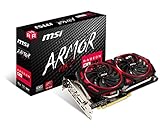
- Chipset: AMD Radeon RX 570
- Video Memory: 8GB GDDR5
- Memory Interface: 256-bit
- Output: DisplayPort x 2 / HDMIx 2 / DL-DVI-D
- Recommended PSU: 450W
Do not assume an RX 570 has the newer Frequency/Voltage curve or Auto Undervolt interface: AMD describes those features for Radeon VII and RX 5700 series. See AMD’s WattMan tuning documentation for its control descriptions and support qualifications.
How to undervolt an RX 570 in WattMan
- Record your baseline. Note the current settings and observe the card during a repeatable game or application workload. Record the readings you can access, along with clock behavior, temperatures, fan behavior, and performance.
- Change voltage gradually. Keep GPU and memory clocks at stock initially. Lower voltage by a modest amount using the voltage control exposed by your card’s driver, then apply the change. WattMan’s exact controls vary, and there is no universal RX 570 voltage target.
- Test your real workloads. Run the games or applications you use and watch for crashes, driver resets, visual artifacts, or unexpected clock drops. A short synthetic test alone cannot establish stability in every workload.
- Continue only while stable. If the card remains stable, make another small voltage adjustment and test again. If problems appear, restore the last stable setting or reset to defaults.
AMD cautions that “GPU tuning requires an advanced level of technical knowledge.” Its documentation also says default GPU and memory settings are best for most applications. Treat tuning as a gradual, reversible experiment rather than a guaranteed way to reach a particular voltage or saving.
Rank #2
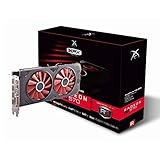
- Chipset: AMD RX 570
- Memory: 8GB GDDR5. 2048 stream processors
- Dual bios - Gaming and cryptocurrency mining
- XFX double dissipation cooling design
- Minimum power supply requirement 500 watt
How to lower the Power Limit
Power Limit is a percentage control, and its available range depends on the GPU. Start at the default and reduce it in small steps, repeating the same workload after each change. Compare power readings alongside sustained clock speed and game or application performance. A lower limit can constrain sustained frequency, so the lowest setting is not necessarily the best balance.
AMD notes that raising Power Limit can help a GPU maintain its highest clock state and recommends maximum Power Limit when increasing clocks. That overclocking guidance is not a reason to raise the limit when your goal is lower draw. AMD does not publish one RX 570-wide Power Limit percentage for power savings.
The Tool Desk
Outbyte PC Repair FREEClear out junk files and repair common Windows errorsFree Scan →Outbyte Driver Updater FREEScan for outdated or missing drivers - takes under a minuteDriver Scan →Rank #3

- The XFX RX 580 series graphics card feature the latest Polaris architecture which includes the 4th gen GCN graphics cores, a brand new display engine, new multimedia cores, all on the revolutionary next finfet 14 process technology for enhanced performance and efficiency
- Equipped with XFX double dissipation cooling technology for optimal cooling and performance. Minimum power requirement is 500 watts. Memory clock true: 8.0GHz, boost OC : 8.1GHz
- Multiple factory GPU overclocked settings - 1366 MHz true clock and 1386 MHz OC
- AMD VR ready premium - Experience the new generation of compelling virtual reality content with the Radeon RX GTS graphics card paired with the leading VR headsets. The Radeon RX GTS graphics card coupled with AMD LiquidVR technology delivers a virtually stutter-free, low latency experience, essential for remarkable virtual reality environments
How to tell whether power draw changed
WattMan’s histogram can monitor GPU temperature, power, fan speed, and clock speed. Compare readings during the same workload before and after each adjustment; software telemetry describes what the GPU reports, not total PC wall consumption.
For whole-system consumption, use a plug-in wall meter and compare the same PC running the same workload. The meter reads the complete connected system, including components beyond the graphics card, so it does not isolate GPU-only draw. Software readings and wall-meter readings have different measurement scopes; do not treat them as interchangeable.
Rank #4

- 2 x HDMI; 1 x DVI-D; 2 x DP
- 256-bit Memory Bus. Compatible with OS Windows 10 and Windows 7
- Cooling Technology: Dual Fan
Choosing between stock, undervolting, and a lower limit
Compare profiles using the same workload and measurement method. The useful question is not just whether a power reading fell, but what happened to performance, temperatures, fan behavior, and stability at the same time.
| Profile | What to change | What to compare |
|---|---|---|
| Stock baseline | Keep factory or default settings. | Record the workload’s power reading, sustained clocks, performance, temperature and fan behavior. |
| Undervolt at stock clocks | Reduce voltage gradually; leave GPU and memory clocks at stock initially. | Check the same measures and verify stability in your actual games or applications. |
| Lower Power Limit | Reduce the percentage in small steps from the default. | Check power and performance together, especially sustained clock speed. |
No cited official source establishes a measured RX 570 power-saving figure for a defined undervolt or Power Limit change. Your own repeatable comparisons are more meaningful than an unqualified watt or percentage claim.
Do these 3 things before closing this tab:
1Clear out junk files and repair common Windows errors2Fix the driver behind crashes, sound loss and screen glitches3Repair Windows errors before they cause bigger problemsQuick Recap
Best Value

- Core Clock (MHz): 1255 in OC Mode and 1244 in Gaming Mode.6+1 power phases on the card make the MOSFET working at a lower temperature and provide more stable voltage output
- WINDFORCE 2X with Blade Fan Design
- RGB fusion – 16.8M customizable color lighting
- Stylish Metal Back Plate
- Intuitive AORUS Graphics Engine
Product prices and availability are accurate as of the date/time indicated and are subject to change. Any price and availability information displayed on Amazon at the time of purchase will apply.

