
Free tools Windows power users keep installed
One-click scans. No signup required.
For most everyday desktop use and typical video, 60Hz is a sensible baseline. Choose 120Hz if smoother motion and more responsive gaming matter to you, or if you want a display that can repeat 24-frame-per-second films evenly. A 48Hz setting is usually a specific video mode or a variable-refresh-rate (VRR) operating point—not a universal display category. The right choice depends on what your display, source device, connection, resolution and selected mode can actually support.
What is refresh rate?
Refresh rate is how many times a display updates its image each second. A 60Hz display refreshes 60 times per second; a 120Hz display refreshes 120 times per second. The number describes the display’s update rate, not how many frames a game or video must produce. A higher rate can make motion look smoother, but only when the source and display support the chosen mode. Microsoft explains refresh rate and gaming.
How 48Hz, 60Hz and 120Hz compare
| Use | 48Hz | 60Hz | 120Hz |
|---|---|---|---|
| Everyday desktop and typical video | Not a general-purpose target; may be available as a film cadence or specific supported mode. | A practical baseline for common use. | Can provide smoother motion, but is not necessary for every task. |
| Gaming | May be the lower end of a particular display’s VRR range. Check the model’s range and low-frame-rate behavior. | Adequate for games running around 60 frames per second. | Allows higher-frame-rate gaming and can feel smoother and more responsive when the game and system sustain the higher output. |
| 24fps film | On a supported set, each frame can be shown twice. | Some displays use 3:2 pulldown, which can create judder in panning shots; some 60Hz VRR TVs can instead operate at 48Hz. | Can repeat each 24fps frame evenly; depending on operating mode, each frame is commonly repeated four or five times. |
| Compatibility | Support is device-specific. | Widely supported, but verify the chosen resolution and input. | Verify the source, connection bandwidth, resolution, input and display all support 120Hz together. |
These are common patterns, not a guarantee of how any particular model behaves. RTINGS’ refresh-rate guide covers motion and film cadence; its TV VRR test methodology and monitor refresh-rate test methodology explain why results vary by model and signal.
When should you choose each refresh rate?
Choose 60Hz for a straightforward everyday setup
For browsing, office work and typical video, 60Hz is a sensible default. You do not need 120Hz simply because it is a larger number; its benefits are most noticeable when the task or content supplies motion at higher frame rates or when you prefer the smoother presentation.
#1 Best Overall

- 【INTEGRATED SPEAKERS】Whether you're at work or in the midst of an intense gaming session, our built-in speakers provide rich and seamless audio, all while keeping your desk clutter-free.
- 【EASY ON THE EYES】 Protect your eyes and enhance your comfort with Blue-Light Shift technology. This feature reduces harmful blue light emissions from your screen, helping to alleviate eye strain during long hours of use and promoting healthier viewing habits.
- 【WIDEN YOUR PERSPECTIVE】Our sleek minimal bezel design ensures undivided attention. The nearly bezel-free display seamlessly connects in a dual monitor arrangement, delivering an unobstructed view that lets you focus on more at once, completely distraction-free.
Choose 120Hz for smoother motion and gaming headroom
A 120Hz display can show more updates per second than a 60Hz one. In games, that can make motion appear smoother and controls feel more responsive when the game, console or PC can deliver additional frames. If the source remains near 60fps, the display’s 120Hz ceiling alone does not create new game frames. Confirm that the complete setup supports 120Hz at your intended resolution and input.
Treat 48Hz as a supported mode, not a buying class
48Hz has a useful role for 24fps film: displaying each frame twice gives an even cadence. It may also be the lower limit of a display’s VRR range. Neither use means that a display marketed or configured around 48Hz is automatically suitable as an all-purpose desktop or gaming display. Check the specific model’s supported modes and VRR behavior.
Rank #2

- Incredible Images: The Acer KB272 G0bi 27" monitor with 1920 x 1080 Full HD resolution in a 16:9 aspect ratio presents stunning, high-quality images with excellent detail.
- Adaptive-Sync Support: Get fast refresh rates thanks to the Adaptive-Sync Support (FreeSync Compatible) product that matches the refresh rate of your monitor with your graphics card. The result is a smooth, tear-free experience in gaming and video playback applications.
- Responsive!!: Fast response time of 1ms enhances the experience. No matter the fast-moving action or any dramatic transitions will be all rendered smoothly without the annoying effects of smearing or ghosting. A 120Hz refresh rate speeds up the frames per second to deliver smooth 2D motion scenes in gaming and video.
- 27" Full HD (1920 x 1080) Widescreen IPS Monitor | Adaptive-Sync Support (FreeSync Compatible)
- Refresh Rate: Up to 120Hz | Response Time: 1ms VRB | Brightness: 250 nits | Pixel Pitch: 0.311mm
What VRR changes—and what to check at low frame rates
Variable refresh rate lets a display adjust its refresh timing to follow the source’s frame rate, which can help reduce tearing or stuttering. The definition is straightforward, but implementation is model-dependent: supported minimum and maximum rates differ, and performance below the minimum depends on low-frame-rate compensation (LFC). Sony’s VRR explanation describes the feature; RTINGS’ TV VRR methodology discusses how minimum rates and LFC are assessed.
If a game’s frame rate falls below a display’s VRR floor, do not assume VRR will continue to behave the same way. Check whether the particular display supports LFC and how it handles frame rates below that floor.
What’s actually slowing this PC down?
Pick the symptom - the matching free tool is one click away.
Rank #3
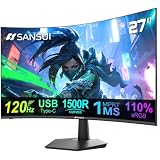
- ⭐27 inch curved monitor with speakers built in for gaming, work or business.
- Screen Feature: 120hz Refresh Rate丨1ms(MPRT) Fast Response Time丨Adaptive Sync
- Display Color: 110% sRGB丨 4000:1 Contrast Ratio丨300Nits Brightness丨16.7M display colors
- Ports and Speakers:1*USB Type-C 丨1*HDMI 1.4 丨2*2W Built-in Speakers for Daily Use.
- Ergonomic Design: -5°~15°Tilt丨178°Wide Viewing Angle丨Ultra-thin Bezel丨100 x 100mm VESA Mount
Check these details before choosing a display
- Find the native refresh rate. Look for the panel’s native rate rather than relying only on motion-processing names or marketing labels. RTINGS’ TV VRR test methodology distinguishes model capabilities and signal conditions.
- Verify the rate at your target resolution and input. A TV may have different refresh-rate limits at 4K and 1080p, or across inputs. Check the manufacturer’s specifications for the exact combination you intend to use; RTINGS’ monitor test framing likewise treats the input signal as relevant.
- Check the VRR range and LFC behavior. If you use VRR, find its minimum and maximum refresh rates, then confirm what happens when frame rates fall below the minimum.
- Confirm the source and connection can deliver the mode. The PC, console or other device, its connection and the display all need to support the chosen resolution and refresh rate. Then select or enable the mode in the source device’s settings. NVIDIA notes that a VRR-capable display may automatically use its highest refresh rate when VRR is enabled; see NVIDIA Control Panel Help.
Does a lower refresh rate save power?
Windows display design guidance includes 24Hz and 48Hz modes for 24fps film and notes that operating below 60Hz can improve video-playback battery life in applicable systems. That is platform-specific guidance, not a promise that lowering refresh rate will save power on every display or during every workflow. Microsoft Learn’s display guidance provides that context.
Quick Recap
Rank #4

- Incredible Images: The Acer KB242Y G0bi 23.8" monitor with 1920 x 1080 Full HD resolution in a 16:9 aspect ratio presents stunning, high-quality images with excellent detail. The zero-frame design provides maximum visibility of the screen from edge-to-edge.
- Adaptive-Sync Support: Get fast refresh rates thanks to the Adaptive-Sync Support (FreeSync Compatible) product that matches the refresh rate of your monitor with your graphics card. The result is a smooth, tear-free experience in gaming and video playback applications.
- Responsive!!: Fast response time of 1ms enhances the experience. No matter the fast-moving action or any dramatic transitions will be all rendered smoothly without the annoying effects of smearing or ghosting. With up to 120Hz refresh rate speeds up the frames per second to deliver smooth 2D motion scenes.
- 23.8" Full HD (1920 x 1080) Widescreen IPS Monitor | Adaptive-Sync Support (FreeSync Compatible)
- Refresh Rate: Up to 120Hz | Response Time: 1ms VRB | Brightness: 250 nits | Pixel Pitch: 0.275mm
Product prices and availability are accurate as of the date/time indicated and are subject to change. Any price and availability information displayed on Amazon at the time of purchase will apply.

