
Make one written plan for two different risks: flooding may require you to leave quickly, while drought or a water interruption may require you to conserve water or rely on a safe stored supply. Decide how your household will get warnings, communicate, reach a safe place, and meet essential water needs. Then practice the plan and check local instructions, which determine evacuation routes, restrictions, and water safety.
Write down who does what and how you will reconnect
List each household member’s name and phone number, an out-of-area contact, and two meeting places: one near home and another farther away. Agree on how you will communicate if you are separated, and make sure everyone knows where to get official alerts.
Assign responsibilities before an emergency: who gathers medications and important documents, who collects supplies, and who helps children, older adults, people with disabilities, or anyone with medical, language, mobility, or transportation needs. CDC advises informing local authorities about special needs, including for older adults, bedridden people, and people with disabilities. Use FEMA/Ready.gov’s fillable family communication plan to record contacts and meeting arrangements.
Include pets in the plan. Identify who will collect them and their supplies, and check whether your intended shelter accepts pets. Plan how each person will travel if they do not have access to a car.
What’s actually slowing this PC down?
Pick the symptom - the matching free tool is one click away.
#1 Best Overall

- 72 HOUR EMERGENCY KIT FOR 2 PEOPLE WITH FOOD AND WATER: Includes 2 emergency food bars totaling 4800 calories and 12 sealed drinking water pouches to support hydration and energy during disasters. Designed for emergency preparedness, survival kits, earthquake kits, and evacuation planning.
- COMPLETE DISASTER SURVIVAL KIT WITH SHELTER AND WARMTH: Equipped with 2 emergency ponchos and 2 survival blankets to help protect against rain, wind, and cold conditions. Critical gear for outdoor emergencies, power outages, and shelter in place situations.
- FIRST AID KIT AND SAFETY PROTECTION SUPPLIES: Features a 33 piece first aid kit, dust masks, and nitrile gloves to support basic medical care and protection from debris and airborne particles. Essential for emergency response, injury care, and disaster safety.
- EMERGENCY LIGHTING AND SIGNALING TOOLS INCLUDED: Comes with 2 long lasting 12 hour lightsticks and a safety whistle for visibility and communication in low light or rescue situations. Ideal for blackout emergencies, nighttime evacuation, and search scenarios.
- COMPACT BACKPACK FOR GRAB AND GO EVACUATION: Lightweight emergency backpack keeps all survival supplies organized and ready for fast response. Perfect for home emergency kits, car emergency kits, office preparedness, and bug out bags.
Check local flood risks, routes, and shelters
Start with your property’s flood-risk information in FEMA’s Flood Map Service Center. A map is only one input: ask local emergency management or planning officials about neighborhood risks, warning systems, evacuation routes, and shelter locations. Local authorities can tell you what signals or instructions should trigger evacuation.
Choose more than one route and destination when possible. Compare them by flood exposure, likely closures, travel time, accessibility, available transportation, shelter availability, and pet accommodation. Practice the routes and identify an alternative if a road is blocked or a household member cannot drive.
Rank #2

- [Preparedness for the Unknown]: While no one can predict when or how severe a disaster or unexpected event will be, our 262pcs survival kit helps your family stay prepared during the critical first 72 hours. Designed for family use, it was developed in collaboration with survival experts, outdoor professionals, special forces operators, and mountain guides. Whether you're preparing for earthquakes, tornadoes, wildfires, or hurricanes, our survival kit provides peace of mind.
- [Comprehensive Emergency Supply Kit]: The included emergency supplies are stored in a bright red pouch, containing tweezers, scissors and pins, non-woven pad, triangular cotton cloth, cotton swabs, cotton balls, a generous supply of adhesive strips etc., meeting your general emergency and outdoor needs. It also includes an emergency information card to record your basic information, helping others quickly access important information when needed.
- [Safety Companion for Journey]: Our emergency kit includes many survival gear and supplies to ensure access to food, water, warmth, and light in a crisis. The fishing kit and multi-usage spoon help you catch and prepare food, while the collapsible water container bag helps store water. Fire starter and stick make it easy to build a fire. A flashlight, camping lamp, and glow sticks provide up to 72 hours of lighting, crucial for signaling for help and safe navigation.
- [Essential Survival Gear]: Additionally, this survival kit includes a detachable multifunctional axe with hammer and a 2-in-1 shovel with pick, made of sturdy carbon steel. Combined with wire saw, emergency tent and blanket, rope, and compass, you can quickly set up an emergency shelter while helping retain warmth. Unlike other mini axes, our axe and shovel are 17 inches long, providing effective protection in the wild against animals or in other emergencies.
- [Convenient Packaging]: The survival gear and supplies are packed in a crossbody bag, making it easy to carry and access in emergencies. The bag features multiple compartments and molle compatible straps and D-rings, allowing you to attach extra pouches or survival tools. The crossbody strap is also detachable, making it easy to connect to a tactical survival backpack using carabiners or the molle system.
Follow evacuation orders promptly. The CDC says, “Never ignore an evacuation order—authorities will direct you to leave if you are in a low-lying area or within the greatest potential path of rising waters.” Never drive or walk through floodwater, go around barricades, or approach downed power lines. Floodwater can sweep people and vehicles away and may contain sewage, chemicals, or other hazards.
Prepare to leave and respond safely during a flood
- Before a threat: Gather your emergency kit, charge communication devices, keep important documents in waterproof storage, and secure outdoor items if there is time and conditions are safe. Be ready to leave rather than waiting for water to rise.
- If evacuation appears necessary: Follow local instructions. CDC advises turning off gas, power, and water if evacuation appears necessary, but do not enter standing water or approach downed lines to reach controls.
- While conditions change: Monitor official updates through local radio, television, phone alerts, or other local channels. Avoid floodwater and use your planned route only if it is open and safe.
- After flooding: Wait for officials to say it is safe to return. Follow local guidance before using tap or well water.
Plan water for droughts and service interruptions
Distinguish a shortage from a safety advisory. A drought or service interruption can mean less water is available; an advisory means water may be unsafe. Check your water utility and local government for the current drought stage, conservation rules, and any water-safety notice. Restrictions and stages vary by location, so use current local instructions rather than a general schedule.
Rank #3

- 72-HOUR EMERGENCY KIT FOR 2: Built for disaster preparedness at home, work or on the road, this 2-person survival backpack includes food, water, first aid, lighting, hygiene and shelter essentials for up to 3 days.
- FOOD, WATER & PURIFICATION: Includes two 2,400-calorie emergency food bars, six 4.225 oz water pouches, water purification tablets and a 32 oz BPA-free bottle to help support hydration and nutrition during outages or evacuations.
- FIRST AID & PERSONAL PROTECTION: Packed with a 33-piece first aid kit, 2 N95 dust masks, nitrile gloves, hygiene kits, ponchos, survival blankets and tissues for added protection, sanitation and comfort during emergencies.
- POWER, LIGHTING & COMMUNICATION: Includes a hand-crank emergency power station with flashlight, AM/FM radio, siren and cell phone charging, plus 2 emergency lightsticks and a 3-in-1 whistle, compass and thermometer.
- DELUXE SURVIVAL TOOLS IN ONE BACKPACK: Adds a multi-function tool, duct tape, bio-hazard bag and emergency contact card in a portable backpack. Ideal for earthquakes, hurricanes, blackouts, wildfire evacuation, cars and workplaces.
CDC’s household preparedness recommendation is at least 1 gallon per person per day for 3 days, and it says households should try to store a 2-week supply if possible. These are preparedness recommendations, not guarantees that a particular amount will meet every household’s needs. Allow extra for pets, pregnancy, illness, and hot climates. Prioritize drinking, cooking, brushing teeth, and other essential uses.
If you rely on a private well, contact your local health department or extension service for advice on drought-related well conditions and water testing. Private-well owners are responsible for ensuring their water is safe. Keep contact information for your water utility, local health department, emergency management office, and, if relevant, an extension service or well contractor with the plan.
Rank #4
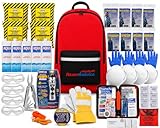
- COMPLETE 4-PERSON DISASTER SUPPLY KIT: Built to support four people for up to 72 hours with emergency food, drinking water, first aid, shelter, lighting, hygiene and survival gear packed together in one portable backpack for fast access at home or work.
- FOOD & WATER FOR 3-DAY PREPAREDNESS: Includes four 2,400-calorie emergency food bars and four 1-liter Aqua Literz cartons, plus survival blankets, ponchos and lightsticks to help support your household during outages, evacuations and major disasters.
- FIRST AID & SAFETY ESSENTIALS: Includes a 107-piece first aid kit, safety goggles, nitrile gloves, leather work gloves, biohazard bags, hygiene supplies and an emergency whistle to help support personal protection and comfort when conditions turn chaotic.
- POWER, LIGHTING & SURVIVAL TOOLS: Hand-crank emergency power station combines flashlight, AM/FM radio, siren and cell phone charging, while a multi-function tool, duct tape and emergency lightsticks add practical support for blackouts and evacuations.
- BUILT FOR HOME, WORK & EVACUATION: Grab-and-go 4-person emergency backpack is ideal for earthquake kits, hurricane supplies, wildfire evacuation, blackout preparedness, offices, vehicles and family disaster planning when critical supplies must move fast.
Store emergency water safely
CDC identifies unopened commercially bottled water as the safest and most reliable emergency source. If you fill containers yourself, use FDA-approved, food-grade water-storage containers. Wash and sanitize each container before filling, then label it “drinking water” and add the storage date. Keep containers cool, out of direct sunlight, and away from gasoline, pesticides, and other toxic substances. Replace household-filled stored water every six months, as CDC advises. Use a clean scoop without touching the water or the inside of the container.
Stored water does not prove that tap, well, cistern, or collected water is safe. Follow local health department and water utility instructions if water is unsafe or unavailable. Use bottled, boiled, or treated water only as directed for the situation. Do not use suspect water for drinking, cooking, brushing teeth, making ice or formula, washing food, or handwashing. If fuel or toxic chemicals may be present, ordinary emergency treatment cannot make that water safe to drink or bathe in.
After a flood or suspected contamination, a private well needs local health department or extension guidance. CDC says a well or pump contractor should handle well disinfection because the work can be hazardous. Use bottled water until authorities or test results establish that well water is safe.
Practice the plan and keep it current
- Household members, an out-of-area contact, and meeting places are written down.
- Everyone knows where to receive local warnings and who checks them.
- Flood risks, routes, shelters, and accessible transportation options have been checked locally.
- Pets, medications, documents, mobility needs, and assistance arrangements are included.
- The household has practiced its communication and evacuation plan.
- Water quantities account for people, pets, duration, health needs, and hot weather.
- Stored water is in safe containers, labeled, protected from heat and chemicals, and rotated.
- The plan distinguishes a water shortage from a safety advisory and identifies the local agencies to contact.
Recheck local routes, shelter arrangements, alert options, drought restrictions, and water contacts as circumstances change. Local authorities and utilities provide the instructions that a household plan cannot determine in advance.
Quick Recap
Product prices and availability are accurate as of the date/time indicated and are subject to change. Any price and availability information displayed on Amazon at the time of purchase will apply.

