
What’s actually slowing this PC down?
Pick the symptom - the matching free tool is one click away.
If a chemical structure will not parse, first determine whether the problem is invalid SMILES syntax, a chemically inconsistent atom or bond assignment, or a difference in how the selected toolkit handles format extensions. Read the full error, inspect the atom or character it identifies, and make one chemistry-supported change at a time. A successful parse confirms that the toolkit accepted the input; it does not prove the structure matches the source you intended.
What a parser failure can mean
For SMILES, failure can occur at different stages. The parser may be unable to read the notation or build the molecular graph—for example, because a branch or ring closure is incomplete. Alternatively, it may build a graph but reject its chemistry during validation, such as when an atom’s specified bonds and hydrogens exceed permitted valence or an aromatic system cannot be assigned a Kekulé form. Some apparent failures are differences in parser settings or extensions rather than errors under every toolkit.
RDKit includes sanitization in its default molecule-reading workflow. Its documentation describes it as “fairly strict” about allowed valences during sanitization. Open Babel offers both a standard parser, which is more forgiving and supports some extensions, and the alternative Smiley parser, which is designed for stricter OpenSMILES compatibility and detailed diagnostics. These tools do not necessarily accept or report every input identically.
Fix the problem systematically
- Save the exact input and complete error. Keep the original string unchanged. Record the full message, including an atom index, character position, warning, or named sanitization step. Change one thing at a time so you can identify which edit addressed the failure.
- Check the notation and graph first. Look for unmatched branch parentheses, ring labels that appear only once, conflicting bond declarations at the ends of a ring closure, and malformed bracket atoms. In documented Smiley examples,
CC(CChas an unmatched opening branch,CC)CCan unmatched closing branch, andC1CCCan unmatched ring bond. A bracket atom can encode isotope, hydrogen count, charge, and stereochemistry; do not remove its brackets or punctuation without checking what those fields mean. - Inspect the flagged atom’s bonds, hydrogens, and charge. For an “explicit valence … greater than permitted” message, check the atom named in the error and add up its specified bond orders and explicit hydrogens. Compare that local environment with the intended structure and formal charge. RDKit’s allowed-valence check uses specified bond orders plus specified hydrogen count.
- Check aromatic heteroatom assignments. Pyridine-like and pyrrole-like nitrogen do not have the same hydrogen assignment, and a toolkit cannot reliably infer the intended placement in every ambiguous case. RDKit’s FAQ gives
c1nccc1as a failure andc1[nH]ccc1as the form for the intended pyrrole-like case. Add[nH]only when the source structure supports that hydrogen. - Confirm the input format and parser settings. Verify that the string is the format expected by the parser, such as SMILES rather than SMARTS, and check for names or annotations after the molecule. RDKit parser parameters can affect whether text after whitespace is treated as a molecule name; disabling CXSMILES and name parsing can instead make extra text an error. Check the parser’s version and supported extensions when two toolkits disagree.
- Parse again, then compare with the source. After each justified correction, reparse and compare connectivity, charge, explicit and implicit hydrogens, aromaticity, and stereochemistry with the source drawing or trusted record. Acceptance by a parser is not an independent identity check.
How to interpret common RDKit errors
“Explicit valence … is greater than permitted”
This usually points to a mismatch between the atom’s specified bond-order sum, explicit hydrogens, formal charge, and the chemistry intended. RDKit’s FAQ uses CN(C)(C)C, which gives neutral nitrogen four single bonds, as an example it rejects. It shows C[N+](C)(C)C for the intended positively charged, four-coordinate nitrogen. That is a correction only if the source structure calls for that charge—not a rule to add a positive charge whenever nitrogen triggers an error.
Do these 3 things before closing this tab:
1Repair Windows errors before they cause bigger problems2Fix the driver behind crashes, sound loss and screen glitches3Clear out junk files and repair common Windows errors#1 Best Overall

- FOR BASIC TEACHING TO ADVANCED SCIENCE: 444 pieces molecular model kit, including 136 atoms, 158 bonds and 150 parts for Carbon-60(Fullerene), provides to students from Grade 7 to Graduate level.
- TWO CHEMICAL STRUCTURE MODELS: The ball-and-stick models use spheres to represent atoms and sticks to represent chemical bonds. In the space-filling model, the spheres are drawn to scale and are next to one another as atoms are in real molecules.
- CHEMISTRY EDUCATIONAL MOLECULE MODEL IN 3D: It can display chemical structure, molecular bond, and bond angle in all directions. Demonstrate fundamental molecular geometry, chemical molecular structure, stereochemistry with 3D modeling studies.
- EASY TO LEARN: The universal standard adopted for each atom's color makes it easier for you to use and learn. Atoms and chemical bonds combine tightly and firmly and can be easily disassembled by disconnecting tools.
- If you’re not in love with it for whatever reason, we’ll give you a full replacement or refund—no questions asked. If you have any doubt, please tell us. With nothing to worry about, or even to share with your friends, try it now.
RDKit’s Book labels its allowed-valence table “as of 2024.09.1”; the Book itself is the 2026.03.6 documentation. If an element-specific value matters, check the installed RDKit version and the matching documentation rather than assuming the table applies unchanged to every release.
“Can’t kekulize mol”
This means RDKit could not assign a chemically reasonable alternating single- and double-bond form to the submitted aromatic representation under its model. Heteroatom hydrogen and charge assignments can affect that result. Inspect the ring and intended drawing rather than changing aromatic letters or adding hydrogens at random. RDKit’s FAQ explains that, when several heteroatoms could plausibly take a hydrogen, it avoids arbitrarily choosing where the user meant it to go.
Rank #2

- Visualize Molecular: The molecular model kit simplifies complex chemistry concepts into tangible 3D structures improve learning efficiency, suitable for students from Grade 7 to Graduate level.
- 444 Pcs Complete Set: The atom model kit includes with 136 atoms,158 bonds, and 150 fullerene model parts, explore most the molecules structures from simple compounds to complex polymers.
- Effortless Assembly: Embedded component design ensures easy to construct Ball-and-stick and Space-filling models that maximizes focus on exploration without complex assembly.
- Durable & Portable: Built to last, the chemistry set is crafted from high-quality materials. Plus, its portable Snap-Lock design allows you to take your experiments learning anywhere, between the home, classroom and lab.
- Essential Study Tool: Whether you're studying organic chemistry, biochemistry, or molecular biology, molecule building kit is an perfect learning tool for you deeper comprehension of molecular science.
Aromaticity is toolkit-sensitive: conventions and perception rules matter, especially for unusual cases. OpenSMILES requires parsers to check aromatic electron assignment against valence, hydrogens, external bonds, and charges. Lowercase aromatic notation should not be treated as guaranteed to have identical behavior in every toolkit.
Unmatched branch, ring, or bracket syntax
These are notation or graph-construction problems, not evidence that a chemically plausible atom has the wrong valence. Match each opening branch parenthesis with a closing one, ensure ring labels are paired, and inspect bond symbols at both ends of a ring closure. For a bracket atom, check the complete expression—including any isotope, hydrogen count, charge, or stereochemical annotation—before editing it.
Rank #3

- UNLOCK YOUR CHEMISTRY POTENTIAL: Our comprehensive molecular model kit includes 238 pieces, featuring 84 atoms, 153 bonds and a remover tool. Suitable for chemistry learners from beginners to advanced levels. Manufacturer recommended age: 15 years and up
- ORGANIZED STORAGE AND EASY LOCATING: Experience hassle-free organization with our storage box, complete with divided compartments and labeled sections. Say goodbye to clutter and quickly find the components you need
- EXTRA LEARNING MATERIALS FOR EXCELLENCE: Enhance your studies with our bonus 6-page learning guide and stencils. From grade 9 to college, from organic to inorganic, finish and master your assignments faster and create numerous molecular structures with ease
- IMMERSIVE 3D VISUAL LEARNING: Explore chemistry in a captivating way with our 3D visual learning approach. The universal color-coded Atomic Balls provide a better understanding of molecular structure, boosting your chemistry knowledge. It's also a perfect gift for someone who are going to learn those complex molecule
- EASY-TO-USE DESIGN: Crafted from smooth, burr-free plastic, our molecular science kit ensures easy assembly. With the included remover tool, disassembling is a breeze
When parsers disagree
Use a parser with detailed diagnostics when the error is vague. Smiley reports specific syntax and semantic problems, including positions; Open Babel describes its standard parser as more forgiving and capable of accepting certain extensions. A string accepted by one and rejected by another is a reason to check the intended format, toolkit version, syntax standard, and extensions. It does not by itself establish which interpretation matches the chemistry.
RDKit can also be asked to read a molecule with sanitization disabled, but this is a diagnostic or advanced workflow, not a normal repair. The resulting object has not undergone chemistry perception, and many RDKit functions may not work properly on it. Partial sanitization also requires care: bypassing a check can defer a real structural problem rather than fix it.
Quick Recap
Best Value

- Visualize Molecular: The molecular model kit simplifies complex chemistry concepts into tangible 3D structures improve learning efficiency, suitable for students from Grade 7 to Graduate level.
- 240 Pcs Complete Set: The atom model kit includes with 86 atoms and 154 bonds, explore most the molecules structures from simple compounds to complex polymers.
- Effortless Assembly: Embedded component design ensures easy to construct Ball-and-stick and Space-filling models that maximizes focus on exploration without complex assembly.
- Durable & Portable: Built to last, the chemistry set is crafted from high-quality materials. Plus, its portable design allows you to take your experiments learning anywhere, between the home, classroom and lab.
- Essential Study Tool: Whether you're studying organic chemistry, biochemistry, or molecular biology, molecule building kit is an perfect learning tool for you deeper comprehension of molecular science.
Rank #4
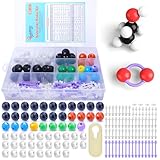
- ADVANCED LEARNING SCIENCE EDUCATION KIT --- Perfect chemistry model kit for modeling simple and small to more advanced and complex chemical structures for schools and college level, students of all ages, researchers and enthusiasts. Fun and interactive early learning molecular set for kids of all years and for use in the classroom.
- HIGH QUALITY --- Made from high quality durable materials designed for easy construction and perfect fit. These Molecular Model Kit pieces are color coded to national standards for easy ID. Organic Chemistry Model Kit includes box for easy storage and transport with your other textbooks, notes, and books. Excellent for the classroom.
- POWERFUL FUNCTIONS --- This Molecular Model Kit has a total of 136 pieces including short link remover tool. Super easy to build models for organic and inorganic chemistry, This model contains C, H, O, N, S and a variety of single and double bonds, Can be put high school, university chemistry in most of the organic or inorganic molecular structure model for the study of experimental operation.
- QUICK AND EASY ASSEMBLY OF COMPLEX STRUCTURES --- Atoms and bonds that are perfectly suited to being connected and disconnected easily without making your fingers hurt. We've also included a link remover to make the task of easy.
- CONVENIENT STORAGE --- The pieces come in a slim plastic box for convenient storage. See the pictures on this listing for a full understanding of what's inside
Documentation for the parser and notation
- Open Babel: Smiley parser documentation — syntax and semantic diagnostics, examples, and the differences between Smiley and the standard parser.
- RDKit FAQ: molecule reading and common errors — examples for explicit valence and kekulization errors; the page shows a March 31, 2023 edit date.
- RDKit Book — parser behavior, sanitization, aromaticity, and valence documentation.
- OpenSMILES specification — rules for SMILES notation, including aromaticity and valence checks.
Product prices and availability are accurate as of the date/time indicated and are subject to change. Any price and availability information displayed on Amazon at the time of purchase will apply.

