
Free tools Windows power users keep installed
One-click scans. No signup required.
To relay an existing HLS live stream to YouTube, configure MediaMTX to pull the HLS playlist, then use FFmpeg or another compatible encoder to read that MediaMTX path and publish it to YouTube using the server URL and stream key from YouTube Live Control Room. The HLS input and YouTube output are separate connections: enabling MediaMTX’s HLS or RTMP features alone does not make it publish automatically to YouTube.
The flow is: HLS origin → MediaMTX path → local MediaMTX reader URL → FFmpeg or another encoder → YouTube RTMPS ingest URL and stream key. The exact encoder command depends on the source codecs, timestamps, destination details, and whether the incoming audio and video are compatible with YouTube.
What you need before configuring the relay
- A reachable HTTP or HTTPS HLS playlist URL, commonly an `.m3u8` playlist. If it is protected, you also need valid credentials.
- A running MediaMTX instance whose configuration you can edit, with its HLS input path and reader protocol available to the machine running the encoder.
- FFmpeg or another encoder/client capable of reading the MediaMTX path and publishing RTMP or RTMPS.
- A YouTube channel with live streaming enabled, plus the server URL and stream key shown for the intended broadcast in YouTube Live Control Room.
MediaMTX is a live media server and proxy that can acquire an HTTP(S) HLS source and make a configured path available to compatible readers. It does not guarantee that every source’s codecs can be sent unchanged to YouTube. If the source is incompatible, the outgoing encoder must convert it.
Configure MediaMTX to pull the HLS playlist
Add a named path to the mediamtx.yml configuration used by your running instance. A typical source declaration is:
Windows Errors? Fix Them Before They Spread
Repair common Windows errors and clear accumulated junk for a smoother, more stable PC - no reinstall needed.Free scan · no reinstallOutdated Drivers Are Slowing You Down
One free scan finds every outdated or missing driver and matches the right update for your exact hardware.Free scan · exact hardware match#1 Best Overall

- 【Innovative Product with Leading Technology】- Equipped with an advanced H.265 /H.264 dual encoding chip, supports 4K UHD (3840x2160) video input and output, with a maximum frame rate of 30fps at 4K resolution and up to 120fps at 2K and lower resolutions, delivering a smooth and detailed visual experience. It also supports HDCP 1.4 decryption, easily decoding various HDMI ultra HD video sources, delivering a cinematic visual experience for both professional live streaming and 4K ultra HD content transmission.
- 【Multi-protocol and Multi-platform Compatibility】- Fully compatible with streaming protocols such as HTTP, RTSP, RTMP(S), SRT, HLS(M3U8), MP4, Multicast(UDP, RTP, PTL), FLV, WebRTC, TRTC, ICECAST, it can simultaneously output 4 video streams with different protocols and push them to live streaming platforms such as YouTube, Facebook, Twitch, and Vimeo with one click. Simultaneous live streaming across multiple platforms can be achieved without additional equipment.
- 【Highly Customizable Settings to Meet Individual Needs】- It supports adding static text, scrolling captions, brand logos, and timestamps. Users can freely adjust core parameters such as video resolution, frame rate, and bitrate, and also perform personalized editing functions such as video cropping, rotation, flipping, and mirroring. It supports dual input of HDMI embedded audio and line-in audio, with adjustable sound quality, making your live stream content more distinctive and allowing you to create a unique brand live stream style.
- 【Stable and Efficient Transmission, Easy Operation】- Employing HDMI to Ethernet core connection technology, it ensures stable and reliable network transmission with low latency and no lag, adapting to various network environments. Equipped with an intuitive user interface and detailed instruction manual, no professional technical background is required; setup can be completed quickly after connecting the device. It is also compatible with multiple terminals such as computers and mobile phones for management, and the video stream status can be viewed in real time via a URL.
- 【Lifetime Free Warranty and Technical Supports】- All URayCoder video codecs come with a lifetime free warranty and technical supports, supporting secondary development and feature customization to meet enterprise-level personalized needs. Meanwhile, we providing many kinds of customization services such as shell pattern printing, logo addition, hardware and function development, ensuring reliable quality and worry-free after-sales service.
paths:
  youtube_relay:
    source: https://example.com/live/index.m3u8
Replace the example with the actual playlist URL. The path name, youtube_relay, is the name the reader will use in the next step. Restart or reload MediaMTX according to the way your deployment is managed, then check its logs or status to confirm it can fetch the playlist.
If the playlist requires credentials, use the source URL format accepted by your MediaMTX version. Characters that have special meaning in URLs may need URL encoding; do not paste unencoded credentials into a URL and assume they will be parsed as intended. Treat credentials in configuration files and logs as secrets.
Rank #2

- 【Hardware H.265/H.264 Encoding at 1080P60】Dedicated hardware encoder delivers broadcast-quality 1080P60 streams with H.265/H.264 compression. Reduces bandwidth usage by up to 50% compared to legacy H.264-only solutions, while maintaining crisp, crystal-clear video output.
- 【Broad Protocol Support for IP Distribution】 Supports SRT, RTMP(S), RTSP, UDP, HTTP, HLS, WebRTC, TRTC, Icecast and SHOUTcast — integrate seamlessly with CDNs, surveillance NVRs, IPTV systems and browser-based monitoring dashboards. One device replaces multiple single-purpose streaming boxes.
- 【Browser-Based Setup in Minutes】 Set up in minutes through any browser — no software, drivers or OS compatibility issues. DHCP is enabled by default to prevent IP address conflicts on your network. Note: basic networking knowledge (IP address, RTSP/RTMP configuration) is recommended for advanced streaming setups.
- 【Compact Design with Flexible Deployment】Palm-sized form factor (approx. 90×54×29mm) fits easily behind monitors, on shelves, or in equipment racks. Low power consumption ensures reliable 24/7 operation for live events, remote monitoring, and digital signage.
- 【Professional Audio & OSD Overlay + 1-Year Warranty】 Supports HDMI embedded audio plus external 3.5mm input. Built-in OSD generator adds scrolling text, logos, or timestamps directly to the video stream — ideal for branding, event info, or security labeling. Backed by a 1-year warranty and 24/7 online technical support.
Check the ports and deployment
The MediaMTX configuration defaults accessed on October 3, 2026, show HLS on port 8888 and RTMP on port 1935. These are defaults, not a guarantee about your running instance: configuration overrides, Docker port publishing, host firewalls, and network rules can change whether a port is available. Verify the effective configuration and make the relevant reader port reachable from the encoder machine.
For a local HLS reader, the typical URL shape is http://127.0.0.1:8888/youtube_relay/index.m3u8 when HLS is enabled on its default port and the reader runs on the same host. If FFmpeg is on a different machine, use the MediaMTX host’s reachable address instead of 127.0.0.1. Confirm the exact reader URL and path format supported by the MediaMTX version and configuration you run.
Rank #3
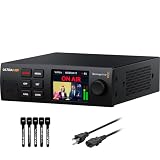
- 4K & HD STREAMING IN H.264 AND H.265 – Self-contained processor supporting H.264 and H.265 encoding in HD or Ultra HD (up to 2160p60) via SRT or RTMP, streaming directly to YouTube, Facebook, X, Twitch, Zoom, Microsoft Teams, OBS, Wowza, and many more — no encoding PC needed.
- 12G-SDI INPUT WITH STANDARDS CONVERSION – Supports input resolutions up to DCI 4K60 with an SDI input and SDI loop output, plus Teranex-powered automatic standards conversion so any HD or Ultra HD source streams cleanly at any target resolution.
- DUAL MONITOR OUTPUTS – Features both SDI and HDMI monitor outputs with a user-configurable standards converter on both the 12G-SDI Out and 4K HDMI Out, so you can feed a confidence monitor or downstream device at any required format independent of your streaming standard.
- ETHERNET + 5G/4G MOBILE WITH AUTO-FAILOVER – Connect via Gigabit Ethernet (10/100/1000BASE-T) or tether a smartphone via USB-C for mobile data, with automatic switchover between connections — ensuring your stream stays on air even if the primary internet connection drops.
- CLOSED CAPTIONS, TIMECODE & REST API – Supports embedding CEA-608 and CEA-708 closed captions in live RTMP streams, source timecode over RTMP and SRT, and offers a REST API over Ethernet for external HTTP control — ideal for broadcast automation and accessibility-compliant workflows.
Get the YouTube ingest URL and protect the stream key
- Open YouTube Live Control Room and create or select the live stream you intend to use.
- Copy the server URL and stream key shown for that stream into your encoder’s connection settings.
- Prefer the RTMPS server URL when YouTube provides it and your encoder supports it. RTMPS encrypts the RTMP connection.
- Keep the key out of screenshots, public examples, shared logs, and shell history. YouTube treats a stream key like a password. If it is exposed, reset it in YouTube and update the encoder with the replacement.
Do not substitute the MediaMTX reader URL for YouTube’s server URL. FFmpeg reads the former as its input and publishes to the latter, with the stream key incorporated in the destination address in the format expected by YouTube and the encoder.
Publish the MediaMTX path to YouTube with FFmpeg
First confirm that FFmpeg can read the MediaMTX HLS URL. Then use an output command in this general form, replacing the placeholders and reviewing the options against the actual source and YouTube’s current requirements:
Rank #4

- ⭐【Innovative Product with Leading Technology】- Equipped with an advanced H.265 /H.264 dual encoding chip, supports 4K UHD (3840x2160) video input and output, with a maximum frame rate of 30fps at 4K resolution and up to 120fps at 2K and lower resolutions, delivering a smooth and detailed visual experience. It also supports HDCP 1.4 decryption, easily decoding various HDMI ultra HD video sources, delivering a cinematic visual experience for both professional live streaming and 4K ultra HD content transmission.
- ⭐【Multi-protocol and Multi-platform Compatibility】- Fully compatible with streaming protocols such as HTTP, RTSP, RTMP(S), SRT, HLS(M3U8), MP4, Multicast(UDP, RTP, PTL), ONVIF, FLV, WebRTC, TRTC, ICECAST, it can simultaneously output 4 video streams with different protocols and push them to live streaming platforms such as YouTube, Facebook, Twitch, and Vimeo with one click. Simultaneous live streaming across multiple platforms can be achieved without additional equipment.
- ⭐【Highly Customizable Settings to Meet Individual Needs】- It supports adding static text, scrolling captions, brand logos, and timestamps. Users can freely adjust core parameters such as video resolution, frame rate, and bitrate, and also perform personalized editing functions such as video cropping, rotation, flipping, and mirroring. It supports dual input of HDMI embedded audio and line-in audio, with adjustable sound quality, making your live stream content more distinctive and allowing you to create a unique brand live stream style.
- ⭐【Stable and Efficient Transmission, Easy Operation】- Employing HDMI to Ethernet core connection technology, it ensures stable and reliable network transmission with low latency and no lag, adapting to various network environments. Equipped with an intuitive user interface and detailed instruction manual, no professional technical background is required; setup can be completed quickly after connecting the device. It is also compatible with multiple terminals such as computers and mobile phones for management, and the video stream status can be viewed in real time via a URL.
- ⭐【Lifetime Free Warranty and Technical Supports】- All URayCoder video codecs come with a lifetime free warranty and technical supports, supporting secondary development and feature customization to meet enterprise-level personalized needs. Meanwhile, we providing many kinds of customization services such as shell pattern printing, logo addition, hardware and function development, ensuring reliable quality and worry-free after-sales service.
ffmpeg -i "http://127.0.0.1:8888/youtube_relay/index.m3u8"
  -c:v libx264 -preset veryfast -b:v 6000k -maxrate 6000k -bufsize 12000k
  -r 30 -g 60 -keyint_min 60 -sc_threshold 0
  -c:a aac -b:a 128k -ar 44100
  -f flv "rtmps://YOUTUBE_SERVER_URL/YOUTUBE_STREAM_KEY"
This is an illustrative transcoding template, not a verified end-to-end command or a universal preset. Replace the destination with the precise RTMPS URL and key format YouTube shows for your stream. Do not publish a real key. The example targets 30 fps and a two-second keyframe interval; change its output settings to match your chosen resolution, frame rate, codec, and available upload capacity.
Choose stream copy or transcoding
Stream copy avoids re-encoding and can reduce CPU use, but it is appropriate only when the incoming video and audio codecs, container handling, timestamps, and stream behavior are compatible with YouTube’s ingest requirements. MediaMTX moving a source between protocols does not itself establish that the source can be copied unchanged to every RTMP(S) destination.
Best Value

- ⭐【Innovative Product with Leading Technology】- Equipped with an advanced H.265/H.264 dual encoding chip, supports 1920x1080 resolution input and output, achieving 60fps high-definition presentation with realistic and delicate color reproduction and lossless detail. It also supports HDCP 1.4 decryption, easily decoding various HDMI high-definition video sources, delivering a cinematic visual experience for both professional live streaming and high-definition content transmission.
- ⭐【Multi-protocol and Multi-platform Compatibility】- Fully compatible with streaming protocols such as HTTP, RTSP, RTMP(S), SRT, HLS(M3U8), MP4, Multicast(UDP, RTP, PTL), ONVIF, FLV, it can simultaneously output 4 video streams with different protocols and push them to live streaming platforms such as YouTube, Facebook, Twitch, and Vimeo with one click. Simultaneous live streaming across multiple platforms can be achieved without additional equipment.
- ⭐【Highly Customizable Settings to Meet Individual Needs】- It supports adding static text, scrolling captions, brand logos, and timestamps. Users can freely adjust core parameters such as video resolution, frame rate, and bitrate, and also perform personalized editing functions such as video cropping, rotation, flipping, and mirroring. It supports dual input of HDMI embedded audio and line-in audio, with adjustable sound quality, making your live stream content more distinctive and allowing you to create a unique brand live stream style.
- ⭐【Stable and Efficient Transmission, Easy Operation】- Employing HDMI to Ethernet core connection technology, it ensures stable and reliable network transmission with low latency and no lag, adapting to various network environments. Equipped with an intuitive user interface and detailed instruction manual, no professional technical background is required; setup can be completed quickly after connecting the device. It is also compatible with multiple terminals such as computers and mobile phones for management, and the video stream status can be viewed in real time via a URL.
- ⭐【Lifetime Free Warranty and Technical Supports】- All URayCoder video codecs come with a lifetime free warranty and technical supports, supporting secondary development and feature customization to meet enterprise-level personalized needs. Meanwhile, we providing many kinds of customization services such as shell pattern printing, logo addition, hardware and function development, ensuring reliable quality and worry-free after-sales service.
Transcoding is the more flexible option when the source codecs are unsuitable or when you need a controlled output resolution, frame rate, bitrate, or audio format. It requires enough processing capacity for the selected encoding settings. If you change the example to use -c:v copy or -c:a copy, remove the corresponding encoding-specific options and verify the resulting streams are accepted; do not assume stream copy will fix incompatible codecs or timestamps.
Set YouTube-compatible output parameters
YouTube’s RTMP/RTMPS guidance accessed in 2026 supports H.264, H.265 (HEVC), and AV1 video, AAC or MP3 audio, and up to 60 fps. It specifies constant bitrate (CBR), recommends a two-second keyframe interval, and says the interval must not exceed four seconds. RTMPS is recommended where supported. Check YouTube’s current settings before a production stream because platform guidance can change.
| Example output target | YouTube H.264 recommended bitrate | Keyframe interval |
|---|---|---|
| 720p at 30 fps | 8 Mbps | 2 seconds recommended; never over 4 seconds |
| 1080p at 30 fps | 14 Mbps | 2 seconds recommended; never over 4 seconds |
| 1080p at 60 fps | 17 Mbps | 2 seconds recommended; never over 4 seconds |
The bitrate figures are YouTube’s recommended H.264 settings for those resolution and frame-rate rows, as accessed in 2026; they are not universal minimums or measurements of this relay. Select the row for the actual output codec, resolution, and frame rate, and ensure the network connection can sustain the outgoing bitrate with headroom. Do not copy a bitrate from a different resolution or codec without checking YouTube’s corresponding table.
Test each stage before relying on the relay
- Confirm source acquisition: verify MediaMTX can fetch the HLS playlist and its media segments without authorization, DNS, TLS, or network errors.
- Confirm the MediaMTX path: verify the configured path becomes available and that a compatible client can read it using the intended local or remote URL.
- Confirm tracks and playback: inspect whether the reader receives the expected video and audio, and check that timestamps advance rather than stall or jump.
- Confirm encoder output: start FFmpeg with the selected copy or transcode settings and inspect its output for decoding, encoding, and connection errors.
- Confirm YouTube reception: check YouTube Live Control Room for the incoming preview and stream health before making the event public or depending on the relay.
- Monitor the full event: watch source continuity, audio, motion, encoder output, network stability, and YouTube’s stream-health indicators.
Troubleshooting by relay stage
| Symptom | Likely area to check | What to do |
|---|---|---|
| MediaMTX never makes the path available | HLS source URL, credentials, DNS, TLS, or access to the playlist and segments | Check the source URL and MediaMTX logs; confirm credentials and that both playlist and referenced segments are reachable from the MediaMTX host. |
| The path is available, but FFmpeg cannot read it | Reader URL, port exposure, path spelling, or protocol availability | Check the effective MediaMTX configuration, use the correct host and port, and confirm the encoder can reach the selected reader protocol through firewalls and container networking. |
| FFmpeg reads the path but reports decode or timestamp errors | Source stream structure, codec support, or discontinuous timestamps | Inspect the incoming tracks and timestamps. Test a transcode instead of stream copy where codecs require conversion; correct source or timestamp problems rather than hiding them with arbitrary encoder flags. |
| YouTube does not show an incoming preview | Destination URL, stream key, outgoing connectivity, or ingest protocol | Recheck the exact YouTube URL and key, confirm the encoder can reach the selected RTMP(S) endpoint, and reset the key if it may have been exposed. |
| YouTube reports poor stream health | Bitrate, frame rate, keyframe interval, network capacity, or unstable source | Use YouTube’s recommendation for the selected output row, keep the keyframe interval within its guidance, and check whether the source or outgoing connection is dropping data. |
| Audio or video is missing in the preview | Absent or incompatible source track, mapping, or codec | Check which tracks FFmpeg receives, explicitly map the intended audio and video if needed, and convert them to supported formats where necessary. |
Do not confuse HLS input with YouTube HLS ingest
In this setup, HLS is the incoming source format, while the outgoing destination is YouTube RTMP or RTMPS. YouTube also offers HLS ingest as a separate destination mode. Its segmented delivery has higher latency than RTMP and has its own segment and upload constraints; use its HLS workflow and requirements only if you deliberately choose HLS as the YouTube ingest protocol.
The Tool Desk
Outbyte Driver Updater FREEFix the driver behind crashes, sound loss and screen glitchesFind Drivers →Outbyte PC Repair FREEClear out junk files and repair common Windows errorsFree Scan →Or let it run in the cloud
If your goal is to keep an uploaded video or playlist live on YouTube continuously, StreamNeo is a simpler cloud alternative to maintaining this relay: upload the recording or build a playlist, add your YouTube stream key once, and go live. Nothing has to stay on at home; videos stream as uploaded at any quality up to 4K 60fps for one flat price per slot. StreamNeo automatically recovers if YouTube drops the stream. The first day is free with no card, and the Monthly price is $9.99 per month. StreamNeo plays uploaded videos and playlists to YouTube; it is not a camera-live service. See StreamNeo, then start the free first day.
Quick Recap
Product prices and availability are accurate as of the date/time indicated and are subject to change. Any price and availability information displayed on Amazon at the time of purchase will apply.

