
Do these 3 things before closing this tab:
1Clear out junk files and repair common Windows errors2Fix the driver behind crashes, sound loss and screen glitches3Repair Windows errors before they cause bigger problemsTo stream NDI video between locations over the internet, use NDI Bridge: set one Bridge endpoint to Host and the remote endpoint to Join, then configure a reachable network port and choose an encoding that fits your bandwidth and latency needs. Bridge connects NDI production networks; it does not remove the need to configure the network path or guarantee internet performance.
What NDI cloud streaming means
NDI is commonly used to move video sources around a production network. Sending those sources between separate locations is a wide-area network (WAN) problem, not simply a matter of putting both computers on the same LAN. NDI Bridge is NDI’s documented tool for connecting NDI infrastructures over a WAN. NDI describes it as a way to “Connect remotely over WAN.”
Bridge makes sources available across connected production networks. The actual result still depends on the internet connection, routing, source formats, encoding choices and receiving equipment at both ends. The official documentation describes the controls and capabilities, not a guaranteed end-to-end bitrate, latency or stability level.
Choose the right Bridge mode
Host and Join for separate sites
Use Host and Join when connecting NDI networks across a WAN. Plan which site will host, which will join, which direction video needs to travel, and how many sources and receivers will be involved. Configure the Bridge roles to match that flow; for a bidirectional production, account for sources and receivers at both locations rather than assuming a one-way setup will cover it.
#1 Best Overall

- Compact but Powerful Design: ZowieBox is smaller than a phone, featuring a tally light and LCD screen for streaming status. Capture console gameplay in up to 4K with zero-lag HDMI passthrough, while the built-in video encoder converts video for IP streaming. The IP stream can also be decoded back to a 4K HDMI signal.
- Standalone Game Streaming: Just plug and play—ZowieBox enables PC-free live gaming without affecting gameplay. As an RTMP hardware encoder and HDMI streamer, it delivers stable streaming directly from your source, making it ideal for gaming, live events, and professional broadcasting.
- NDI|HX3 Converter Technology: ZowieBox converts HDMI signals to NDI|HX3/HX2/HX, functioning as an NDI video encoder, or NDI Video Decoder for flexible IP workflows. Certified NDI technology enables low-latency gameplay streaming through OBS/vMix. Note: Encoder and decoder modes cannot run simultaneously; full NDI signals are not supported.
- UVC to HDMI Conversion: Supporting up to 4K@30fps and 1080p@60fps decoding, ZowieBox enables flexible conversion for webcam and video workflows. As a video decoder and HDMI to IP converter, it expands connectivity options for professional video devices. Note: USB capture card functionality is not currently supported.
- All-around Configuration Options: Control ZowieBox through its web UI on a PC, phone, or tablet. Manage connected PTZ cameras, tally light, video/audio, OSD, work mode, streams, network, and system settings. Support for VISCA over IP encoder workflows enables flexible PTZ control, while the dashboard provides video preview and system status.
Local for proxying or local transcoding
Bridge’s Local mode can proxy sources or support local transcoding use cases on a LAN. It is not a substitute for the Host/Join WAN connection when the goal is to link separate sites.
Plan bandwidth, quality and delay before setup
NDI’s bandwidth guidance says a typical 1080p60 NDI stream can yield data rates up to 150 Mbps per stream. This figure comes from NDI / Vizrt AB’s Bandwidth | Docs and Guides; the page does not state a publication year. NDI also cautions that bandwidth is not deterministic and should be planned around average utilization. Treat the figure as local/workflow planning guidance, not as a universal internet upload-speed requirement or a promised WAN bitrate.
Rank #2

- SDI NDI Encoder Decoder: Encode SDI signals to NDI or decode NDI signals to SDI. It supports NDI|HX3, NDI|HX2, and NDI|HX (Certified), but not full NDI (NDI|HB). Streamlines workflows with high-efficiency NDI|HX formats, ensuring seamless integration between different production systems. Note: ZowieBox cannot be used as an encoder and decoder at the same time. It can only switch between the two working modes, not use both modes at the same time
- AVoIP to NDI and SDI: It can decode AVoIP video streams (RTMP, RTSP, SRT) into NDI and SDI in decoding mode, seamlessly integrating diverse video sources into NDI-compatible workflows for enhanced efficiency in media production and broadcasting
- UVC to SDI Converter: Easily turn your UVC cameras into SDI cameras. With up to 1080@60fps decoding resolution, ZowieBox allows you to unfold more possibilities for webcam devices. Note: USB capture card functionality is not supported
- SDI Extender: Using two ZowieBoxes enables point-to-point transmission: one serves as an SDI encoder/transmitter, while the other functions as an SDI decoder/receiver. This setup allows SDI video signals to be transmitted via a LAN. Note: The SDI signal of ZowieBox (hardware before 10.1.13) is not compatible with ATOMAS SHOGUN INFERNO, SHOGUN ULTRA, Blackmagic Decklink Quad 2
- Standalone Live Streaming: Just plug and play, ZowieBox can stream videos PC-free, not affecting your computer performance at all. Support SRT caller/RTMP(S)/RTSP streaming protocol
For a multi-source setup, consider each simultaneous stream and the receivers that need it. A wired gigabit network may be appropriate for the local production network: NDI describes gigabit networking as essential to production workflows. A gigabit switch and cabling do not raise your ISP’s service rate or guarantee a stable WAN path.
Choose between less compression and lower WAN load
Bridge’s transcoding choices depend on the incoming stream type and selected configuration. For NDI HX, its documentation describes H.264 or HEVC transcoding. High Bandwidth NDI can use SpeedHQ, passthrough or no transcoding according to configuration. Compression can reduce the load on a constrained WAN path, but codec support and the desired visual quality must be checked at both ends.
Rank #3
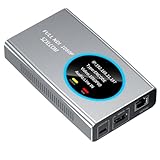
- 【Real-Time IP Workflow】1920×1080@60fps NDI encoder, enabling frame-accurate synchronization for live streaming teams, sports events, game streaming, and multi-camera production. The NDI encoder converts HDMI signals into full NDI video streams with latency below 65 milliseconds, ensuring seamless synchronization of video motion and fast-paced actions. Compatible with vMix/OBS/Wirecast integration.
- 【Flexible IP to Display】A bidirectional all-in-one device that functions as both an NDI encoder and NDI decoder. When used as an decoder, it converts NDI streams into 1080p60 HDMI signals. Decode NDI signals from the production console to HDMI large screens for real-time multi-camera monitoring, project vMix NDI video streams onto meeting room displays, or route live signals to broadcast monitors. Eliminate complex cabling—a single Ethernet cable can simultaneously transmit power and signals. (Select encoder or decoder mode via the NDI backend network interface).
- 【IP-Based Wiring Infrastructure】Using an HDMI-to-NDI converter, a single network cable can replace long-distance HDMI cabling (up to 100 meters), enabling both power supply (PoE+) and network transmission over a single cable, significantly simplifying on-site cabling. Also supports PoE+ or Type-C interface 5V power supply, reducing cabling costs. It is an ideal solution for educational live streaming and recording classrooms, as well as enterprise IT management IP-based production.
- 【Real-Time Status Monitoring】The HDMI decoder is equipped with a Tally indicator light and an LCD screen that displays real-time information, including IP address, network status, encoding/decoding status, video resolution, audio input/output status, and indicator light status. Without the need for a computer, you can monitor the latest program updates in real-time during live events.
- 【Real-Time Monitoring via Uncompressed HDMI Signal Loop-Out】The NDI live streaming encoder supports HDMI loop-out functionality, enabling near-zero latency signal pass-through. This allows for real-time video signal monitoring without interrupting NDI encoder processing and transmission. This provides a simpler setup solution for video production or live streaming.
Also account for decoding support. NDI’s Bridge documentation notes that an HEVC decoder on Windows 10 and later may require a separate Microsoft Store license. Confirm the codec and hardware/software support on the systems that will receive the video before committing to a workflow.
Use buffering when continuity matters more than minimum delay
Bridge’s configurable buffer stores video data and can help smooth a path with variable latency or bandwidth. A larger buffer also adds delay. Tune it against the production’s real tolerance for latency—interactive work may need a different balance from a feed where continuity matters more than immediacy.
Rank #4

- 4K HDMI Encoding with Loop-Through Output – Encode HDMI video up to 4096×2160p30 while using the HDMI loop-through for local monitoring or pass-through to displays and switchers.
- Multi-Protocol & Multi-Destination Streaming – Stream simultaneously via RTMP, RTMPS, SRT, NDI|HX, HLS, and TS over UDP/RTP, supporting modern broadcast and IP workflows.
- Advanced Video Processing & Overlays – Includes de-interlacing, scaling, cropping, aspect ratio conversion, and support for text, image, and clock overlays for branded output.
- Simultaneous Streaming & Recording – Record video directly to internal storage (128 GB), external USB storage, or network locations while streaming live, with support for scheduled and loop recording.
- Flexible Network & Connectivity Options – Equipped with Gigabit Ethernet with PoE and Wi-Fi 802.11 a/b/g/n/ac, plus support for 4G/5G USB modems (not supplied) for fixed or mobile deployments.
Set up an NDI Bridge connection
- Map the production flow. List the NDI sources needed at each site, whether transport is one-way or bidirectional, and how many receivers will consume each source. Decide which system will Host and which will Join.
- Check the Bridge computer requirements. NDI’s Bridge page lists Windows 10 64-bit or later, an Intel or AMD CPU with SSE4 or later, at least 6 GB RAM and a 1 Gbps LAN as minimum requirements. Requirements and current software versions can change; verify the current Bridge page before deployment.
- Install and configure Bridge at the participating sites. Set the appropriate Host and Join roles for the planned connection. Choose transcoding and buffer settings based on source type, receiving support, available network capacity and acceptable delay, rather than assuming one configuration suits every link.
- Make the Host reachable from outside its LAN. At the host site, configure the router to forward the selected Bridge port to the local IP address of the Bridge computer. NDI says Bridge can discover the public IP address, but it cannot create the router’s forwarding rule. The documented default is port 5990; a different port can be selected. NDI’s Bridge page states that at least one location needs a public IP address and a network port translated to a local Bridge IP.
- Share the encryption key securely. NDI says Bridge uses 256-bit encryption and all endpoints must use the same encryption key. Treat the key as a credential: share it only with intended participants and avoid exposing it in public notes or messages.
- Connect and verify the sources at the receiving site. Confirm that the expected NDI sources appear for the intended receivers, then test the actual production flow—not just a successful connection indicator.
- Measure and tune under realistic load. Use Bridge diagnostics to inspect send and receive rates, round-trip time, packet loss and buffer behavior. The buffer test described in NDI 6.1 Bridge documentation requires both Bridge endpoints to be on that version. Do not assume that test is available on other versions.
Choose an approach for your production
| Approach | Best fit | Trade-offs to assess |
|---|---|---|
| High Bandwidth NDI with passthrough or no transcoding | Workflows prioritizing the source format and with sufficient network capacity | Potentially heavier network load; plan simultaneous sources, sustained capacity and receiver compatibility. |
| Bridge transcoding | WAN links where reducing network load is important and both ends support the chosen codec | Codec and hardware/software compatibility matter; compression changes the workflow characteristics and must be tested against the required image quality. |
| Bridge with a larger buffer | Paths where smoothing variation is more important than keeping delay low | Improved continuity may come at the cost of additional latency; tune for the real use case. |
There is no universal best setting. Compare the required resolution and visual quality, sustained upload and download capacity at both sites, tolerance for delay, simultaneous source and receiver counts, codec support, and whether an operator can configure router access and protect credentials.
Independent reader supportYour contribution helps us test, update, and keep practical guides available for everyone.Troubleshoot common connection problems
The Join site cannot connect
- Check forwarding: confirm that the router forwards the chosen port to the Bridge computer’s current local IP address. Discovering a public IP does not create this rule automatically.
- Check the port: make sure both sides are using the intended port; 5990 is the documented default, but it may have been changed.
- Check reachability: confirm that the Host network has a public IP and that the required port can reach the Bridge endpoint. NDI’s documented WAN setup requires a reachable endpoint.
The video stutters or drops
- Inspect Bridge send/receive rates, packet loss, round-trip time and buffer behavior using diagnostics.
- Reduce WAN load by revisiting the number of simultaneous sources or selecting a supported transcoding option.
- Test whether a larger buffer improves continuity, keeping in mind that it increases latency.
- Check the local production network separately from the WAN. Gigabit LAN planning helps the production network but cannot fix an ISP bottleneck or an unstable internet route.
Video does not decode or looks wrong
- Verify the incoming source type and Bridge’s selected output/encoding mode.
- Confirm receiver compatibility with H.264, HEVC, SpeedHQ or passthrough as applicable. On Windows 10 and later, an HEVC decoder may require a separate Microsoft Store license.
- Compare the decoded result with the source and adjust the workflow only after confirming both ends support the chosen settings.
Buffer testing is unavailable
The buffer test described for NDI 6.1 requires both Bridge endpoints to run that version. Check the documentation for the installed version rather than assuming version-specific diagnostics are present.
Best Value

- HDMI to SRT/RTMP(S)/RTSP Encoder:Convert HDMI video sources into SRT, RTMP, or RTSP streams for real-time online broadcasting and remote production. Stream directly from cameras, gaming consoles, or other HDMI devices to platforms such as YouTube, Twitch, Facebook Live, or private streaming servers. Ideal for live events, conferences, sports, education, and professional AV applications, delivering stable, high-quality video with low latency.
- SRT/RTMP(S)/RTSP to HDMI Decoder: Decode SRT, RTMP(S), and RTSP network streams and output them through HDMI to TVs, monitors, switchers, and other video equipment. Easily bring remote cameras, drones, action cameras, or surveillance streams to local HDMI displays for real-time monitoring and playback. Ideal for sports events, press conferences, live production, and multi-display applications, providing stable HD video output and seamless integration with devices such as ATEM switchers.
- HDMI to UVC Encoder: Use an HDMI to UVC converter to connect a professional HDMI camera to your computer for high-quality video calls in meetings. It also allows you to link HDMI devices (e.g., cameras or classroom equipment) to teaching computers or projectors for better interactivity. Enables HDMI cameras or sources to connect to computers or streaming devices for high-quality live broadcasts
- UVC to HDMI Decoder: Convert UVC cameras (e.g., USB webcams, action cameras) to HDMI signals for easy connection to conference equipment or large displays or ATEM switcher, enhancing video quality and participation. In education and training, convert UVC signals to HDMI for display on large screens
- SRT/HDMI Encoder & Decoder:SRT (Secure Reliable Transport) provides secure, low-latency video transmission with enhanced stability over challenging network conditions. ZowieBox enables bidirectional conversion between HDMI and SRT streams, allowing reliable remote production, live streaming, and video contribution workflows with high-quality transmission even across long-distance networks.
Do not rely on NDI Remote for a current guest link
NDI Remote is discontinued and offline. NDI’s tools catalog and dedicated documentation carry the discontinuation notice; it should not be treated as a currently working link-based guest workflow. Check the current NDI Tools information for status.
Or let it run in the cloud
NDI Bridge is for carrying NDI production sources between connected networks. If your separate goal is to keep a pre-recorded YouTube channel live around the clock, StreamNeo is a different workflow: it loops uploaded videos to YouTube from the cloud, not live camera video or NDI sources.
- Upload a recording or build a playlist.
- Add your YouTube stream key once.
- Go live; StreamNeo loops the uploaded video from the cloud.
Your computer and home connection do not have to stay on. Every slot streams the uploaded quality up to 4K 60fps at one flat price per slot, with automatic recovery if YouTube drops the stream. The first day is free with no card. Monthly is $9.99 per month. See StreamNeo, or start the free day.
Quick Recap
Product prices and availability are accurate as of the date/time indicated and are subject to change. Any price and availability information displayed on Amazon at the time of purchase will apply.

