
The Tool Desk
Outbyte PC Repair FREEClear out junk files and repair common Windows errorsFree Scan →Outbyte Driver Updater FREEFix the driver behind crashes, sound loss and screen glitchesFind Drivers →It depends on what you already own and what you count. A Linux virtual server can start at $5 USD per month, while a Raspberry Pi has no rental fee once purchased—but its real running cost includes measured electricity use, and buying a board and accessories adds an upfront cost. For a clear comparison, this article uses a 480p, 30 fps H.264 stream at 0.4 Mbps, YouTube’s listed minimum bitrate for that resolution. That is not its recommended bitrate, and neither a low monthly VM price nor a Pi’s power rating proves the setup will stream reliably.
What counts as a low-bitrate radio stream?
“Low-bitrate” needs a specific resolution and bitrate to make a cost estimate meaningful. At 480p and 30 fps, YouTube lists 0.4 Mbps as the H.264 minimum and 4 Mbps as its recommended bitrate. The minimum is not a guarantee of acceptable picture quality: results depend on the video’s movement, detail, frame size, and the viewer’s connection. A mostly static radio visual may behave differently from footage with frequent motion.

YouTube’s encoder guidance recommends H.264, constant bitrate (CBR), RTMP or RTMPS ingestion, and a two-second keyframe interval (no more than four seconds). Test with representative audio and video movement, check the outgoing bitrate, then watch YouTube’s stream-health status and messages. YouTube transcodes live streams into formats for viewers. See YouTube’s encoder settings, bitrate, and resolution guidance. Google for Developers describes RTMPS as a good choice for most ordinary user content, particularly when low latency is needed; see Delivering Live YouTube Content via RTMPS.
Cloud VM versus Raspberry Pi: the costs to compare
| Cost or factor | Linux cloud VM | Raspberry Pi at home |
|---|---|---|
| Published example | AWS Lightsail lists a Linux/Unix bundle at $5 USD per month, with 0.5 GB memory, 2 vCPUs, 20 GB SSD storage, and 1 TB transfer. AWS also lists bundles at $7 per month (1 GB memory and 2 TB transfer) and $12 per month (2 GB memory and 3 TB transfer). Prices and terms can vary by region, taxes, and current offers. Check AWS Lightsail pricing and current terms. | No cloud rental fee if you already own the Pi. If buying, include the board and the power supply, storage, case or cooling, and any replacements in the upfront cost. |
| Recurring operating cost | Monthly VM charge, plus any costs arising from the provider’s current transfer rules, taxes, or other services on the VM. | Electricity based on the complete setup’s measured wall draw and local tariff; add any incremental home internet cost. |
| Network and power dependency | Depends on the hosting provider’s machine and network. It still needs process and stream-health monitoring; a VM is not an uptime guarantee. | Depends on home power, router, ISP upload, and hardware. A home outage or unstable upload can interrupt the stream. |
| Encoding suitability | The published price and specifications do not establish that the smallest VM can encode your particular loop reliably. Test the real source and settings, and monitor CPU, memory, and stream health. | Official hardware specifications do not establish continuous YouTube streaming performance for a particular setup. Measure power and test the actual stream. |
The AWS $5 bundle is a useful price anchor, not proof that its 0.5 GB of memory and 2 vCPUs will handle a particular source, encoder, and profile. Check the price, region, transfer accounting, and taxes before committing. A simple FFmpeg process that pushes one feed to YouTube is also not the same product as a managed encoding-and-distribution service. AWS’s managed Live Streaming on AWS example estimates about $69.74 for a one-hour SD-540p event serving about 1,000 viewers in US East (N. Virginia), including encoding, packaging, and distribution. That is not the price of a small VPS sending a stream to YouTube. Read AWS’s managed streaming cost example.
Recommended Free Tools
#1 Best Overall

- Includes Raspberry Pi 5 with 2.4Ghz 64-bit quad-core CPU (8GB RAM)
- Includes 128GB Micro SD Card pre-loaded with 64-bit Raspberry Pi OS, USB MicroSD Card Reader
- CanaKit Turbine Black Case for the Raspberry Pi 5
- CanaKit Low Noise Bearing System Fan
- Mega Heat Sink - Black Anodized
Estimate the Raspberry Pi’s electricity cost
Use the complete setup’s measured average wall power, not the maximum rating printed on a power supply. The calculation is:
Measured average watts ÷ 1,000 × hours per month × local electricity price per kWh
Rank #2

- Includes Raspberry Pi 4 4GB Model B with 1.5GHz 64-bit quad-core CPU (4GB RAM)
- Includes Pre-Loaded 32GB EVO+ Micro SD Card (Class 10), USB MicroSD Card Reader
- CanaKit Premium High-Gloss Raspberry Pi 4 Case with Integrated Fan Mount, CanaKit Low Noise Bearing System Fan
- CanaKit 3.5A USB-C Raspberry Pi 4 Power Supply (US Plug) with Noise Filter, Set of Heat Sinks, Display Cable - 6 foot (Supports up to 4K60p)
- CanaKit USB-C PiSwitch (On/Off Power Switch for Raspberry Pi 4)
For a 30-day month, use 720 hours. For example, if an outlet meter reports an average of W watts and your tariff is T per kWh, the estimate is (W ÷ 1,000) × 720 × T. Substitute your own measured watts and local tariff; the result excludes any internet charge and the purchase cost of the hardware.
Raspberry Pi’s documentation lists approximately 0.78 A average for a Pi 4 H.264 video-playback workload at 5 V—about 3.9 W. This is an older, approximate workload measurement, not a current test of a headless 24/7 YouTube encoder; the documented setup included a monitor, keyboard, mouse, and Ethernet, and peripherals affect consumption. The same documentation lists model-specific power requirements and measurements, which are not substitutes for measuring your own setup. Read Raspberry Pi’s computer and power documentation.
Do these 3 things before closing this tab:
1Scan for outdated or missing drivers - takes under a minute2Repair Windows errors before they cause bigger problems3Fix the driver behind crashes, sound loss and screen glitchesIf you already own a suitable Pi and your home internet is already paid for, compare the incremental electricity and reliability costs. If you are buying hardware solely for this stream, add the kit’s upfront cost and decide how to account for it over the period you expect to use it.
Estimate the stream’s monthly transfer
At a continuous 0.4 Mbps, 30 days of payload is approximately 130 GB: 0.4 megabits per second × 2,592,000 seconds ÷ 8. This is a simple arithmetic estimate, before protocol overhead—not a provider’s billing guarantee. It is below the 1 TB transfer allowance in the listed AWS $5 bundle if the VM’s billed transfer accounting applies as assumed. Check the provider’s current transfer measurement rules and account for overhead, monitoring traffic, and other services on the VM.
Rank #4
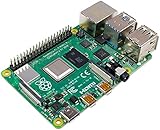
- Broadcom BCM2711, quad-core Cortex-A72 (ARM v8) 64-bit SoC @ 1. 5GHz
- 2. 4 GHz and 5. 0 GHz IEEE 802. 11b/g/n/ac wireless LAN, Bluetooth 5. 0, BLE
- 2 × USB 3. 0 ports, 2 x USB 2. 0 Ports
- 2 × micro HDMI ports supproting up to 4Kp60 video resolution
- Micro SD card slot for loading operating system and data storage
Which option is cheaper for your situation?
- You already own the Pi: Its marginal cost may be limited to electricity and any incremental internet charges. Measure the whole setup and consider whether your home power and upload connection meet your availability needs.
- You need to buy a Pi: Include the initial board and accessory costs as well as electricity. A VM avoids that local hardware purchase but has a recurring charge.
- Your electricity or internet costs are high or variable: Use your local tariff and provider terms rather than assuming a Pi is nearly free. Data caps, outages, and upload stability can matter as much as the electricity estimate.
- You are considering the lowest-priced VM: Treat its advertised monthly bundle as a starting price. Run the intended encoder and source, then inspect CPU and memory use and YouTube stream health; specifications alone do not confirm capacity.
- You mean a managed service that delivers directly to viewers: Compare that service’s own encoding, packaging, and distribution charges. Its architecture and costs are different from a VPS sending a single stream to YouTube, which then serves viewers.
For the narrow 480p30, 0.4 Mbps example, the VM has a known published monthly price anchor, while the Pi’s operating cost cannot be calculated honestly without a whole-setup power measurement and local electricity rate. Separate one-time hardware and setup costs from recurring charges, and compare like-for-like assumptions for quality, location, power, internet, and reliability.
Independent reader supportYour contribution helps us test, update, and keep practical guides available for everyone.Or let it run in the cloud
If you would rather not maintain a VM or keep a Pi and home connection available, StreamNeo keeps a YouTube channel live from uploaded videos: upload a recording or build a playlist, add your YouTube stream key, and go live. Nothing has to stay on at home. Each slot streams uploaded material at the quality it was made, up to 4K 60fps, at one price per slot with no quality tiers; it also loops playlists and automatically recovers if YouTube drops the stream. The first day is free with no card. Monthly pricing is $9.99 per month. Start StreamNeo’s free first day.
Quick Recap
Best Value
- Includes Raspberry Pi 5 16GB with 2.4Ghz 64-bit quad-core CPU (16GB RAM)
- Includes 128GB Micro SD Card pre-loaded with 64-bit Raspberry Pi OS, USB MicroSD Card Reader
- CanaKit Turbine Black Case for the Raspberry Pi 5
- CanaKit Low Noise Bearing System Fan
- Mega Heat Sink - Black Anodized
Product prices and availability are accurate as of the date/time indicated and are subject to change. Any price and availability information displayed on Amazon at the time of purchase will apply.

