
Free tools Windows power users keep installed
One-click scans. No signup required.
Technology can help insurers, employers, health-care practitioners, and injured workers coordinate a return to work by organizing job information, communicating work restrictions, tracking case-management tasks, and planning accommodations. It supports the process; it does not determine a worker’s medical capabilities or replace the employer’s legal responsibilities. In this U.S.-focused guide, “insureds” generally means employers or workers covered by workers’ compensation, although roles and rules vary by state and program.
What technology can do in a return-to-work process
A return-to-work plan depends on information moving among people who have different responsibilities. A digital case-management system or other information tool can help keep that work coordinated, but the underlying services—such as job analysis, case management, accommodation assessment, and vocational referrals—are not themselves proof that a particular software product improves outcomes.
Organize job and restriction information
Job analysis documents the tasks a role actually involves. When a practitioner provides information about a worker’s capabilities or restrictions, that job description can help the parties consider whether duties can be modified or restructured. Texas’s Division of Workers’ Compensation lists job analysis and job-modification or restructuring assessments among possible insurer return-to-work coordination services, with the participating employer’s agreement.
Coordinate case management and referrals
Case-management tools can help authorized participants keep track of updates, referrals, and next steps across an insurer, employer, provider, and worker. The U.S. Department of Labor’s review of stay-at-work and return-to-work models describes information-based services such as helping workers navigate resources and service providers, coordinating communication among employers, health-care providers, and insurers, and giving employers technical assistance with policies. Those are program functions, not a measure of current software adoption.
#1 Best Overall

- Essential Workplace Safety Guide – Educates employees on proper PPE usage, reducing injury risks in construction sites, factories, warehouses, and laboratories, ensuring a safer work environment.
- OSHA-Compliant PPE & Hazard Prevention – Follows OSHA safety regulations, providing clear instructions on selecting and using the right protective gear, including gloves, goggles, respirators, and hard hats.
- Clear & Easy-to-Read Design – Features bold text, detailed illustrations, and color-coded sections, making it an effective quick-reference PPE compliance poster for all industrial and workplace environments.
- Durable, Waterproof & Tear-Resistant – Made from high-quality, heavy-duty material, this safety poster withstands harsh industrial conditions and outdoor environments, ensuring long-term visibility.
- Ideal for All Workplaces & Industries – Perfect for construction sites, warehouses, factories, healthcare facilities, and laboratories, reinforcing safety awareness and reducing workplace accidents.
Support accommodation and vocational planning
The Department of Labor’s Vocational Rehabilitation Counselor Handbook addresses evaluating equipment and accommodations for a return to full duty, light or modified duty, or a gradual return. It also covers assistive technology, compatibility between a job and a worker’s abilities, and assessment of telework workspace and equipment. Digital records can help organize these assessments and options; an algorithm should not decide what a worker can do or what accommodation is appropriate.
Who is responsible for each decision?
The roles below describe Texas’s explanatory model and federal ADA guidance; they should not be treated as a single nationwide workers’ compensation rule. State law, the particular program, and the facts of a case matter.
Rank #2

- Package Includes: you will receive 1 single sided printed safety first banner with metal grommets, hanging rope not included; This professional signage is specially designed for safety first shops/booths, featuring high visibility to maximize advertising reach and impact
- Ideal Size: this safety first banner measures 2 feet x 4 feet, ensuring clear visibility at mid to long distances; For large indoor/outdoor displays, this optimized size enhances visibility while remaining portable and easy to set up
- Material: crafted from knitted polyester fabric, this safety first banner is tear resistant, abrasion proof, and machine washable; Features UV protected printing that resists fading, ensuring long lasting vibrancy for continuous advertising impact; The lightweight, foldable design allows for easy reuse across multiple events
- Eye Catching Design: this professionally designed safety first banner features bold "safety first" text on a clean white background, accented with vibrant paint splashes and palette graphics; The high contrast color scheme ensures long distance readability, effectively grabbing attention and boosting foot traffic to your booth or store
- Multi Event Commercial Grade Signage: this single sided printed safety first banner features bold "safety first" text and vibrant paint palette graphics on a white background; For booths, festivals, and storefronts to attract customers
| Participant | Role in the process |
|---|---|
| Health-care practitioner | Determines physical capabilities and work status, according to Texas Division of Workers’ Compensation guidance. |
| Employer | Provides work opportunities and makes employment decisions under the Texas guidance. Under EEOC guidance addressing the ADA, the employer—not a physician or rehabilitation counselor—has ultimate responsibility for deciding whether an employee can perform essential job functions with or without reasonable accommodation, or work without posing a direct threat. |
| Insurer | May provide income and medical benefits, case management, and return-to-work coordination under the Texas model. |
| Worker | Participates in planning and provides relevant information about the work and the practical fit of proposed duties or accommodations. |
Medical and vocational professionals can inform an employer’s ADA assessment, but an insurer’s workflow or technology tool does not transfer the employer’s responsibilities or override applicable law.
How to assess a technology-supported plan
For a worker asking, “How can I return to work after an injury?”, start with the work itself and the documented restrictions—not with a device or app. A useful process keeps information understandable and routes decisions to the people responsible for them.
Rank #3
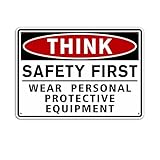
- ⚠️【PACKAGING CONTENT】You will receive a red safety first sign stickers,which comes with an adhesive backing and is very convenient to use, and the surface is a delicate matte with a certain thickness. This sign measures 11.4x8.3 inches, so your delivery person won't miss it!
- ⚠️【High-Visibility Design】Eye-catching colors and large text ensure safety signs for workplace and industry doors are easily noticed. Think Safety First/Wear Personal Protective Equipment sign stickers reinforce workplace safety rules and compliance. Helps meet safety regulations with "Must Wear Protective Clothing" messaging, take personal protective measures and reducing workplace hazards.
- ⚠️【HIGH QUALITY】The safety signs for workplace is made of thick vinyl material, durable and not easy to bend or broken, withstands most environments, and will not fade in extreme temperatures.You can use it for a long time!
- ⚠️【Easy to Apply】Self-adhesive safety warning stickers for industry stick firmly to doors, walls, machine and glass.Just tear off the protective film on the surface and the tape on the back and press it on a clean door, wall or other smooth flat surface.
- ⚠️【Versatile Use】Perfect as wear personal protective equipment warning signs for construction sites, factories, labs, warehouses, and workshops – essential safety signs & signals.
- Describe the job. Record the role’s actual tasks, physical demands, schedule, and work setting so a proposed plan can be assessed against the work to be done.
- Clarify the available work information. Use current practitioner-provided work-status and capability information as the basis for considering duties. Do not ask software to infer medical capacity.
- Compare duties with restrictions. Consider whether full duty, modified or light duty, a gradual return, or another suitable role fits the individual’s circumstances.
- Evaluate accommodations individually. Assess whether a task change, equipment, assistive technology, or workspace modification would address a specific barrier. Federal guidance emphasizes job compatibility and individualized assessment, not assuming one device works for everyone.
- Coordinate and document next steps. Use case notes, referrals, and appropriate status updates to keep participants aligned. Limit access to sensitive information to people who need it; the cited official materials do not prescribe a particular privacy architecture.
- Review the plan with human decision-makers. The worker, employer, and relevant practitioners or case managers should address whether the arrangement is workable and safe, with the employer retaining applicable employment and ADA decisions.
When comparing digital tools, consider worker access and clear communication, coordination among insurer, employer, and provider, case notes and referrals, job-task analysis, accommodation planning, and integration with existing claims or HR processes. Also ask how sensitive information is handled and how human review is preserved. The official materials cited here do not rank software vendors or establish that digitizing these functions by itself improves return-to-work results.
What accommodations can help someone return to work?
There is no universal accommodation list: the useful option depends on the person’s restrictions and the job’s essential tasks. Possibilities reflected in federal vocational-rehabilitation guidance and Oregon workers’ compensation materials include modified or transitional work, changes to duties or worksite, tools or equipment, assistive technology, and telework workspace or equipment assessment. These are categories to evaluate, not medical or ergonomic prescriptions.
Rank #4

- Premium Roof Braided Rope: 50 FT vertical rope assembly with diameter 0.55 in is made from heavy duty braided 100% polyester that features solid multiple layers sewn terminations to strengthen the construction This way ensures maximum safety and stability for the person using it. Its max weight capacity is 310 lbs, so there is no worry about looseness or breakage.Please confirm length before purchase.
- Alloy Steel Rope Grab:Safety harness roofing rope come with double lock-locking screw mechanism and locking clip added two safeguards to your work environment.Its min. Breaking strength: 3600 lbs, meets ANSI Z359.1.In addition,anti-panic locking feature allows brake to lock the rope grab onto lifeline in event of a fall, even if the user holds the device open.
- Steel Snap Hooks:Roofing tree climbing fall restraint system comes with two strength steel snap hooks constructed of a long-wearing non-corrosive steel material which as a strong connection with your other security equipment like a security harness and anchors with D-rings. Spring switch design & strength lock switch on two sides allows workers to better use the rope while working, and are self-locking with minimal tensile break strength of 5,000 lb. and a 3,600 lb. gate rating.
- Energy Absorber:The lanyard shock absorbers statically tested with minimum breaking strength more than 5,000 pounds (22.2 kN). It is designed for up to 6-foot free fall applications including clothing, tools, etc. with a maximum deployment distance of 48 inch/1.2m & average arresting force 900 lbs. When deployed, the shock cord unpacks allowing a 18' fall before the elastic part of the cord slows the velocity. Tips: No need to break the sealed package, it will pop open automatically when used.
- 【ANSI Standard】:The ANSI fall protection equipment is suitable for use by professionals in various industries, includes one eye termination with hardend thimble and one knot on the other end, applied with Anti-abrasive tubes for protecting rope ends from abrasion. Our roofing safety lanyard rope has multi applications which provides fall protection for climbing, gutter cleaning, steep roofs, inspection, rescue, window washing and other works.
For a physical product or worksite change, the decision should address its fit to documented restrictions and actual tasks, who evaluates the need, who provides and maintains it, and whether it can be used safely. A worker should not be assumed to need or personally purchase a generic accessory. The Department of Labor’s guidance describes vocational rehabilitation as aiming to help a person return as quickly as possible to work compatible with physician-provided restrictions and with pay as close as possible to pre-injury wages.
Independent reader supportYour contribution helps us test, update, and keep practical guides available for everyone.Oregon example: programs that support different return-to-work paths
Oregon illustrates how state programs can pair return-to-work coordination with transitional work, accommodations, or vocational help. These are Oregon-specific programs, not national benefits or standards. The state describes the Employer-at-Injury Program (EAIP) as encouraging early return by helping lower an employer’s costs and supporting transitional work. Its Preferred Worker Program (PWP) serves qualified workers with permanent restrictions who cannot return to their regular employment. Vocational assistance supports a return to suitable employment, including placement or training where appropriate.
Best Value
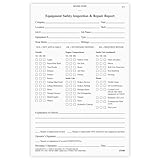
- Vehicle inspection report book helps document and report needed repairs to help maintain safe workplace utility vehicles.
- Heavy equipment inspection report contains a checklist of 36 common vehicle items and space for additional comments. Easy to use for reporting vehicle condition.
- This equipment maintenance log book set comes with 10 books. Each book contains 31 sets of forms. In total, you will receive 310 forms.
- The maintenance book is 2-ply and carbonless.
- Driver inspection books measure 5.5" x 8.5".
| Oregon program activity | Reported figure | What the figure describes |
|---|---|---|
| EAIP placements | 6,564 | Oregon Department of Consumer and Business Services, 2022 program activity. |
| Employers using EAIP | 1,386 | Oregon Department of Consumer and Business Services, 2022 program activity. |
| Workers starting PWP contracts | 339 | Oregon Department of Consumer and Business Services, 2022 program activity. |
| Injured workers found eligible for vocational assistance | 218 | Oregon Department of Consumer and Business Services, 2022 program activity. |
Oregon’s worker-facing program information gives tools, clothing, and worksite modifications as examples of support that can enable restricted work. The figures above count program activity; they do not measure technology use or prove program effectiveness.
What published return-to-work figures do—and do not—show
A U.S. Department of Labor Chief Evaluation Office report released January 1, 2019, examined federal employees in the Office of Workers’ Compensation Programs disability-management program. It reported the following outcomes for that study population:
| Reported outcome | Figure and qualification |
|---|---|
| Returned to work at some point during the disability-management program | 82% of the federal employees studied; U.S. Department of Labor, 2019. |
| Returned after 12 months in disability management | 76% of the federal employees studied; U.S. Department of Labor, 2019. |
The report notes that its return-to-work outcome excludes other disability-management resolutions that might count as successful because they reduce benefits paid. It reports associations between services and outcomes, not evidence that a particular service—or technology—caused a return to work. These results should not be generalized to all workers, employers, insurers, or technology programs.
How workers’ compensation can support a return
Depending on the state and program, workers’ compensation may provide medical and income benefits, case management, return-to-work coordination, or vocational rehabilitation. For federal employees covered by the relevant Office of Workers’ Compensation Programs process, the agency describes vocational rehabilitation this way: “The goal of vocational rehabilitation is to help you return to work as quickly as possible, to a job compatible with the work restrictions provided by your physician, with pay as close as possible to your pre-injury wages.” That statement describes the agency’s goal, not a guarantee of a particular job or wage.
PC Slower Than It Used to Be?
A free scan shows the junk files, broken settings and background clutter dragging Windows down - then fixes them in one click.Free scan · Windows 10 & 11Crashes, No Sound, or Screen Glitches?
Random freezes, missing sound and display glitches usually trace back to one bad driver. Find and replace yours safely.Free scan · under a minuteQuick Recap
Product prices and availability are accurate as of the date/time indicated and are subject to change. Any price and availability information displayed on Amazon at the time of purchase will apply.

