
Outdated Drivers Are Slowing You Down
One free scan finds every outdated or missing driver and matches the right update for your exact hardware.Free scan · exact hardware matchPC Slower Than It Used to Be?
A free scan shows the junk files, broken settings and background clutter dragging Windows down - then fixes them in one click.Free scan · Windows 10 & 11IoT automates a warehouse by connecting goods, equipment, people and operating software so that reliable data about identity, location, condition and task status can inform or trigger work. The practical starting point is not buying a robot: it is identifying a bottleneck, improving the data and connectivity around it, and choosing equipment and software that solve that problem safely. A barcode or RFID system may be the right first step; a robot fleet or private 5G network may be justified in some operations, but neither is a universal requirement.
What warehouse automation with IoT means
A connected warehouse uses sensors and identification devices to make physical activity visible to software. A scan, location update, temperature reading or machine-state signal can update inventory records, direct a task, or alert staff to an exception. Automation is therefore an operating system of connected capabilities—not a single robot purchase.
The International Telecommunication Union’s Recommendation Y.4228, approved on 29 August 2024, offers a useful industrial-IoT architecture: devices, gateways, networks, service and application support, identification facilities, and security and information protection. Applied to a warehouse, those layers connect item-level events to decisions made by the warehouse management system (WMS), warehouse-control software and human operators.
How an IoT event becomes warehouse action
- Identify or sense: A barcode or RFID reader records an item or pallet, a location beacon reports position, or a sensor measures conditions such as temperature or vibration.
- Process locally: An edge device or gateway translates protocols, filters data, buffers events if a connection drops, and can support time-sensitive local control.
- Transmit securely: Industrial Wi-Fi, wired Ethernet, or—in suitable cases—private 5G carries data between equipment and systems.
- Coordinate work: A WMS, warehouse-control system, fleet manager or connected analytics service uses events to update records, assign tasks or surface exceptions.
- Protect and govern: Device identities, access permissions, segmentation, patching, retention rules and incident response help keep systems and data controlled.
For example, an item identifier read at receiving can help reconcile an arrival against expected inventory. A later location event can help direct put-away or picking, while an exception alert can prompt a person to check a mismatch. The value depends on accurate item and location data, dependable connections and clear operating procedures—not simply on collecting more sensor data.
#1 Best Overall

- All-in-One Electronics & Coding Starter Kit: Learn the fundamentals of electronics, coding, and circuit design with the Horizon Uno board (Arduino-compatible), LEDs, sensors, and specialty components — everything you need to start building.
- Includes Step-by-Step Video Lessons: Gain lifetime access to a full online video course created by robotics engineers. Each lesson walks you through real-world projects, coding examples, and clear explanations designed for beginners. Each kit comes with a unique access code to access on our course website. The course includes lectures, labs, projects and problem sets.
- High-Quality Components for Reliable Learning: Each kit includes premium parts for accurate circuit performance — from durable resistors and sensors to jumper wires and LEDs — ensuring a frustration-free learning experience.
- Perfect for Students, Educators & Hobbyists: Ideal for classrooms, STEM programs, and self-learners. The Horizon Uno Kit makes it easy for beginners to grasp the fundamentals of electricity, coding logic, and microcontroller programming.
- Learn, Build & Innovate with Horizon Robotics Lab: Backed by an experienced team of engineers and educators, Horizon Robotics Lab is dedicated to making robotics and electronics education accessible, inspiring learners to build cool projects and bring ideas to life.
Why warehouses are investing
MIT Center for Transportation and Logistics researchers Miguel Rodríguez García and Erez Agmoni described the future warehouse in 2024 as “a highly automated, interconnected system.” Their framing reflects pressures including e-commerce growth, supply-chain disruption, labor shortages and sustainability. Deloitte likewise identifies labor constraints and disruption as important drivers; the International Society of Automation (ISA) connects automation with resilient, efficient, sustainable and safe supply chains.
The operational case is strongest when a facility has a persistent constraint that connected automation can address: excessive travel or handling, poor inventory visibility, labor-intensive counting, service-level pressure, or demand peaks that are difficult to staff. Automation.com, a trade publication, reported that more than 25% of warehouses had implemented some form of automation as of 2024. That figure is a publication-reported estimate, not a universal census or a measure of how deeply each warehouse was automated.
A 2024 study by Ericsson and Verizon with INCISIV surveyed 134 warehouse executives. In that survey, 61% reported dissatisfaction with overall network performance, and 65% said their current network could not support needs over the following 24 months. Respondents expected the share of warehouse tasks with some automation to rise from 31% to 54% within 24 months; 25% planned to invest in robotics for picking and packing within two years. Managing operating costs was a top investment driver for 78%. These are survey results and expectations, not measured outcomes across all warehouses.
Which warehouse technologies fit which jobs?
Common options include automated storage and retrieval systems (AS/RS), goods-to-person robots, autonomous mobile robots (AMRs), shuttle systems, robotic picking and packing, collaborative robots (cobots), machine vision, and conveyor or sortation automation. McKinsey’s 2023 automation analysis and ISA’s 2024 work discuss these technology families; the right choice depends on the work profile and facility, not on a generic ranking.
Rank #2

- BUILD, CODE & DRIVE YOUR OWN ROBOT CAR: Turn coding, electronics and engineering into a working programmable robot car you can assemble, program and drive; ideal for weekend family projects, STEM classrooms, coding clubs, robotics lessons and maker challenges
- EXPLORE FPV, LINE TRACKING & OBSTACLE AVOIDANCE: Control the robot with the ELEGOO app or IR remote, view live FPV video through the onboard camera, follow black lines, avoid obstacles with the ultrasonic sensor and explore multiple interactive driving modes
- BEGINNER-FRIENDLY BUILD WITH GUIDED WIRING: Keyed XH2.54 connectors help reduce wiring mistakes, while the illustrated tutorial and example programs guide beginners step by step from chassis assembly and module connection to programming and the first successful run
- GO BEYOND ASSEMBLY WITH CREATIVE CODING: Program with Arduino IDE to explore movement, sensors and control logic, then modify example code to create custom routes, reactions and robotics experiments that develop coding, problem-solving and engineering skills
- COMPLETE RECHARGEABLE STEM ROBOTICS KIT: Includes an ELEGOO UNO R3 controller board, ESP32-WROVER-based camera and Wi-Fi module, line-tracking and ultrasonic sensors, motors, IR remote and a 2000 mAh rechargeable lithium-ion battery; recommended for ages 8+ with adult guidance for first-time builders
| Technology | Typical role | Questions to resolve before choosing |
|---|---|---|
| AS/RS and shuttle systems | Automate storage and retrieval, often where density and repeatable movements matter. | Does the SKU and container profile fit? Is building height suitable? What happens during maintenance or a system outage? |
| Goods-to-person systems | Bring stored goods to a person for picking, reducing the need for the picker to travel to each location. | Can the system handle the order mix and peak volume? How will replenishment, exceptions and manual fallback work? |
| AMRs | Move inventory or materials through the facility along dynamically managed routes. | Are routes, traffic, people and charging locations manageable? How will the fleet coordinate with existing equipment? |
| Robotic picking, packing and cobots | Automate or assist repetitive handling at workstations, with the degree of human collaboration varying by design. | Can the items be reliably grasped and presented? How will the system handle irregular items, jams and human intervention? |
| Machine vision | Inspect, identify or help guide handling using camera-based perception. | Are lighting, image quality and data representative of real conditions? What is the safe response when confidence is low? |
| Conveyors and sortation | Move and route goods along fixed paths or through sorting operations. | Does volume justify fixed infrastructure? Can the layout adapt to future process or building changes? |
| Barcode and RFID identification | Capture item, package or pallet identity at receiving, movement, inventory checks and dispatch. | Are tags and readers appropriate to materials, read zones and required accuracy? Can events be reconciled with WMS records? |
Compare candidate systems against the actual task and SKU mix—case, piece, pallet or irregular item—as well as required throughput, peak elasticity, service target, storage density, clear height, integration interfaces, data quality, deployment disruption, safety validation, maintenance, fallback modes and exit options. Capital purchase and robotics-as-a-service (RaaS) also shift costs and responsibilities differently; neither model removes the need to evaluate total operating costs and contract terms.
How RFID, sensors and connected identity improve inventory visibility
Barcodes remain useful when a deliberate scan at a controlled point is sufficient. RFID can support identification without requiring the same visual scan action, subject to tag, reader, material and site conditions. In either case, an identifier is useful only when software can associate it with the correct item, location and transaction.
ITU-T’s 2025 ambient-IoT report describes devices attached to pallets and packages that transmit unique IDs and package information into warehouse systems. This can support receiving, gate-in, inventory, gate-out, and checking or loading workflows. Temperature, vibration or machine-state sensors add condition and equipment-status signals rather than replacing identity capture. For package and pallet identification, RFID inventory tags are a practical category to evaluate; a retail RFID tag should not be assumed to implement an ambient-IoT standard.
Ambient IoT is an emerging architecture, not a blanket replacement for established barcode or RFID systems. The report identifies constraints including limited harvested energy, deployment complexity, interoperability, coverage gaps and possible need for assist or charging nodes. At very large scale, energy-harvesting or battery-free devices could reduce battery replacement, but the appropriate design depends on the environment and the required read performance.
Quick wins for a faster PC:
Scan for outdated or missing drivers - takes under a minuteDriver Scan →Clear out junk files and repair common Windows errorsFree Scan →Rank #3
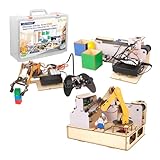
- BUILD REAL-WORLD KIT - This is a starter kit for learning electronics, programming, IoT, and smart factory automation. This kit integrates multiple practical projects such as smart robotic arms, intelligent production lines, smart warehouse, designing an automated sorting system, simulating logistics and inventory management, helps students master programming knowledge and electronic component knowledge in practical operation, and cultivates their STEAM ability and innovative thinking.
- IOT SMART FACTORY KIT - The coding kit is based on the ESP32 Internet of Things to achieve automation, wireless control and intelligent management. The kit project fully applies all sensors and modules in the kit, such as color sensor, infrared obstacle avoidance sensor, RFID, LCD 1602 module, MG90 servo, etc. With the ESP32 Max3.0 controller board, this kit has excellent flexibility and scalability, you can create as many designs as you like. Perfect for coding and robotics enthusiasts!
- PERFECT TEACHING ASSISTANT - Our STEM science kit includes 90 minutes, 16 class hours/semester teaching content to support school teaching needs. Introduced through problems, interdisciplinary, and with complete course sections and teaching materials, including electronic textbooks and ppt, to reduce the pressure of teachers. The kits are easy to build and disassemble, suitable for large class teaching.Most parent and school prefer to choose it as their programming educational courses kit.
- SAFE & DURABLE - We adopt the non-toxic wood with good conscience and quality. There is no a pungent smell with 3D Wooden Puzzles, and the details are more treated. Safe, not hurt,with good electronic parts,stable and reliable.The child is happy, the family is more assured. In addition, each product of ACEBOTT is accompanied by detailed online manual, we can safely play for your assured.
- THROUGHTFUL STARTER KIT : This Kit is ideal for kids aged 10+ as a demo in internet of things class,summer camps,science clubs,hands-on center,and generally for anything related to the STEM education. Also great for anyone that's into learning Arduino, electronic, factory automation and coding. Christmas|Chanukah|Easter| kit for aspiring engineers and adults.
Do you need private 5G?
No. Private 5G is one connectivity option, not a prerequisite for IoT or warehouse automation. Ericsson’s study positions reliable private 5G as an enabler for robotics, inventory management, order processing and communications among automated systems. Whether it is worth deploying at a particular site depends on coverage, interference, latency requirements, device density, spectrum and regulatory conditions, resilience needs and total cost.
Industrial Wi-Fi may suit many mobile devices and work zones; wired Ethernet often fits fixed equipment; and a warehouse may use a mix with resilient backhaul. Map coverage and performance requirements to each process before selecting a network. A connection that is adequate for routine inventory updates may not meet the needs of a time-sensitive control loop, so edge processing or a different network design may be appropriate for those functions.
What makes a connected warehouse architecture workable?
Devices, gateways and networks
Inventory the readers, sensors, cameras, safety devices and machine-state monitors needed for the chosen workflow. Gateways should handle the protocols in use and be designed for local filtering, buffering during outages and low-latency functions where required. Connectivity should be selected by zone and use case rather than imposed as a single answer for every device.
Operations software and integration
The WMS generally manages inventory and warehouse work; warehouse-control software coordinates equipment; fleet managers direct mobile robots; and order-management systems connect fulfillment to demand. Analytics, digital-twin services or a control tower can help expose performance and exceptions across those systems. Before buying equipment, document the interfaces, event definitions, ownership of records and recovery behavior when systems disagree or lose connection.
Recommended Free Tools
Rank #4

- Discover Engineering with a Real Robotic Arm Kit:This complete engineering kit includes motors, a micro controller, and circuit boards. As kids build and operate this robotic arm kit, they will experience how electronics control movement. It’s the perfect hands-on introduction to robotics and circuits for ages 8-12 and up, blending 3D construction with practical STEM learning
- Full 270° Motion & Multi-Axis Control:Master precise lifting, steering, and full 270° rotation with this interactive robotics for kids ages 8-12. This dynamic design turns physics and mechanical engineering principles into engaging play, sparking creativity and demonstrating how real robotic movement works
- The Perfect STEM Gift for Young Engineers:An ideal gift for birthdays, Christmas, or classroom rewards! This STEM kit appeals to boys, girls, teens, and adults—perfect for solo projects, family STEM nights, or school science programs. It delivers hours of rewarding challenge and a true sense of achievement
- Build & Learn with Challenging Wooden Construction:Assemble with natural wooden parts using clear, step-by-step instructions. This engineering kit for kids age 8-12 offers a satisfying build that sharpens problem-solving, patience, and fine motor skills. It’s a hands-on STEM kit that makes complex concepts tangible and fun
- Interactive STEM Projects for All Ages:From timed competitions to parent-child teamwork, this robotics for kids ages 12-16 turns learning into an adventure. Designed to cultivate future engineers, it’s perfect for home or school use. Inspire a lifelong passion for science and STEM kits for kids age 12-14 and beyond
Security, governance and safety
Connected equipment expands the systems that need security and operational governance. Maintain a device inventory, assign identities and access, segment networks, patch supported systems, define retention and incident-response practices, and establish responsibility across vendors. Safety validation is a separate requirement from cybersecurity: define safety zones, human override, emergency procedures and maintenance access with the people who will operate and service the equipment.
Independent reader supportYour contribution helps us test, update, and keep practical guides available for everyone.What is changing: physical AI, edge intelligence and modular automation
Physical AI in warehouse work
The World Economic Forum’s 4 September 2025 paper, Physical AI: Powering the New Age of Industrial Operations, describes “physical AI” as robotic systems capable of perception, reasoning and autonomous action, enabled by progress in hardware, AI and vision systems. It distinguishes rule-based, training-based and context-based robotics. In warehouse applications, these capabilities could support adaptive picking, route planning, exception handling and collaboration with people. They should be assessed as specific capabilities in specific deployments, not as proof that warehouses generally operate without human oversight.
Edge intelligence and network choice
As more devices and automated systems communicate, local processing can filter data and support decisions that should not depend on a distant service response. Private 5G may be one way to provide reliable connectivity for particular mobile or dense-device use cases, but Wi-Fi or wired connections can remain more appropriate elsewhere. The design should follow measured coverage, latency, device-density and cost needs.
Modular systems and service-based models
Deloitte highlights RaaS, IoT integration, safety and space optimization as part of the automation landscape. Modular cells and service-based arrangements may let an operator phase deployment rather than committing to a full-site redesign up front. Contracts should make uptime, maintenance, cybersecurity responsibilities, data ownership and exit rights explicit; subscription terms do not eliminate integration or operating risk.
Do these 3 things before closing this tab:
1Clear out junk files and repair common Windows errors2Fix the driver behind crashes, sound loss and screen glitches3Repair Windows errors before they cause bigger problemsBest Value

- Beginner-friendly: The ACEBOTT smart robot car kit is controlled by an advanced ESP32 controller board, making programming easy. Through 16 story-rich tutorials, students will systematically master the principles of programming and electronic hardware, and easily master the mysteries of the smart car. (The robot kit does not include batteries)
- Rich Expandability: ACEBOTT based on the classic omnidirectional mecanum wheel robot car kit, we have added a rich set of expansion packs that can be freely matched: camera expansion pack, robotic arm expansion pack, tank expansion pack, solar expansion pack. Whether it is App and IR remote control, photo taking, image recognition, voice recognition, tracking mode, shooting, or multi-degree-of-freedom robotic arms, etc., the STEM robot kit will satisfy your desire for exploration and unleash your creativity!
- All-round control: This ACEBOTT coding robot for kids is equipped with advanced 6cm omnidirectional Mecanum wheels, also known as omnidirectional wheels or lion wheels, which can easily achieve 360° movement in any direction, support multiple movement modes (forward, sideways, diagonal, rotation), and can complete difficult actions such as left and right drifting, and easily cross any position, including narrow bends, narrow alleys, and intricate roads.
- Multi-way Cruise & Multi-direction Obstacle Avoidance: Accurate multi-way cruise allows the rc control car to easily plan the path and realize autonomous navigation; multi-direction obstacle avoidance allows flexible response in the face of obstacles; the new follow mode allows the car to always follow your steps.
- IR remote Control and App Control: Allows children to control this robotics kit through the IR remote control and App, make you enjoy the fun and convenience of intelligent technology. Simply master all the actions of the car with just one touch.
People, safety and sustainability belong in the business case
Automation changes job content and warehouse design as well as equipment. ISA emphasizes that people and automation technologies need to work together. Arup’s 2024 research, drawing on interviews with developers, operators and other stakeholders, examines worker attraction and retention alongside the relationship between automation and employment.
Plan for ergonomic redesign, role-specific training, safety zoning, human override, maintenance access and worker participation. Measure effects on job quality and safe work as well as throughput. Sustainability also requires site-specific accounting: include energy use, battery lifecycle, building changes and reverse logistics in the business case rather than assuming that automation is inherently more sustainable.
A practical sequence for implementing warehouse IoT automation
- Baseline the operation. Measure travel time, handling touches, pick errors, stockouts, downtime, injuries, energy use and peak demand. Define the time period and process boundaries so later comparisons are meaningful.
- Choose the bottleneck and target. Set a measurable objective before selecting equipment—for example, reducing a specified source of travel or improving visibility at a defined inventory checkpoint.
- Prepare data and interfaces. Clean item, location and order records, then document WMS and control-system interfaces, data ownership and exception handling.
- Pilot one bounded process. Select a limited workflow with a rollback path, operational owner and human safety review. Avoid making a pilot depend on assumptions that have not been validated at the site.
- Instrument results and failure modes. Capture the same baseline measures alongside system availability, exceptions, manual interventions and recovery time so the pilot shows both benefits and operational limits.
- Expand in modules. Scale only with adequate network capacity, cybersecurity controls, maintenance coverage and worker training. Preserve safe fallback procedures as equipment and processes change.
- Reassess the architecture. Review emerging ambient-IoT tags, physical-AI capabilities and connectivity options against proven site needs as they mature.
Why automation projects miss their goals
McKinsey reports that projects can fail when leadership lacks a cohesive vision or understanding of the technology, or when organizational beliefs and principles are misaligned. Gartner’s 2024 research emphasizes roadmap decisions, process and organizational change, supply-chain data governance, AI-enabled vision, integration services and traceability. Taken together, these findings point to a common risk: installing equipment without changing the data, processes, responsibilities and exception paths around it.
Scenario evaluation, a centralized control tower for exceptions, disciplined procurement and contracting, and proactive risk management can help align an investment with operating needs. Compare vendors on interoperability and exit options as well as throughput claims. Require clarity on system interfaces, safety responsibilities, maintenance, uptime, data ownership and what happens when a component is unavailable. No general figure establishes the return for a given facility; benefits and costs need to be measured against its baseline and operating conditions.
Quick Recap
Product prices and availability are accurate as of the date/time indicated and are subject to change. Any price and availability information displayed on Amazon at the time of purchase will apply.

