
The Tool Desk
Outbyte PC Repair FREERepair Windows errors before they cause bigger problemsFix Now →Outbyte Driver Updater FREEScan for outdated or missing drivers - takes under a minuteDriver Scan →Saturn reaches opposition on October 4, 2026, at 8 a.m. EDT. Earth will be between the Sun and Saturn, so the planet appears opposite the Sun in our sky: it rises around sunset, stays up through much of the night and is especially well placed for evening observing. The week’s other standout event is the Moon’s close encounter with Jupiter on October 6, which becomes an occultation only for observers in parts of North America.
When and where to see Saturn at its best
Opposition is a moment in Saturn’s orbit, not a single viewing window. On October 4, Saturn is in Cetus, below the Great Square of Pegasus as it rises. The Astronomy.com guide reports it at magnitude 0.3 that night; it rises around sunset and sets around sunrise, with its highest point around local midnight in the guide’s observing context. Your exact rise time, altitude and best viewing time depend on your location. NASA’s October skywatching guide likewise highlights opposition as one of the year’s best opportunities to see Saturn (NASA Science, October 1, 2026; Astronomy.com, October 2, 2026).
For a practical session, look after twilight when Saturn is above the horizon and give it time to climb higher; viewing through less atmosphere generally makes detail easier to discern. A clear, steady sky matters more for fine planetary detail than trying to observe at the exact instant of opposition.
What you can see
- Naked eye: Saturn looks like a bright point of light. You do not need equipment to find it.
- Binoculars: They can help you locate Saturn within a wider sky field, but they are not a way to resolve its rings.
- Telescope: A telescope is the direct choice for seeing the rings. Astronomy.com’s October 4 guide gives Saturn’s disk as about 20 arcseconds across and the rings nearly 45 arcseconds end to end. Those are date-specific apparent sizes, not equipment specifications.
The guide also places Titan around mid-8th magnitude, with Tethys, Rhea and Dione around magnitude 10. These are much fainter than Saturn and are not guaranteed sights in every telescope or under every sky; visibility depends on the instrument, observing conditions and experience. Saturn’s moons change position over the course of the night, so consult a current sky map or planetarium tool for their positions at your observing time.
Recommended Free Tools
#1 Best Overall

- 【Excellent Optics】Astronomical telescope features 80mm aperture 600mm(f/6.7) focal length-The big aperture can capture more light; high transmission multi-fully coated optical lens can improve light transmittance, reduce the reflection of light. It will bring you more bright and clear images.
- 【Portable & Stable】Our refractor telescope has a backbag, an adjustable aluminum tripod and an upgraded phone adapter. All accessories can be packed into the bag, which is convenient for you to carry and storage for traveling. The tripod is stable and the height can adjust from 17.7" to 52", which is suitable for adults and kids. With the phone adapter, you can take amazing photos through your phone.
- 【Easy to Operate】 This telescope is easy to assemble even for astronomy beginners and kids. You can set up easily with the detail installation manual and video. No tools are required. It’s a great astronomy gift telescope for adults, astronomy enthusiasts, beginners and kids 8-12.
- 【Optimum Magnification】Our telescope for kids and adults is equipped with two replaceable excellent-quality eyepiecesa (20mm and 9mm) for 30X and 66X magnification. A moon filter transmits only 13 percent of the incoming light and improving contrast. Also with 5x24 finderscope, you can locate objects easily. A great option for astronomy lovers to explore the moon, Saturn and Jupiter.
- 【Satisfaction Service】We provide 3 years satisfaction service. If you have any questions about the product and service, please feel free to contact us to get 24-hour technical support from our expert team. Whether observing moon or viewing planets, our telescope can meet your all needs. It’s a great telescope for adults & 8-12 kids & astronomy beginners.
Will the Moon cover Jupiter on October 6?
On October 6, the Moon passes 0.2° north of Jupiter at 6 a.m. EDT and covers it for observers along only part of its path. Astronomy.com’s visibility map includes much of the eastern and central United States and parts of southern Canada; some other locations have a reappearance-only or grazing view. In parts of the western United States and eastern Mexico, Jupiter may rise after it has disappeared behind the Moon, leaving only the reappearance visible.
The guide estimates the event begins around 4:15–4:20 a.m. EDT in the eastern United States and ends roughly an hour later. Those approximate times are not universal: the disappearance and reappearance times, and whether the event is visible at all, vary by location. Check a location-specific occultation prediction before setting an alarm. The event occurs near dawn in many areas, so a clear horizon and a suitably dark sky will help. See the Astronomy.com guide and its visibility map for the event’s regional footprint.
Rank #2
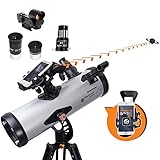
- SMARTPHONE-POWERED SKY TOUR: No experience needed! Just dock your phone, launch the StarSense Explorer app, and follow the on-screen arrows to locate stars, planets, nebulae, and more.
- PATENTED STARSENSE TECHNOLOGY: Unlike other astronomy apps, StarSense Explorer uses sky recognition technology to turn your phone into a celestial navigation system, analyzing star patterns overhead to pinpoint your telescope’s position.
- TONIGHT’S BEST TARGETS, INSTANTLY: The app generates a curated list of the top objects to see based on your time and location. See planets, bright nebulae, galaxies, and star clusters from the city—and even more from dark skies.
- SIMPLE SETUP, SMOOTH TRACKING: Features a manual altazimuth mount with altitude slow motion adjustment with a sliding rod. Follow the on-screen arrows to your target; when the bullseye turns green, you can view it clearly through the eyepiece.
- 114MM REFLECTOR WITH IMPRESSIVE VIEWS: The 4.5" Newtonian reflector with high-reflectivity coatings delivers sharp, vivid views of the Moon, planets like Jupiter and Saturn, and deep-sky favorites like the Orion Nebula and Andromeda Galaxy.
Other sky events, October 2–9
The times below retain their stated time zones and geographic context. In Astronomy.com’s daily observing table, sunrise, sunset, Moonrise, Moonset and illumination refer to 40° N, 90° W; illumination is given at 10 p.m. local time there. Planet positions, visibility and observing circumstances change with location.
| Date | What to look for |
|---|---|
| Friday, October 2 | Venus is stationary at 10 a.m. EDT. At the guide’s reference location (40° N, 90° W), Venus and Mercury are extremely low after sunset: 20 minutes after sunset, Venus is about 2° high at magnitude −4.8 and Mercury about 4° high at magnitude −0.1. These are location-specific figures, and the planets may be difficult to pick out so close to the horizon. After twilight, look for the Teapot asterism in Sagittarius. The Moon is listed at 55% illumination at 10 p.m. local time at the reference location. |
| Saturday, October 3 | The Last Quarter Moon is exact at 9:25 a.m. EDT. Shortly after 11:40 p.m. EDT, Saturn’s moon Dione begins a roughly 90-minute transit across the planet; its shadow is expected to be very difficult to see visually. At the guide’s stated observing moment, Tethys and Rhea lie west of Saturn and Titan east of it. |
| Sunday, October 4 | Saturn reaches opposition at 8 a.m. EDT. The guide places it in Cetus at magnitude 0.3, rising around sunset and setting around sunrise. Its moons shift position through the night; Tethys emerges from occultation around 8:20 p.m. EDT, and the guide describes a later overnight passage involving Rhea. |
| Monday, October 5 | The Moon passes 1.2° north of Mars at 2 a.m. EDT. It also crosses near the Beehive Cluster and may occult some of its stars, depending on your location. Mercury and Venus remain very low at dusk. |
| Tuesday, October 6 | The Moon passes 0.2° north of Jupiter at 6 a.m. EDT. From some locations it occults Jupiter; see the location-specific guidance above. |
| Wednesday, October 7 | Titan is listed less than one arcminute from Saturn early in the evening. This is a date-specific separation; the positions of Titan and Saturn’s fainter moons change quickly. |
| Thursday, October 8 | The guide lists a 3% waning crescent at its reference location. It also suggests 2 Pallas in Cetus as a faint target for binoculars or a telescope. |
| Friday, October 9 | The guide lists New Moon at its reference location, making this a transition to darker evening skies. It suggests globular cluster M30 in Capricornus for binoculars or a small telescope. |
Choose equipment for the view you want
No special equipment is needed to spot bright planets or the Moon. Choose based on the detail you want rather than assuming one instrument does everything.
Quick wins for a faster PC:
Scan for outdated or missing drivers - takes under a minuteDriver Scan →Repair Windows errors before they cause bigger problemsFix Now →Fix the driver behind crashes, sound loss and screen glitchesFind Drivers →Rank #3

- Superior Optics: 400mm(f/5.7) focal length and 70mm aperture, fully coated optics glass lens with high transmission coatings creates stunning images and protect your eyes. Perfect full positive telescope for astronomers to explore stars and moon.
- Magnification: Come with two replaceable eyepieces and one 3x Barlow lens.3x Barlow lens trebles the magnifying power of each eyepiece. 5x24 finder scope with mounting bracket and cross-hair lines inside make locating objects easily.
- Wireless Remote: This refractor telescope includes one smart phone adapter and one Wireless camera remote to explore the nature of the world easily through the screen and take amazing celestial images.
- Adjustable Tripod: This telescope allows for many different viewing positions with a adjustable aluminum alloy tripod and a carry bag, the telescope and tripod can fit inside the bag for easy traveling and storage.
- Satisfaction: Buy with confidence from a leading manufacturer.
- Recognize planets and follow the Moon: Start with your unaided eyes. A sky map or planetarium app can help translate a sky guide to your time and location.
- Scan wider fields: Binoculars are useful for locating objects and viewing broader groupings, but do not expect them to show Saturn’s rings as distinct rings.
- See Saturn’s rings: Use a telescope. The ability to detect faint moons such as Tethys, Rhea or Dione depends on optical capability and sky conditions; the guide does not establish a guaranteed telescope size for them.
For more general context on observing with the unaided eye, binoculars and telescopes, see Space.com’s October 2026 night-sky guide.
Quick Recap
Best Value

- Outstanding Optical Performance: The eyepiece features a large 90mm optical glass, allowing for greater light transmission and brighter imaging. Combined with double ED glass and FMC broadband coating technology, the colors are more authentic with minimal chromatic aberration, ensuring the brightness, clarity, and authenticity of images.
- Deep Space Observation Powerhouse: With a 90mm aperture, 600mm focal length, and a focal ratio of 6.5, this scope is specially designed for observing planets and deep-sky nebulae. From the lunar craters to Saturn's rings, Jupiter's cloud bands, and Mars' craters, you can explore them all. The optical finderscope installs and aligns easily,even beginners can easily locate celestial bodies. The professional optical design meets the needs of astronomers and photographers alike.
- Dual-purpose for sky and land: Equipped with an erecting prism for easy astronomical and terrestrial viewing, ensuring upright images with no inversion issues. Even at a distance of 3 km, text, birds, and landscapes remain clear. Includes a phone adapter for effortless photography of both celestial and terrestrial views.
- Stable Viewing Experience: The metal AZ mount is easy to install and fully adjustable in 360 degrees, accommodating any viewing angle. Equipped with a heavy-duty stainless steel tripod, it's both stable and anti-vibration, perfect for extended stargazing and photography sessions. Adjustable height is suitable for users of varying heights.
- Flexible Magnification and Portable Design: Achieve a wide magnification range from 28x to 350x using eyepieces and a Barlow lens. The lightweight design, weighing only 6KG, It comes with a portable carrying case for easy transport.It’s easy to set up and use, making it very beginner-friendly.With a 1-year warranty and 24/7 customer support, you can enjoy worry-free use.
Rank #4
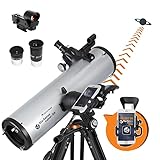
- SMARTPHONE-POWERED SKY TOUR: No experience needed! Just dock your phone, launch the StarSense Explorer app, and follow the on-screen arrows to locate stars, planets, nebulae, and more.
- PATENTED STARSENSE TECHNOLOGY: Unlike other astronomy apps, StarSense Explorer uses sky recognition technology to turn your phone into a celestial navigation system, analyzing star patterns overhead to pinpoint your telescope’s position.
- TONIGHT’S BEST TARGETS, INSTANTLY: The app generates a curated list of the top objects to see based on your time and location. See planets, bright nebulae, galaxies, and star clusters from the city—and even more from dark skies.
- SIMPLE SETUP, SMOOTH TRACKING: Features a manual altazimuth mount with dual-axis slow-motion controls. Follow the on-screen arrows to your target; when the bullseye turns green, you can view it clearly through the eyepiece.
- 130MM REFLECTOR WITH IMPRESSIVE VIEWS: The 5" Newtonian reflector with high-reflectivity coatings delivers sharp, vivid views of the Moon, planets like Jupiter and Saturn, and deep-sky favorites like the Orion Nebula and Andromeda Galaxy.
Product prices and availability are accurate as of the date/time indicated and are subject to change. Any price and availability information displayed on Amazon at the time of purchase will apply.

