
On April 8, 2024, NASA’s Deep Space Optical Communications experiment sent duplicated engineering data from the Psyche spacecraft to Earth across more than 140 million miles (226 million kilometers), at a peak rate of 25 megabits per second. It was a major DSOC milestone—not the experiment’s final distance record, and not a replacement for Psyche’s operational radio communications.
What NASA transmitted across 140 million miles
The April 8, 2024, downlink carried about 10 minutes of duplicated spacecraft engineering data. The distance was roughly 1.5 times the average distance between Earth and the Sun. NASA’s Jet Propulsion Laboratory described the test as a demonstration that optical communications could interface with a spacecraft’s radio-frequency communications system. NASA JPL’s account of the milestone.
The maximum rate on this particular 140-million-mile link was 25 Mbps. That is a peak measured during the demonstration, not a constant rate guaranteed throughout every pass or at every distance.
How the DSOC laser link worked
Deep Space Optical Communications (DSOC) is an experimental communications payload attached to NASA’s Psyche spacecraft. A near-infrared laser transceiver on the spacecraft sent signals to optical receiving infrastructure on Earth. For the April data transfer, DSOC connected with Psyche’s radio-frequency transmitter and downlinked a copy of engineering data. Psyche’s operational mission communications continued to use radio systems.
Outdated Drivers Are Slowing You Down
One free scan finds every outdated or missing driver and matches the right update for your exact hardware.Free scan · exact hardware matchWindows Errors? Fix Them Before They Spread
Repair common Windows errors and clear accumulated junk for a smoother, more stable PC - no reinstall needed.Free scan · no reinstall#1 Best Overall
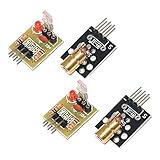
- Operating voltage: 5V
- Source wavelength: 650 nm
- Apply to: for Arduino AVR
- Model: 1*Laser Receiver Sensor Module+ 1* KY-008 Laser Transmitter Module
- Laser Receiver Sensor Module uses the non modulated laser receiver, please use in the room where without the light, the sunlight or other lamps and lanterns will interfere, suggested in the dark environment use.
In other words, DSOC tested a new way to move data over deep-space distances while flying on a spacecraft whose regular communications system remained in use. It was not a consumer internet connection or a live broadband service.
Why the 25 Mbps figure needs context
DSOC’s headline rates varied across demonstrations because the tests happened at different distances and under different conditions. An earlier test sent a 15-second, preloaded ultra-high-definition video from 19 million miles away at a maximum 267 Mbps. The video showed what the technology could do; it was not a live video call from deep space. NASA’s report on the video test.
Rank #2

- Output power: 5mW
- Wavelength: 650nm
- Working Voltage: 5V
| DSOC milestone | Distance | Reported result |
|---|---|---|
| Earlier video test | 19 million miles | Maximum 267 Mbps; a 15-second preloaded video |
| Engineering-data downlink, April 8, 2024 | More than 140 million miles (226 million kilometers) | Maximum 25 Mbps; about 10 minutes of duplicated data |
| Later downlink, December 3, 2024 | 307 million miles (494 million kilometers) | NASA reported a DSOC downlink at this distance |
The figures describe separate demonstrations, not a controlled comparison of speed at identical distances. The April 140-million-mile event was a record-breaking milestone at the time, but NASA later reported a downlink from 307 million miles—farther than the average distance between Earth and Mars. NASA’s later DSOC distance report.
Independent reader supportYour contribution helps us test, update, and keep practical guides available for everyone.How laser communications compare with deep-space radio
NASA designed DSOC to pursue data rates 10 to 100 times higher than those of comparable state-of-the-art deep-space radio-frequency systems. That is a program target and broad comparison, not a claim that every laser transmission will be 10 to 100 times faster than every radio link. NASA JPL’s DSOC overview.
Recommended Free Tools
Rank #3

- Working voltage: 5V; Wave length: 650nm; Output power: 5mW; Shape of the laser light: Dot; Outer diameter: 6mm /0.24Inches.
- The laser head consists of a luminescent tube core, a condenser lens and a copper adjustable sleeve. The three parts have been assembled, the focal length of the lens has been adjusted, and the lens has been glued together with strong glue. The user can connect the 3.3V DC power supply to work.
- Made of high quality material,Durable, long service life.
- Low power consumption,simple driving circuit,convenient modulation, resistance to mechanical shock and vibration.
- Application: Level instrument, Ground instrument, Long distance laser listener remote light control, Long distance laser wireless communication
Higher throughput could let spacecraft send larger volumes of science data, higher-resolution images, and high-definition video. NASA has also identified the technology as potentially useful for future human missions to Mars. The practical performance of an optical link depends on the complete communications system and conditions including precise pointing and tracking and the ground link’s atmospheric path. NASA’s cited demonstrations establish the data-rate ambition, but do not provide a complete numerical, apples-to-apples comparison across link precision, weather sensitivity, spacecraft mass, power, aperture, and operational maturity.
Quick Recap
Rank #4

- Integrated Design: This 650nm red dot laser module, laser head boasts durability. Its integrated aspherical lens, laser diode, and APC (Auto-Power-Control) driver circuit delivers consistent, Class 3R, less than 2.5mW (Class IIIa, <2.5mW), 2.6~6 VDC.
- Versatile Use Across Industries: Suitable for multi-industry applications, including positioning, measuring, laser sighting, and pointing. With cost-effective specifications, it is well-suited for a wide range of industries, including wood, metal, stone processing, textiles, food, automotive, and medical sciences.
- Energy-Efficient & Indoor-Optimized: This 650nm red laser delivers key advantages - lower cost, reduced power consumption, and easier manufacturing. Ideal for battery-powered devices, it ensures reliable performance in low-light/indoor environments despite being less visible than green lasers.
- Delivering a 650nm wavelength with a beam divergence (Full angle) of 0.6 mRad, this laser module produces a concentrated, oval beam that ensures alignment and reliable visibility for various applications. Mean Time to Failure (MTTF): 5,000 hours at 77°F (25°C)
- Compact, Economical, and Ready for Integration: Measuring just D7×L21mm (D0.276 x L0.827 inches), this economical solution integrates optics, diode, and driver circuit into a compact package. Please note: the module requires wiring to an external power source (not included) for proper operation.
What the milestone does—and does not—show
- It shows: an optical communications payload on Psyche could deliver duplicated engineering data to Earth over a distance exceeding 140 million miles and interface with the spacecraft’s radio system.
- It does not show: that Psyche switched its routine mission communications to lasers, that 25 Mbps is a sustained rate at all distances, or that the demonstration was an internet service.
- It does not set DSOC’s final distance record: NASA later reported a downlink from 307 million miles on December 3, 2024.
Product prices and availability are accurate as of the date/time indicated and are subject to change. Any price and availability information displayed on Amazon at the time of purchase will apply.

