
A digital signal processor (DSP) is a programmable processor designed to carry out repeated arithmetic on digitized signals at a dependable rate. It is used for workloads such as audio filtering, wireless communications, radar processing, and real-time control. A dedicated DSP is not always necessary: a general-purpose CPU or microcontroller with DSP instructions, or an FPGA or heterogeneous system-on-chip, may be a better fit depending on the workload, timing, power, and development constraints.
What is a digital signal processor?
A DSP processes samples produced when an analog signal—such as sound, temperature, pressure, or position—is converted into digital values. Its program applies mathematical operations to those samples to filter noise, detect patterns, change frequencies, compress data, or estimate the signal’s properties. The results may be sent to another system or converted back into an analog signal.
A typical signal path is sensor or input → analog front end and analog-to-digital converter (ADC) → processor and memory → output interface or digital-to-analog converter (DAC). Not every application needs both converters: a DSP may receive digital samples over a communications link or pass its results to another digital subsystem.
The central challenge is not just performing arithmetic. Samples must be moved into and out of memory, processed quickly enough to meet the application’s deadlines, and handled without unacceptable delay. A DSP’s value is its ability to sustain the required calculations and data movement predictably.
#1 Best Overall

- Advanced ADAU1467 DSP core for superior processing capabilities.
- Compact design suitable for embedded systems and applications.
- Supports various formats and provides sound output.
- Ideal for developers and engineers seeking to enhance projects.
- Easy integration with existing systems and various devices.
How does a DSP differ from a CPU or microcontroller?
A CPU is built to handle a broad range of software and system tasks. A microcontroller (MCU) combines a processor with memory and peripherals for embedded control. A DSP is specialized around recurring mathematical workloads and the data-access patterns common in signal processing. These are design tendencies, not rigid categories: modern CPUs and MCUs can include DSP or vector instructions, and modern DSPs may also provide general-purpose control features.
| Processor approach | Typical strength | What to check for signal-processing work |
|---|---|---|
| General-purpose CPU | Flexible software execution and broad system support. | Whether its SIMD/vector instructions and memory bandwidth can meet the workload’s throughput and worst-case latency. |
| Microcontroller | Embedded control with integrated memory and peripherals. | Whether its arithmetic capabilities, memory, I/O, and real-time behavior are sufficient; some MCUs include DSP extensions. |
| Dedicated DSP | Efficient execution of repeated signal-processing operations and associated data movement. | Whether its numerical format, interfaces, performance, tools, and software ecosystem suit the application. |
Traditional DSP engines may include fast multipliers and accumulators, extended-precision arithmetic, barrel shifters, dual address generators, and efficient instruction sequencing. Some use separate program and data memories, a pattern associated with Harvard architecture. Specialized address generation can help with patterns used in algorithms such as fast Fourier transforms (FFTs). These features can reduce the work needed to keep a signal-processing pipeline running, but the advantage depends on the actual algorithm and implementation.
Rank #2

- Complete ADAU1401 Single-Chip Module: Built around the ADAU1401 with embedded 28 / 56-bit processing, analog-to-digital and digital-to-analog conversion, microcontroller-style control interfaces — all on compact board for quick prototyping
- Self-Booting from Onboard Storage: The module loads its program independently from onboard non-volatile storage at power-up and can save current parameters back to storage on shutdown, eliminating the need for an external main controller in standalone setups
- Expandable via I2C and 4-Wire Ports: All function ports are out, including digital I2S input / output, push-button inputs, drive, auxiliary analog inputs for volume controls, and rotary — letting users extend the board as needed
- 98.5 Dynamic Range for Clear Sound Output: Two analog input channels and four output channels deliver 98.5 of analog-to-analog dynamic range, with digital input and output ports for linking additional conversion in the chain
- Stable Across Wide Temperature Range: for a working span from minus 40 to 105 degrees Celsius, this board suits both casual desktop use and more demanding environments where temperature stability is important
What happens inside a DSP?
Many signal-processing algorithms repeatedly multiply values and add the products to a running result. A multiply-accumulate (MAC) operation is one example: it is used extensively in digital filters and other numerical workloads. DSP architectures may provide MAC units, accumulators, and specialized address generators so the processor can perform these calculations while fetching the next data efficiently.
Other useful capabilities include SIMD or vector instructions, which apply one instruction to multiple data elements, and predictable data movement between memory and compute units. Program and data memory organization, memory bandwidth, and the ability to meet timing deadlines can matter as much as a processor’s headline arithmetic capability. An algorithm that cannot get samples to its compute units quickly enough may fail to deliver the expected throughput.
Rank #3
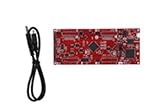
- DEVELOPMENT PLATFORM: Texas Instruments C2000 MCU F280025C LaunchPad development kit for rapid prototyping and evaluation
- CONNECTIVITY: Features USB connection cable for programming, debugging, and power supply
- PROCESSOR: Built around the F280025C microcontroller, ideal for real-time control applications and digital signal processing
- DESIGN FEATURES: Red PCB board with comprehensive development capabilities and expansion headers for additional functionality
- COMPATIBILITY: Supports TI's development ecosystem with Code Composer Studio and other programming tools
DSPs can use fixed-point or floating-point arithmetic. Fixed point can be efficient when signal ranges are controlled and scaling is understood. Floating point offers a wider dynamic range and can simplify some algorithm implementations, including workloads such as audio or instrumentation. Neither is universally preferable: the decision depends on performance and power needs, numerical accuracy, and how thoroughly the implementation can be verified.
Where are DSPs used?
- Audio and speech: Equalization, filtering, echo cancellation, noise reduction, codecs, and voice interfaces.
- Wireless communications: Channel equalization, error-correction decoding, and OFDM modulation and demodulation.
- Radar and sonar: Matched filtering, pulse compression, Doppler processing, and extracting target parameters.
- Medical imaging: FFT-based reconstruction in systems such as MRI and CT scanners.
- Control and sensing: Real-time filtering and estimation, motor and industrial control, and sensor-hub processing.
- Embedded vision and machine learning: Feature extraction, transforms, and other front-end processing before or alongside a machine-learning accelerator.
Do you need a dedicated DSP?
Not necessarily. A CPU with DSP extensions can combine signal processing and control code on one processor, potentially simplifying system design. Arm’s DSP extensions, including Neon and Helium, are examples of SIMD/vector capabilities aimed at signal-processing workloads. An FPGA can provide configurable DSP engines, while a heterogeneous SoC can combine processor cores, vector units, accelerators, and high-speed I/O.
Rank #4

- Fully programmable ADAU1467 DSP core board with 32-bit and 64-bit processing capabilities, ideal for multimedia and applications.
- User-friendly SigmaStudio software allows for drag-and-drop system creation without coding, enabling easy development of custom processing systems.
- Supports various applications including digital frequency dividers, mixers, and equalizers, making it perfect for professional setups.
- Includes multiple interfaces such as , SPI, and IIC for seamless integration and real-time tuning, ensuring optimal performance in any project.
- Comes with comprehensive documentation including schematics, PCB size charts, and application routines to facilitate easy implementation and .
These alternatives exchange different amounts of integration, flexibility, power, and software effort. A dedicated DSP may be attractive when its architecture and toolchain closely match the workload. A CPU or MCU with suitable instructions may be preferable when its capacity is sufficient and combining functions matters. FPGA or heterogeneous designs may suit systems that need configurable or specialized processing, but they must be evaluated as complete systems rather than by arithmetic capability alone.
| Implementation | Potential fit | Main trade-off to assess |
|---|---|---|
| Dedicated DSP | Repeated signal-processing work with demanding throughput or timing requirements. | Whether its architecture, peripherals, libraries, and development environment fit the product. |
| CPU or MCU with DSP extensions | Signal processing that can share a processor with application or control code. | Whether real-time performance, memory bandwidth, and power remain adequate under the full software load. |
| FPGA DSP engines | Workloads that benefit from configurable processing structures or integrated programmable logic. | Whether the implementation effort and system design are justified by the workload’s requirements. |
| Heterogeneous SoC or accelerator-based design | Systems that divide work among CPUs, vector units, DSPs, or dedicated accelerators. | Whether data movement, software partitioning, and integration complexity are manageable. |
How should you choose a DSP or signal-processing platform?
Start with the algorithm and the system requirements, not a processor-family label. Estimate the workload using representative data and the intended operating conditions, then verify timing and numerical behavior on the candidate platform.
Quick wins for a faster PC:
Scan for outdated or missing drivers - takes under a minuteDriver Scan →Repair Windows errors before they cause bigger problemsFix Now →Best Value

- Multi-Channel Signal Acquisition Based on ADS1299 for high-resolution raw signal data collection and analysis.
- WiFi UART Wireless Communication Supports stable wireless serial data transmission for development and testing.
- Complete Development Resources Includes SDK package, communication protocol, and PC software source code.
- Open Hardware Design Provides schematic files and supports secondary development and customization.
- STM32 Development Kit Supports rapid integration with STM32 platforms and embedded applications.
- Define the workload. Identify the operations to be performed, sample rates, channels, data formats, and how often results must be produced.
- Set the timing target. Determine sustained throughput and the worst-case latency the system can tolerate. Check whether execution time remains predictable when other software and I/O are active.
- Choose and validate precision. Compare fixed-point and floating-point implementations against accuracy, scaling, and verification requirements rather than assuming one is always faster or better.
- Check memory and data movement. Evaluate on-chip SRAM or cache, memory bandwidth, buffers, and the path between interfaces and compute units. Account for the effect of data transfers on latency and throughput.
- Match the I/O and acceleration. Confirm the required ADC/DAC, serial, network, and other interfaces are available, and determine whether SIMD/vector instructions or dedicated accelerators are useful for the algorithm.
- Evaluate the software environment. Compare compiler and IDE support, signal-processing libraries, RTOS compatibility, debugging, and the effort needed to port and maintain the code.
- Account for product constraints. Check power and thermal limits, security and safety needs, package, expected product lifetime, and total development cost.
- Benchmark the complete design. Measure representative end-to-end processing, including I/O and memory transfers, against the required latency, throughput, and power limits before committing to a platform.
Examples of DSP implementations
Texas Instruments’ C7000 is a VLIW DSP architecture with wide vector instructions and multiple functional units. TI’s optimization guide documents SIMD instructions capable of performing up to 64 operations in one instruction; the exact count depends on the data type and C7000 CPU version, so it is not a general measure of application throughput.
AMD’s Versal DSP engine illustrates DSP functionality integrated into an FPGA/SoC design. The 2026 technical-reference revision describes a DSP58 engine with a dedicated 27 × 24-bit multiplier and a 58-bit accumulator, as well as SIMD add/subtract/accumulate, single-precision floating-point accumulation, and INT8 dot-product modes. These are architectural capabilities, not a cross-platform performance comparison.
For an exact processor example, Texas Instruments maintains product and datasheet resources for the TMS320C6747, a fixed- and floating-point DSP. Analog Devices’ educational guide names its SHARC and Blackfin families as options for DSP designs. The right part or family still depends on the application’s interfaces, timing, memory, tools, and lifecycle requirements.
What do DSP performance figures actually tell you?
Historical and architectural figures need context. IEEE Technology Navigator reports that Texas Instruments’ TMS32010, introduced in 1982, performed 5 million multiply-accumulate operations per second and helped establish the Harvard-architecture pattern of separate program and data memories. That figure describes a historical processor, not current DSP performance.
Likewise, an instruction-level operation count or the presence of a particular multiplier does not by itself establish how quickly a product will run an application. Results depend on the algorithm, data type, processor version, memory and I/O behavior, software, and operating conditions. Compare candidates using representative end-to-end workloads rather than treating a single specification as a universal ranking.
Quick Recap
Product prices and availability are accurate as of the date/time indicated and are subject to change. Any price and availability information displayed on Amazon at the time of purchase will apply.

