
The personal computer did not simply replace the typewriter in one leap. It inherited the typewriter’s keyboard and the office work built around producing documents, then added electronic display, editable storage, software and networking. Electric and electronic typewriters, magnetic tape, TV displays and floppy disks formed the bridge between the two.
Why the typewriter mattered to the modern office
Before typewriters became practical, offices depended on handwritten documents. A typewriter made text more consistent and legible, and once machines became fast enough, typing could rival handwriting for speed. Early designs were held back in part because they could not yet deliver that practical combination of speed and usability.
Christopher Latham Sholes developed the design that led to the Remington typewriter between 1867 and 1874; Remington began selling the machines in 1874. The keyboard layout that emerged from this era became QWERTY. One account links the arrangement to reducing type-bar collisions, and the layout persists on computer keyboards today.
The typewriter also changed who did office work. Typing schools trained people for clerical jobs, and demand for typists helped expand office employment for women. A historical account reports that the 1900 U.S. census counted 112,000 typists and stenographers, 86,000 of them women. These figures are reported in the historical narrative, which does not identify a separate statistical publication date.
#1 Best Overall
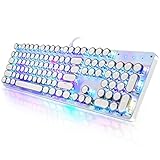
- 【Retro Typewriter Style Keyboard】: Merges the charm of vintage typewriters with advanced mechanical blue switches for medium resistance, clear click sounds, and tactile feedback, offering a unique and comfortable typing experience.
- 【 RGB Lighting】: Features multi RGB colors backlight modes and adjustable sidelights, enabling brightness and speed customization for immersive gaming or mood lighting in any setting
- 【Comfortable Typing Experience】 Enjoy a responsive and lag-free typing experience with our gaming keyboard featuring classic switches that provide satisfying tactile feedback with each keystroke. The stepped layout offers an ergonomic angle and concave keycap design for comfortable typing. Advanced anti-ghosting technology allows all 104 keys to work simultaneously, ensuring fast typing response.
- 【26Key Anti-Ghosting for Peak Responsiveness】: With 26 keys anti-ghosting, ensures every keystroke is registered during intense gaming or fast typing, for flawless performance.
- 【Powerful Compatibility 】 Our keyboard is compatible with Win XP, Vista, Win7, Win8, Win10A, Android, Linux, Mac, etc. It is a plug-and-play device that can be directly plugged into a computer's USB port for easy use. We provide a comprehensive after-sales system to ensure your satisfaction with our product.
How typewriters evolved into document-processing systems
Visible typing and mass adoption
The Underwood No. 1, designed by Franz Xavier Wagner, was commercially marketed in 1895 as a modern visible-type machine. Underwood’s No. 5, introduced in 1901, sold in the millions over the following three decades. The Digital Media Handbook reports that Underwood produced 200 typewriters per week during the model’s first three years; the accessed excerpt does not state the handbook’s publication year.
Electric power, memory and electronic text
Electric typewriters remained common through the 1960s and 1970s. Electronic models added the ability to memorize text, making it possible to revise or reproduce material without treating every typed page as a one-off original. In parallel, experiments with magnetic tape and TV displays, followed by floppy disks and word-processing software, made it practical to create and edit documents as digital information.
Rank #2

- Retro Typewriter Style Round Keycaps: Mechanical blue switch offers a quicker and springier response, crisp click sound, precise tactile feedback for ultimate gaming performance. Double-shot injection molded vintage steampunk round keycaps for clear backlight and extreme durability. The stepped floating keycap fit your fingertips perfectly for precise positioning, prevent fatigue and wrong typing. Comes with keycap puller for easy keycaps cleaning
- Multimedia and Backlight Control Knob: This wired mechanical keyboard effortlessly controls media thanks to its dedicated media control keys. Quick-access buttons for media volume, backlight effect, music play, pause, switch. You can switch 19 different lighting effects or adjust the backlit brightness and speed. And you can create 3 customized backlight as you like. Long press knob for three seconds to switch between media and lighting modes
- Metal Panel and Magnetic Wrist Rest: The computer keyboard panel is made of top-grade aluminium alloy material, with matte-finish texture, sturdy and robust enough to protect it from scratch. The ergonomic ABS palm rest provides firm support that alleviates pressure on your wrist from gaming at an elevated angle. The surface has a smooth and comfortable touch that enhances the feeling of the keyboard. USB connector for a reliable connection and ultimate gaming performance
- 104 Keys Anti-Ghosting Programmable: This mechanical gaming keyboard features Anti Ghosting Technology which ensures your simultaneous keystrokes register the way you intended, allow multi-keys to work simultaneously with high speed. Each key is controlled by independent switch, let you enjoy high-grade games with fast response, boosting your performance! The PC Gaming Keyboard has been ergonomically designed to be a superb typing tool for office work as well
- Stylish Durable and Wide Compatibility: Modern and sleek design with superior performance. High low key layout with suspended round key fits fingers effectively, help reduce hand fatigue, aluminum alloy metal panel, matte texture, sturdy and robust, protect it from scratch. Support PC Mac Laptop, Tablet, Desktop computer, suitable for Windows 7/8/10/XP/Vista, Linux and Mac OS systems. USB wired conection, plug and play! No drivers or softwares are required
This was a cumulative transition. Each development addressed a limitation of the previous approach: electric mechanisms reduced the physical effort of typing; memory and storage separated a document from its printed page; displays let users inspect text before printing; and software made editing a routine part of document production.
What changed when the PC replaced the typewriter?
| Work dimension | Typewriter | PC |
|---|---|---|
| Editing and revision | Changes generally meant correcting a page or retyping it. | Word-processing software allows text to be edited before printing. |
| Storage and retrieval | The document was primarily a physical page; later electronic typewriters could memorize text. | Digital files can be stored and retrieved; floppy disks were one bridge technology. |
| Output and legibility | Typing produced consistent, readable pages and could reach speeds that rivaled handwriting. | A screen supports review and revision before a printed copy is made. |
| Power and portability | Mechanical typewriters did not require electrical power; electric models did. | A PC requires electronic power, while portability depends on the particular computer. |
| Training and workflow | Typing schools and office routines trained workers to prepare documents on machines. | Typing remained useful, but work shifted toward software-based document creation and file handling. |
| Reuse and sharing | Text was tied to paper, with later electronic models adding limited memory. | Digital files can be reused and, on networked PCs, shared electronically. |
| Office labor | Large clerical staffs handled typing, copying and document distribution. | Computers consolidated document work with other office tasks and changed how those tasks were organized. |
The clearest continuity is the keyboard. A modern PC still gives users a QWERTY layout descended from typewriter practice, but the keys now enter text into software rather than directly imprinting each character on paper. The PC combines that familiar input method with electronic display and storage.
Rank #3

- ?Retro design?: The appearance is similar to that of a typewriter in the 1940s. The mechanical keys click and let you feel the charm of the typewriter.
- ?Ergonomic design?:Based on ergonomics, blue shaft and round keycaps are used, easy to click, and excellent input and response capabilities. Even if you use it for a long time, you won't feel tired.
- ?Anti-collision, high-definition printing?:83-key anti-collision button layout, laser engraving is not easy to fade, you can press multiple buttons at the same time, fast response, and enjoy a better gaming experience and work.
- ?Wireless and wide compatibility?: It can support 3 devices at the same time via Bluetooth wireless connection. Wide compatibility, can be used on iOS, Android, Windows and other devices. Supported operating systems: WIN2000 / WINXP / VISTA / WIN7 / WIN8 / WIN10 / LINUX / ANDROID / ISO / Mac
- ?LED Backlight?: Equipped with white backlight, you can accurately view the key position even in a dark place, and obtain high operability.
How office-machine companies helped shape computing
Typewriters were part of a larger office-machine business that included document preparation, storage, calculation and accounting. Companies that served those needs entered the computer era with experience selling equipment to organizations that were already automating office work.
A historical comparison in Computer: A History of the Information Machine lists the four leading office-machine suppliers in 1928 as Remington Rand ($60 million in annual sales), NCR ($50 million), Burroughs ($32 million) and IBM ($20 million). Forty years later, those firms were among the top ten computer manufacturers; IBM reported $21 billion in revenue. These are historical figures from the book’s accessed edition, not current company comparisons.
Rank #4

- Retro Typewriter Style with Mechanical Keys: Mechanical blue switches offer medium resistance, audible click sound & tactile feedback, provides responsive and precise gaming environment and performance. Vintage steampunk keyboard round keycaps looks like a classical typewriter, brings you comfortable typing feeling & stable clicking touch.
- Unique RGB Backlit Light Up Keyboard: Featuring dynamic colorful Per-Key Illumination, up to 168 LED backlit modes, Dynamically adjusting color changing. This RGB mechanical keyboard has customizable transparent sidelight for an immersive gaming atmosphere. You can also adjust the rainbow keyboard backlit brightness and speed. Moreover, you can create customized backlight as needed.
- Detachable Wrist Rest & Metal Panel: The ergonomic ABS palm rest provides firm support that alleviates pressure on your wrist from gaming at an elevated angle.The gaming mechanical keyboard panel was made of top-grade aluminium alloy material, with matte-finish texture, sturdy and robust enough to protect it from scratch.
- 108-Key Anti-Ghosting: 108 keys full size keyboard with number pad, and all keys non-conflict. Every keystroke is registered during intense gameplay and fast typing, no matter how many other keys are pressed at the same time. Clicky keyboard let you enjoy high-grade game with fast response.
- PC Gaming Keyboard Compatibilty: Support PC Mac Laptop, Tablet, Desktop computer, compatible with Windows 7/8/10/XP/Vista, Linux and Mac OS systems. Plug and play. No drivers are required. Universal Keycaps Compatibility: Seamlessly swap between vintage typewriter keycaps and standard keycaps for a unique and versatile typing experience, catering to your individual style and preferences.
IBM’s later products illustrate that continuity. Commentary on the company places the 1981 IBM PC alongside the Selectric typewriter and System/360 as transformative products. The PC also helped establish a mass software environment, extending office computing beyond the specialized machines and workflows that preceded it.
What replaced the typewriter—and what did not
Word-processing software and PCs replaced the typewriter as the everyday way to create and revise most office documents. The change was not just a faster typing mechanism: it moved the document from a page-centered process to a file-centered one. Users could edit text on a display, store it, retrieve it and reuse it without retyping an entire document.
Do these 3 things before closing this tab:
1Clear out junk files and repair common Windows errors2Scan for outdated or missing drivers - takes under a minute3Repair Windows errors before they cause bigger problemsBut the typewriter’s central interface survived. The QWERTY keyboard remains a direct, visible link between the machine used in the nineteenth-century office and the PC. The deeper inheritance is the office practice of treating text as work that can be prepared, standardized and reproduced—a practice that digital systems made easier to revise, store and share.
For a broader account of computing’s history, see Computer: A History of the Information Machine.
Quick Recap
Product prices and availability are accurate as of the date/time indicated and are subject to change. Any price and availability information displayed on Amazon at the time of purchase will apply.

