
Free tools Windows power users keep installed
One-click scans. No signup required.
Ambarella says multimodal large language models are ready to support advanced computer-vision, autonomous-driving and robotics tasks—but its evidence is a set of company-reported demonstrations, not proof that LLM-powered vehicles or robots are ready for unsupervised deployment. The practical case is for adding a model with broader scene context to a system that still relies on faster, specialized models.
What Ambarella means by “ready”
In an interview published by EE Times on 15 July 2024, Ambarella CTO Les Kohn argued that systems aiming for autonomy beyond Level 3—or more robust Level 3 driving—need more than narrow visual recognition. In Ambarella’s view, a model that combines visual inputs with language-based knowledge can interpret a complex scene in context and help reason about what might happen next.
That is a claim about the potential role of multimodal models in advanced perception and decision support. It is not an independent finding that every such model understands traffic reliably, makes safe decisions, or meets the requirements for a production self-driving system.
How multimodal models could add context
A conventional computer-vision model can be optimized for particular recognition or perception tasks. Ambarella’s argument is that a multimodal model can bring broader knowledge to ambiguous situations: rather than processing objects only as visual categories, it may interpret more of what a scene means and use that context to inform a response.
#1 Best Overall

- Stability: Long-term stable use
- Maintenance: Easy to maintain
- Easy to install: Simple operation
- Application: Wide range of applications
- Correct use: correct use can extend the product life
Kohn described this as a way to improve complex-scenario understanding and edge-case reasoning. The distinction is breadth, not a claim that a general model will always be more accurate. Ambarella also says large models have higher latency than optimized models, making them unsuitable for every task in a real-time system.
| Comparison | Multimodal model, as Ambarella describes it | Conventional or task-specific vision model |
|---|---|---|
| Scene understanding | Uses visual input alongside broader learned context; Ambarella argues this can help interpret complex scenes. | Optimized for defined vision tasks; Ambarella says it lacks the same higher-level world understanding. |
| Generalization | Intended to help reason about unusual or complex cases; the report does not establish a measured edge-case improvement. | Effective within its task and training scope; the report gives no comparative accuracy results. |
| Latency | Higher than more optimized models, according to Kohn; no latency measurement is stated. | Faster for its intended tasks, according to Kohn; no numerical comparison is stated. |
| Power and compute | Ambarella reported specific N1 workloads and power figures, but the report does not provide a comparable conventional-model benchmark. | Comparative power and compute figures are not stated in the report. |
What N1 and Cooper do
N1 is the demonstration hardware
Ambarella’s N1 is the chip used for the reported model demonstrations. The reported results show that the company was running multimodal and vision workloads on its hardware, but they should be read as vendor-reported demonstrations rather than independent benchmarks.
Rank #2

- Dual-channel adapter for connecting two GMSL cameras to RPi 5 or Jetson Orin platforms.
- Features the MAX9296A chip for high-bandwidth, low-latency video transmission
- Software-configurable compatibility with both GMSL1 and GMSL2 protocols
- Supports long-distance, high-speed serial data transmission over a single cable
- Ideal for autonomous driving, machine vision, and intelligent security applications
Cooper is the software stack
Cooper is Ambarella’s software stack for enabling these models on its chips. According to the EE Times report, it adds transformer libraries and distributes batch-one inference work across six NVP engines, with low-latency edge inference as its target. N1 is therefore the demonstration platform; Cooper is the software intended to make transformer-based workloads run across Ambarella hardware.
What Ambarella reported running on N1
The figures below were reported by EE Times from Ambarella in 2024. They describe company-stated workloads, not independently verified performance tests.
Crashes, No Sound, or Screen Glitches?
Random freezes, missing sound and display glitches usually trace back to one bad driver. Find and replace yours safely.Free scan · under a minutePC Slower Than It Used to Be?
A free scan shows the junk files, broken settings and background clutter dragging Windows down - then fixes them in one click.Free scan · Windows 10 & 11Rank #3
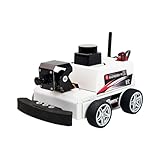
- 【Developed for Raspberry Pi 5】 The microROS Pi5 robot is developed based on the latest Raspberry Pi 5. Difference from previous Raspberry Pi versions is that this robot needs to solve special power supply problems in order to unleash the full performance of Raspberry Pi 5. At the same time, this smart robot is NOT compatible with pi 4B, 4, 3B+.
- 【ROS2-HUMBLE and microROS system learning】This intelligent robot, based on the ROS2 system's Humble version, is widely used, highly stable, and offers abundant case tutorials. It employs MicroROS communication technology between the main control and driver boards, with open-source code and all-in-one programming software for comprehensive learning.
- 【MS200 Lidar】Featuring a high-performance TOF laser radar resistant to 30Klux strong light, supporting indoor and outdoor mapping navigation, path planning, and obstacle avoidance. It extensively explores intelligent driving in modern automobiles, with radar obstacle avoidance, tracking, and patrol providing important model learning experiences in intelligent industrialization.
- 【AI visual gameplay】The 2-degree-of-freedom 2MP HD camera gimbal is utilized for AI visual depth development, remote control through APP or handle,paired with the high performance of Raspberry Pi 5, enabling smooth implementation of face, QR code, and posture recognition, object tracking, line-following autonomous driving, and gesture recognition control.
- 【you will get】A programmable robot kit with a metal chassis structure, with most components pre-installed. It includes an expansion board with onboard ESP coprocessing and a six-axis IMU, 310 encoder-reduced motors, a 7.4V rechargeable battery, Raspberry Pi 5 (depending on version), Pi 5 active heat sink,lidar, and 2DOF camera. The combination of high-performance hardware and solid electronic course content, including Yahboom's original practical and theoretical courses,technical guidance
| Workload or program detail | What Ambarella reported | How to interpret it |
|---|---|---|
| LLaVA-34B | Ran on N1 at under 50 W. | The report does not state a comparable test setup or independent measurement. |
| LLaVA-13B | Ran across 16 channels of 1080p video. | This is the reported channel count and resolution; a frame rate or latency figure is not stated. |
| CLIP | Ran across 16 channels, with up to 24 video streams stated for this workload. | The report does not give the conditions or a comparison with other hardware. |
| Model set | Ambarella said six LLMs, ranging from 1 billion to 34 billion parameters, and about 14 CNN-based vision models were running in its N1 test environment. | This indicates a broad set of models in the company’s environment, not that all were deployed in a product. |
| Gemma port | Ambarella said it took less than a week to port Gemma. | This is the company’s reported porting time; the report does not specify the engineering scope or staffing. |
Ambarella also cited Cooper-compatible chips with power envelopes of 5 W for CV72 and 1–2 W for CV75 in the 2024 report. Those figures describe the stated chip envelopes; they are not power results for the N1 model workloads listed above.
Why Ambarella expects hybrid systems
Ambarella does not argue that an LLM should handle every perception or control task. Kohn said latency will remain significantly higher than for optimized models. The architecture he expects is hybrid: fast, specialized models handle tasks that need a quick response, while a more capable model contributes broader interpretation where additional context is useful.
Rank #4
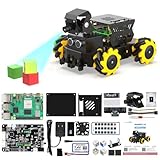
- 【Powerful control system】RaspberryPi 5 has made breakthroughs in processor speed,multimedia performance,memory and connection.Based on the RaspberryPi 5 main control,AI performance has been greatly improved,and the camera picture is smoother.The combination of RaspberryPi 5 and the robot driver expansion board significantly enhances the AI performance of Raspbot V2!
- 【Empowered by Large Al Model, Enhanced Human-Computer Interaction】Raspbot V2 uses an OpenRouter-centric interactive system based on 3 AI models. Combined with the AI voice interaction module, it uses multimodal vision to determine whether the scene on the screen matches the description, enabling environmental perception and AI visual gameplay. Only superior kit.
- 【Multiple control methods】Raspbot-V2 can be connected through APP,PC,remote control,and handle,and FPV transmits images.Android and iOS APP can be used for remote control of robots.Through the APP,you can control the robot in real time and switch various AI games with just one click.
- 【Excellent hardware configuration】Equipped with Pi5 robot driver board,communicates with Pi5 via I2C, and supports Pi5 PD (5V/5A) power supply.The metal chassis is equipped with TT motors and Mecanum wheels to achieve 360°moving;it adopts a four-way patrol module,infrared patrol sensors with 4-way high-precision infrared probes;Ultrasonic waves to achieve distance measurement,obstacle avoidance,and following;with an OLED screen to view the main control temperature data in real time.
- 【What do you get?】You will get a programmable metal chassis structure robot kit,you need to assemble the camera, main control,and expansion board yourself.With rich tutorials and open source Python code,Raspbot-V2 is a perfect platform for Raspberry Pi 5 robot learning,where you can learn ROS, Python programming,Open CV technology and AI vision,shorten the project development cycle and fully experience AI!
- Potential role for a multimodal model: add context to a complex scene or help interpret a less familiar situation.
- Role for specialized models: perform narrower tasks more quickly when response time matters.
- Engineering trade-off: use the broader model where its added reasoning may justify the latency and compute cost, rather than assuming it belongs in every part of the system.
This hybrid approach is Ambarella’s stated direction, not a demonstrated safety architecture with published end-to-end latency or reliability results.
Independent reader supportYour contribution helps us test, update, and keep practical guides available for everyone.What the automotive program says—and does not say
Ambarella said it was productizing software modules for Continental’s Level 4 truck project. The report gave a planned start of production of 2027 and said the project includes high-definition radar processing on the same chip. This is a specific planned automotive program; it does not establish that the truck had entered production or that the LLM demonstrations described elsewhere in the report were deployed in that program.
What this could mean for robotics
The same broad idea applies to robotics: a multimodal model could help a system interpret visual input in a wider context, while specialized models remain responsible for time-sensitive tasks. But the report’s concrete demonstrations concern Ambarella’s N1 workloads and an automotive development program. It does not provide a separate robotics deployment, robot-specific performance measurements, or evidence of safe autonomous operation in the field.
How strong is the evidence?
The case for experimentation is clearer than the case for readiness in production. Ambarella’s reported N1 results show that it had run a range of models on its platform and identified workloads it considers useful. They do not provide independent validation, comparative accuracy figures, complete latency measurements, or safety approval. Those distinctions matter especially in driving, where a model’s ability to describe or interpret a scene is not by itself evidence that the overall system will respond safely.
Quick Recap
Product prices and availability are accurate as of the date/time indicated and are subject to change. Any price and availability information displayed on Amazon at the time of purchase will apply.

