
Quick wins for a faster PC:
Repair Windows errors before they cause bigger problemsFix Now →Fix the driver behind crashes, sound loss and screen glitchesFind Drivers →Aerogel capacitors are carbon-aerogel supercapacitors designed to deliver or absorb high current quickly. They can support brief pulse loads, bridge short power interruptions, and serve in selected main-power designs—but they store far less energy than a battery of comparable practical size. Choose one by checking both its equivalent series resistance (ESR), which affects immediate voltage sag, and its capacitance, which determines how long it can support a load.
What an aerogel capacitor is—and what it is good at
An aerogel capacitor is a type of electrochemical double-layer capacitor (EDLC), more commonly called a supercapacitor or ultracapacitor. Its carbon-aerogel electrode structure is associated with high power delivery, rapid charge and discharge, low ESR, and long cycle life. Those traits make it useful where a circuit needs a quick burst of current or a short bridge across a power interruption.

Low ESR limits the immediate voltage drop when current starts flowing. Capacitance supplies energy as the voltage falls during the pulse or backup interval. Neither property alone is enough: a large capacitance with excessive ESR can sag under a heavy burst, while low ESR cannot make a small capacitor sustain a load for long.
Cooper Electronic Technologies engineer Marc Juzkow wrote in 2002 that, for a given capacitance, aerogel capacitors were “between 2000 to 5000 times smaller in size than electrolytic capacitors.” Treat that as a historical comparison attributed to Juzkow, not a universal size guarantee for every capacitor, package, or modern product.
#1 Best Overall

- High Capacitance: 1 Farad rated at 2.5VDC – ideal for backup power and energy storage applications
- Compact Size: Measures only 0.49" (12.5mm) tall x 0.32" (8.2mm) diameter with ~2.5mm lead spacing
- Reliable Performance: Aerogel-based design provides low ESR and long cycle life
- Versatile Uses: Great for memory backup (SRAM/RTC), LED smoothing, miniature robotics, and IoT projects
- Convenient Format: Delivered on cut tape—ideal for breadboarding, DIY electronics, or assembly into compact devices
Three roles: pulse, hold-up, and main power
| Role | What the capacitor does | Typical fit |
|---|---|---|
| Pulse power | Supplies a brief, high-current burst while limiting voltage sag. | Solenoids, valves, motor starts, and wireless transmissions. |
| Hold-up or bridge power | Keeps a circuit running through a short interruption or battery change. | Memory, microprocessors, real-time clocks, UPS functions, and control electronics. |
| Main power | Provides the primary energy source where the required runtime, voltage range, and recharge arrangement fit the capacitor system. | Selected designs, including documented PowerStor B-series applications; not a general substitute for a battery during long runtimes. |
Pulse loads
A capacitor can supply a transient current demand that a battery or power supply would otherwise have to meet by itself. A hybrid battery-supercapacitor pack pairs the battery’s higher stored energy with the capacitor’s ability to deliver current quickly. The battery still needs to recharge the capacitor between bursts, so pulse repetition rate and the impedance of the recharge path matter.
PowerStor’s 2007 A-series catalog listed DC/DC converters and valve or solenoid actuation among its applications. That is application guidance for the cited product family, not proof that every aerogel capacitor is suitable for every actuator or converter.
Hold-up power
For hold-up, start with the interval the circuit must survive and the current it draws during that interval. A capacitor is a good fit when that brief reserve is more important than storing enough energy for a long outage. Account for the circuit’s minimum operating voltage: the capacitor’s voltage declines while it delivers energy, so the load may stop working before the capacitor is fully discharged.
Rank #2
Main power
Main-power operation is possible in appropriately designed systems, but the label does not mean battery-like runtime. The PowerStor catalog documented B-series devices for main power as well as hybrid battery packs, hold-up, and pulse power. Whether a design works depends on its energy demand, usable voltage window, recharge method, and acceptable recharge interval.
Recommended Free Tools
How to size for a pulse or backup interval
Estimate the voltage lost to ESR and the voltage decline from discharging the capacitance. For a simple constant-current estimate, the total drop over a pulse is approximately:
Voltage drop ≈ (load current × ESR) + (load current × pulse duration ÷ capacitance)
Rank #3

- ALLECIN Electrolytic Capacitors Kit contain 24 Different Values In-line Aluminum Capacitors - Perfectly suitable for variety electronic experiments.
- Features & Advantages : Large capacity and small size. Ripple current resistance - small loss tangent, small leakage current, low internal resistance and low ripple.
- Dielectric material: aluminum electrolytic. Lead description: long lead = positive "+"; short lead = negative "-".
- Wide Application : In-line electrolytic capacitors are widely used in household appliances and various electronic products, and are also very suitable for DIY circuit boards.
- Humanized packaging for easy storage and use. # Please confirm the capacitance, voltage and volume before purchasing.
The first term is the immediate ESR step; the second is the capacitive fall over time. For a hold-up calculation, the same relationship helps estimate the capacitance needed for a chosen current, duration, and allowable voltage drop. Confirm the result against the actual load’s minimum voltage and the capacitor datasheet; real loads may not draw constant current.
Electronic Design illustrated the ESR effect with a 1.5 F capacitor having 0.060 ohm internal resistance, noting that resistance can dominate the capacitive contribution for millisecond pulses. This is an illustrative example, not a recommended part or a universal pulse result.
- Check rated voltage and the circuit’s full voltage range.
- Use ESR at the relevant frequency and conditions, rather than capacitance alone, to estimate the initial sag.
- Allow for capacitance tolerance and the voltage drop during the required interval.
- Check leakage current, pulse duty cycle, recharge-path impedance, temperature limits, package constraints, and required cycle life.
Examples from the PowerStor catalog
The following are nominal values from the Cooper/Bussmann PowerStor catalog published in 2007. They describe historical product-family specifications, not confirmation of current availability or a substitute for checking the datasheet for the exact part.
Rank #4

- Operating Temperature: -40℃ to 70℃ / -104℉ to 158℉
- Easy Replacement: Directly replaceable with labeled terminals for hassle-free installation - "Herm"/"H" for compressor, "Fan"/"F" for fan, "C" for common line
- Advanced Safety Design: Incorporates S1 safety standards and features a specialized 10000 AFC Anti-Explosion Pressure Switch, ensuring enhanced safety and protection in operation
- Compliance: Meets U.S. standards - EIA-456-A, IEC 60252-1:2001.
- Compatibility: 97F9838, Z97F938, 97F9838BZ3, 12786, RC0108, 97F9849, C3DR405, Z97F9848BZ2, P291-4054RS, C3405R, HCKS400D050R440Z, P291-4053RS, TT-CAP-40/5/440R, TRCFD405, TP-CAP-40/5/440R, HC98JA041, HC98CA040, HC98CA041, HC93CZ035, and more
| Catalog part or specification | Published value | Qualification |
|---|---|---|
| A1020-2R5105 | 2.5 V; 1 F nominal capacitance; approximately 0.090 ohm nominal ESR | ESR stated at 1 kHz; PowerStor catalog, 2007. |
| A1635-2R5475 | 2.5 V; 4.7 F nominal capacitance; approximately 0.025 ohm nominal ESR | ESR stated at 1 kHz; PowerStor catalog, 2007. |
| PowerStor operating-temperature specification | -25 °C to 70 °C | PowerStor catalog, 2007; confirm the exact part’s current datasheet before design use. |
| PowerStor capacitance tolerance | -20% to +80% at 20 °C | PowerStor catalog, 2007; applies to the cited family specification. |
Series connections and cell balancing
A system that needs more voltage than one cell can provide must use cells in series. The cited PowerStor families used 2.5 V cells, with a 5 V P-series option in the 2007 catalog. Series-connected cells do not necessarily share voltage evenly: differences between cells can cause one to exceed its rating unless the string is balanced.
Passive balancing
Equalizing resistors across the cells provide a simple, inexpensive path to reduce voltage mismatch. They draw current continuously, however, which adds standing consumption and can matter in a low-power or long-hold-up design.
Active balancing
An active circuit monitors cell voltages and corrects mismatch when needed. It can reduce continuous balancing loss compared with resistors, but adds circuit complexity and cost. Select a balancing method as part of the system design, not as an afterthought once the series string is built.
Free tools Windows power users keep installed
One-click scans. No signup required.
Best Value
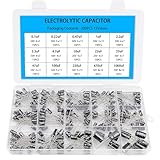
- Comprehensive Kit of 200PCS Includes 15 commonly used capacitor values from 0.1uF to 1000uF, with voltage ratings of 10V, 16V, 25V, and 50V. Each value is neatly organized in a labeled plastic storage box for easy access and use.
- Clear Polarity Markings Aluminum electrolytic capacitors with radial leads. Long lead = positive (+), short lead = negative (−), making installation easier and safer.
- Durable and Stable Designed with an operating temperature range of -40℃ to +105℃ and ±20% tolerance, ensuring stable and reliable performance under harsh conditions.
- Low ESR & Ripple Resistance Features low equivalent series resistance (ESR) and high ripple current resistance, ideal for smoothing, filtering, and timing circuits in power supply and audio applications.
- Wide Applications Perfect for hobbyists, engineers, and technicians working on TVs, monitors, speakers, game consoles, amplifiers, and other consumer electronics
When to choose a supercapacitor instead of a battery or electrolytic capacitor
Supercapacitors generally suit high peak current, rapid cycling, and short backup intervals. Batteries generally store more energy for long runtimes. An electrolytic capacitor may be more suitable in other designs; the Juzkow size comparison does not establish that aerogel capacitors are the better choice in every application.
Compare options using the load’s peak current and ESR, usable energy and voltage window, recharge time, leakage and self-discharge, cycle life, operating temperature, package and safety constraints, and total system cost. The right part is the one that meets the whole load profile—not simply the one with the largest capacitance or lowest ESR.
Quick Recap
Product prices and availability are accurate as of the date/time indicated and are subject to change. Any price and availability information displayed on Amazon at the time of purchase will apply.

