
Yes. VHDL-AMS can model a battery charger by combining continuous electrical behavior—such as terminal voltage and current—with event-driven controller logic for charge modes and protection. The key is to define how those two parts interact, handle discontinuities explicitly, and check that the target simulator supports the device models you need.
What VHDL-AMS contributes to a charger model
VHDL-AMS is the analog, digital, and mixed-signal extension of VHDL defined by IEEE 1076.1. The 2017 edition updates the language alongside IEEE 1076-2008. IEEE describes it as a language for describing and simulating analog, digital, and mixed-signal systems.
For a charger, the language lets one model represent both the continuous electrical network and the controller that changes its behavior in response to events or measured conditions. VHDL-AMS models lumped physical systems with ordinary differential and algebraic equations. The language specifies required simulation results rather than prescribing one numerical solution method, so solver behavior remains an important simulator choice.
How to divide the charger and battery model
Electrical power path and interfaces
Start by defining the charger, battery, sensors, and load as connected electrical terminals. Use the simulator’s conservative electrical quantities—typically voltage across a branch and current through it—to express how energy and signals pass between those elements. Keep the controller’s sensed quantities and its control outputs explicit: for example, measured battery voltage or current on the input side, and a command that changes the power stage or charge mode on the output side.
Free tools Windows power users keep installed
One-click scans. No signup required.
#1 Best Overall

- Efficient, Energy-Saving, and Fast Charging: The TowerTop 12v battery charger offers 4 adjustable current settings (2A/10A/25A/AUTO) to meet your diverse needs. With a max charging current of 25A, you can fully charge a 100Ah battery in under 3.5 hours. Achieving an 85% charging efficiency (industry average 75%), this battery chargers is more efficient, increasing charging speed by 1640% compared to 2A car battery charger. Not only is it energy-efficient, but it also saves you a lot of wait time
- Fully Automatic Charging for Convenience and Safety: This 12 volt battery charger automatically detects battery status and starts charging automatically within 30 seconds if you forget to press Start. After a full charge, it enters pulse repair mode, turns off the screen to save energy, and maintains a safe voltage for long-term storage. If voltage drops, it restores full power. The smart battery charger also remembers your last settings, ensuring seamless operation even after a power outage
- All-in-One Compatible Design: Designed for 12V sealed lead-acid batteries in cars, boats, RVs, power sports, and deep-cycle batteries, including 12V STD, AGM, GEL, Wet, MF, EFB, calcium and deep-cycle batteries
- HD LCD Screen and 8-Stage Intelligent Charging: With true 8-stage smart charging (desulfurization, soft start, bulk charge, absorption, analysis, repair, float, and pulse maintenance), it optimizes battery life and repairs batteries without overcharging or damaging them. The HD LCD screen allows you to view the charging stage and parameters at any time rather than leaving you guessing, keeping you informed of the charging status
- Battery Repair: Independent desulfurization and repair buttons allow you to manually desulfurize and repair your battery to restore lost battery performance, helping to revive old/idle batteries and extend battery life. If your battery cannot be charged, you can try the "repair" mode to fix it. Note: It cannot repair completely drained batteries
Battery behavior at the needed level
Choose the battery model according to the design question. A system-level charger study may need a state-of-charge state equation driven by battery current and a voltage relation that reflects the chosen battery abstraction. A deeper electrochemical model may be warranted when internal cell behavior is itself part of the question. Avoid adding parameters that do not affect the decision being studied, and do not treat a model calibrated for one chemistry as interchangeable with another.
Published VHDL-AMS examples span different levels of detail: George Overton’s 2001 EE Times article describes a parameterized NiCd battery model used with a fast-charge controller, while a 2012 SAE paper by Hu, Lin, and Stanton applies VHDL-AMS to a physics-based Newman lithium-ion cell model. These examples demonstrate different modeling choices; they do not establish that either model is suitable for every charger or battery.
Controller behavior
Represent the control algorithm using VHDL or VHDL-AMS logic, then connect it to the analog model through defined interfaces. The controller can express such behaviors as switching between charge modes, responding to sensed thresholds, and stopping or changing operation when a termination or protection condition is met. Keep the threshold values, state transitions, and their interaction with the electrical power path visible enough to inspect in simulation.
Rank #2

- 【All-in-one Universal Charging Solution】It's an all-in-one solution: charger, maintainer, trickle charger, and desulfator. This 12V 20-Amp and 24V 10-Amp battery charger is ideal for fast charging and servicing lead-acid automotive, RV, deep cycle batteries including flooded, gel, AGM, SLA, GEL, on board battery chargers for boats, truck, SUV, farm vehicle, tricycle, motorcycle, lawn mower, lifep04 batteries etc.
- 【7-Stage Automatic Smart Battery Charger】The 7-stage charging process is thoughtfully designed, including desulfurization, trickle charging, constant current charging, constant voltage charging, battery current detection, compensation charging, floating charging. Automatically adjust the charging mode according to your battery status.
- 【Charging Protections】Trickle charger for car battery 12/24 v can be optimized for the climate, and easily handle various over-cooling and over-heating voltage environments. Provide multiple charging protections, such as reverse polarity, overheating, overcurrent/overvoltage, short circuit protection, etc. Note: If the dE5 mode is displayed during charging. You don't need to do anything. Just wait at least 5 minutes for the charger to automatically adjust and start charging the battery.
- 【Efficient Pulse Repair, Battery Rejuvenation】Battery trickle charger input power: 100-240V. Adopts high-power high-frequency low-frequency pulse technology, which can better eliminate the vulcanization phenomenon of the battery, help restore the lost performance of the old/idle battery and prolong. NOTE: It can not activate a dead battery or repair a damaged battery,also cannot jump-start the car.
- 【Visualization Charging】After the car battery charger is plugged into the power supply, it will automatically display each charging stage and battery status, such as real-time voltage, current, temperature, etc. When the battery is full, the screen will intuitively display the words "100%" and automatically stop charging.
Why discontinuity handling matters
A controller state change can cause an abrupt change in a modeled quantity, even while the surrounding electrical system is described continuously. VHDL-AMS requires discontinuities to be handled explicitly. In the 2001 charger case study, Overton explains that a break statement makes the analog solver resume at the same simulation time and recalculate quantities after a discontinuity. The article warns that a model with a quantity discontinuity at a particular time and no executed break is erroneous.
The Tool Desk
Outbyte PC Repair FREEClear out junk files and repair common Windows errorsFree Scan →Outbyte Driver Updater FREEFix the driver behind crashes, sound loss and screen glitchesFind Drivers →Identify transitions that can create abrupt changes—such as a charge-mode change or a switched control output—and apply the language’s discontinuity mechanism where required. Do not assume that a digital event alone automatically tells the analog solver to recompute every affected quantity correctly.
A practical modeling workflow
- Define the circuit boundary. Specify the charger power-path terminals, battery terminals, sensors, and load, along with the voltage and current quantities exchanged across each interface.
- Select the battery abstraction. Implement only the state equations and electrical behavior needed to answer the design question. State the chemistry and assumptions represented by the model.
- Implement the controller. Express mode logic, sensing, thresholds, and termination behavior in VHDL or VHDL-AMS, with explicit interfaces to the analog quantities.
- Handle state-change discontinuities. Locate transitions that abruptly change quantities and use
breakas required so the analog solver recalculates at the transition time. - Add detailed device models selectively. Before relying on vendor, SPICE-derived, or other foreign models, check how the target simulator imports and executes them and whether they will remain usable in any export or co-simulation workflow.
- Exercise the design across conditions. Sweep source voltage, temperature, initial state of charge, component tolerances, and charge-termination thresholds. Inspect both waveforms and protection behavior; compare with measured data when it is available.
Simulator support and portability
Language support alone does not guarantee that a charger model will run unchanged across tools. Discrete-component models may be unavailable, and SPICE or other foreign-model integration depends on the simulator. In the EE Times case study, Mentor Graphics ADVanceMS was used for a model that combined analog, digital, VHDL-AMS, SPICE, and C-function capabilities. That is a report of a 2001 project, not evidence about current product availability or present-day feature support.
Rank #3
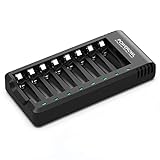
- POWEROWL smart charger passed US safety certification comes with chip control, when the battery is fully charged, it will automatically stop charging, and with LED indicator. (NOTE) only compatible with NiMH or NiCD AA and AAA rechargeable batteries.
- Scientific and reasonable battery charging position design, high quality materials effectively protect the battery from normal charging
- Charge any number of AA AAA rechargeable batteries to make your charging easier. It is recommended to use a 5V/2A plug.
- With a USB input interface, you can use a laptop, car charger, mobile phone charger, etc. to charge the battery
- AA AAA batteries charger uses trickle charge to extend battery life and charge up to 99%. Please read the instruction manual carefully before use.
Ansys Twin Builder documentation describes Basic Elements VHDL-AMS libraries with circuit and block models, including a rectifier-bridge and smoothing-capacitor example, and documents exporting VHDL-AMS models to ASCII netlists. Ansys also cautions that netlists containing foreign models in most cases cannot be used with other VHDL-AMS simulators without manually replacing those models. Check current documentation for the specific version and workflow you intend to use.
| Capability to compare | Why it matters for a charger |
|---|---|
| IEEE 1076.1 language coverage | Confirm that the simulator supports the VHDL-AMS constructs used in the model, including analog quantities and event-driven behavior. |
| Analog solver behavior | Battery equations and switched charger circuits can place demands on the solver; assess whether it handles the model’s equations and discontinuities reliably. |
| SPICE and foreign-model integration | Determine whether required vendor or circuit models can be used, and whether their integration is specific to one simulator. |
| Model-library breadth | Check whether suitable circuit and block models are available or must be built separately. |
| Export and co-simulation portability | Find out whether exported models retain their behavior in another tool, particularly when they contain foreign models. |
| Debugging and parameter sweeps | Assess how easily you can inspect state transitions, trace solver behavior, and automate the operating-condition sweeps needed for the design. |
What published examples establish—and what they do not
Overton’s 2001 EE Times article reports converting a Maxim 2003 fast-charge controller and a parameterized NiCd battery model to VHDL-AMS, then simulating the charger circuit. It is a concrete example of combining controller behavior and a battery representation in one mixed-signal simulation.
What’s actually slowing this PC down?
Pick the symptom - the matching free tool is one click away.
Hu, Lin, and Stanton’s 2012 SAE paper reports implementing a physics-based Newman lithium-ion cell model in VHDL-AMS in less than two days. That is an implementation-time report, not a charger-accuracy benchmark. The cited examples do not publish a charger-specific accuracy percentage, convergence statistic, or laboratory-correlation result. Treat any claim of predictive accuracy as something that must be demonstrated for the particular model and application, not inferred from the existence of a published simulation.
Quick Recap
Product prices and availability are accurate as of the date/time indicated and are subject to change. Any price and availability information displayed on Amazon at the time of purchase will apply.

