
Quick wins for a faster PC:
Scan for outdated or missing drivers - takes under a minuteDriver Scan →Clear out junk files and repair common Windows errorsFree Scan →Intel Tremont is a low-power x86 microarchitecture introduced in 2019 for compact client devices, embedded and IoT systems, and efficient data-center products. Its defining change is a clustered front end with two 3-wide decoders that can process up to six instructions per cycle; Intel also describes larger out-of-order and memory-handling resources than in earlier low-power designs. Tremont is an architecture, not a single processor: Jasper Lake chips such as the Pentium Silver N6005 and Celeron N5100 are examples, and their performance and power classes vary by model.
What is Intel Tremont?
Tremont is an Intel low-power x86 CPU microarchitecture announced on October 24, 2019. Intel designed it for workloads in compact client devices, IoT and efficient data-center products. The name identifies the underlying processor design, not one particular chip or a guarantee of a specific level of performance.
Intel described Tremont as a substantial generational improvement in instructions per clock (IPC) over earlier low-power x86 designs, but its published claim is qualitative rather than a single benchmark result. IPC describes how much work a processor can complete per clock under particular conditions; it does not by itself tell you how fast a computer will feel. Clock speed, core count, memory, cooling, power limits, software and workload all affect the result.
What changed in Tremont’s CPU design?
Tremont combines a wider instruction front end with more capacity to keep work in flight and move data. These are architectural resources; they explain how the design aims to improve performance efficiently, but do not translate into a fixed speed increase for every program.
The Tool Desk
Outbyte Driver Updater FREEScan for outdated or missing drivers - takes under a minuteDriver Scan →Outbyte PC Repair FREEClear out junk files and repair common Windows errorsFree Scan →#1 Best Overall

- Get ultra-efficient with Intel Core Ultra desktop processors that improve both performance and efficiency so your PC can run cooler, quieter, and quicker.
- Core and Threads 24 cores (8 P-cores plus 16 E-cores) and 24 threads. Integrated Intel Graphics included
- Performance Hybrid Architecture Integrates two core microarchitectures, prioritizing and distributing workloads to optimize performance
- Performance Unlocked Up to 5.7 GHz unlocked. 40MB Cache
- Compatibility Compatible with Intel 800 series chipset-based motherboards
Two clustered instruction decoders
The front end uses two 3-wide decode clusters, for a maximum of six instructions processed per cycle. This is the source of Intel’s “6-wide” description. It is an upper bound, not a promise that every workload supplies six useful instructions each cycle. The design also includes an enhanced branch predictor and a banked instruction cache with dual 16-byte reads, supporting the supply of instructions to the execution machinery.
More room for out-of-order work and memory operations
Tremont increases the depth of its out-of-order windows and expands load/store buffers. Out-of-order execution lets the CPU work on ready instructions while other operations are waiting, rather than stalling the entire pipeline unnecessarily. Intel’s Optimization Reference Manual also documents a 32 KB data cache and two generic load/store execution pipes. These resources can help keep data moving, although the benefit depends on the program’s access patterns.
Rank #2

- Next‑Gen Platform Support: Compatible with Intel 800 Series Chipset‑based motherboards with LGA1851 Socket enabling PCIe 5.0/4.0 and high‑speed DDR5 memory (up to 7200 MT/s).
- High‑Performance Core Configuration: Features up to 24 cores (8 P‑cores + 16 E‑cores) for demanding gaming and creator
- Ultra‑Fast Boost Clocks: Reaches up to 5.5 GHz max turbo frequency for top‑tier responsiveness and performance
- Built for Enthusiasts: Unlocked for performance tuning when paired with Intel Z‑series chipsets, making it ideal for overclockers and power users.
- Robust Power & Thermal Design: Engineered with 125W base power and 250W max turbo power to sustain high‑intensity
Cryptography, vector-related features and low-power waiting
Intel documents GFNI, dual AES units, enhanced SHA-NI and faster PCLMULQDQ support. These instructions can accelerate supported cryptographic and related workloads; software must use them to benefit. Tremont also supports UMWAIT/UMONITOR and TPAUSE, instructions intended for low-power or low-latency spin loops. Their presence does not mean every application will consume less power: the result depends on whether software uses the feature and on the system’s implementation.
Integration with the rest of the system
Tremont CPU cores can be integrated alongside a shared uncore that includes a ring interconnect, L3 cache slices, graphics and an integrated memory controller. The processor core is only one part of a computer, so memory configuration, graphics, platform components and the system’s power and cooling limits also matter when comparing complete devices.
What’s actually slowing this PC down?
Pick the symptom - the matching free tool is one click away.
Rank #3

- Designed to support Intel’s LGA1700 (LGA17xx family) platform. Screw-mount design provides easy & secured installation with the included back plate.
- Super low profile to fit in any chassis: only 28mm (1.10 inches) from processor contact point to the top of the fan.
- Automatic speed control (1100-3500 RPM) with 4pin PWM power connector, backward compatible with 3pin motherboard header
- Kit Content: Quiet 95mm cooling fan and aluminum heat-sink assembly, motherboard back plate. Thermal paste is already pre-applied to the heatsink's chip contact area.
- TDP: 75W, 12V DC @ 0.15A, Operating Temperature: -10 °C ~ +70 °C, Supports Intel LGA-1700 Core i7, i5, and i3 series processors
Which processors use Tremont?
Intel’s Jasper Lake family includes Pentium Silver and Celeron processors built on Tremont. Intel lists the following representative Jasper Lake models as 10 nm products launched in Q1 2021. The table separates model-level specifications from family-catalog entries; “not stated” means the cited Intel catalog information does not establish that value here.
| Processor | Cores | Base frequency | Maximum burst frequency | TDP | Launch |
|---|---|---|---|---|---|
| Intel Pentium Silver N6000 | 4 | not stated (Intel Jasper Lake ARK catalog) | not stated (Intel Jasper Lake ARK catalog) | 6 W (Intel Jasper Lake ARK catalog) | Q1 2021 (Intel Jasper Lake ARK catalog) |
| Intel Pentium Silver N6005 | 4 | 2.00 GHz | up to 3.30 GHz | 10 W | Q1 2021 |
| Intel Celeron N5100 | 4 | 1.10 GHz | up to 2.80 GHz | 6 W | Q1 2021 (Intel Jasper Lake ARK catalog) |
| Intel Celeron N5105 | 4 | not stated (Intel Jasper Lake ARK catalog) | up to 2.90 GHz (Intel Jasper Lake ARK catalog) | 10 W (Intel Jasper Lake ARK catalog) | Q1 2021 (Intel Jasper Lake ARK catalog) |
| Intel Celeron N4500 | 2 | not stated (Intel Jasper Lake ARK catalog) | not stated (Intel Jasper Lake ARK catalog) | 6 W (Intel Jasper Lake ARK catalog) | Q1 2021 (Intel Jasper Lake ARK catalog) |
| Intel Celeron N4505 | 2 | not stated (Intel Jasper Lake ARK catalog) | not stated (Intel Jasper Lake ARK catalog) | 10 W (Intel Jasper Lake ARK catalog) | Q1 2021 (Intel Jasper Lake ARK catalog) |
Intel’s N6005 specification lists 10 nm fabrication, four cores and four threads, 4 MB cache, a 2.00 GHz base frequency, burst frequency up to 3.30 GHz and a 10 W TDP. The N5100 specification lists 10 nm fabrication, four cores, 4 MB cache, a 1.10 GHz base frequency, burst frequency up to 2.80 GHz and a 6 W TDP. The catalog’s N5105 entry gives a burst frequency up to 2.90 GHz and a 10 W TDP. Do not infer unlisted specifications for the other catalog models from these examples.
Rank #4

- Be everything you want to be, in-game and out with optimized performance and new features. Play harder and work smarter with Intel Core 14th Gen processors
- 14 cores (6 P-cores plus 8 E-cores) and 20 threads. Integrated Intel UHD Graphics 770 included
- Up to 5.3 GHz Max Turbo Frequency
- Compatible with Intel 600-series (with potential BIOS update) or 700-series chipset-based motherboards
- DDR4 and DDR5 platform support cuts your load times and gives you the space to run the most demanding games
How fast and power-efficient is Tremont?
Tremont’s design changes—wider decode, deeper out-of-order capacity, larger memory-operation resources and specialized instructions—are intended to raise performance efficiently. Intel’s announcement characterizes IPC gains over prior low-power x86 generations as significant, but the Intel material cited here does not provide one benchmark number that can fairly describe every Tremont processor or workload.
Nor does a processor’s TDP equal a fixed measurement of electricity used by a complete PC. It is a processor specification, while actual system draw and sustained performance depend on the specific chip, its power limits, cooling, memory configuration and workload. A 6 W part and a 10 W part therefore should not be treated as interchangeable simply because both use Tremont.
Recommended Free Tools
Best Value
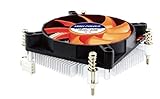
- Supports: Intel Socket LGA 1156/1155/1151/1150/1200, Intel Core i9, i7, i5, and i3 Processors
- 4pin PWM Power Connector, backward compatible with 3pin motherboard header
- Low profile: only 27.3mm from processor contact point to the top of the fan
- Kit Content: Quiet 80mm cooling fan and aluminum heat-sink assembly, motherboard back plate, and now thermal paste has been factory pre-applied
- TDP: 85W, 12V DC @ 0.12A with Quiet Hydraulic Bearing Fan: Fan Speed 1000-3000 RPM, Air Flow 10.23-28.19 CFM. FCC, CE, and RoHS Compliance.
For a useful comparison between two Tremont-based computers, check the exact processor model and consider:
- Power class and cooling: Compare the processor’s listed TDP and how the complete system is configured to sustain its performance.
- Cores and frequencies: Check the specific SKU rather than relying on the Tremont name. A burst-frequency ceiling is not the same as a speed maintained continuously.
- Memory: Memory type and bandwidth can affect workloads that frequently move data.
- Graphics and I/O: Verify the complete system’s graphics and ports against what your applications and peripherals require.
- Purpose: A compact client computer and an industrial system may use related CPU technology but differ in connectivity and deployment requirements.
Is a Tremont mini PC suitable for everyday use?
A Tremont-based mini PC can be a candidate for routine, lighter desktop tasks, but the architecture name alone cannot establish that a particular machine will suit you. Compare the complete computer’s processor SKU, memory, storage, cooling and required ports with the applications you intend to run. The Intel material cited here does not establish a universal everyday-use benchmark or a performance guarantee for mini PCs.
For work that depends on sustained CPU throughput, demanding software, or substantial multitasking, assess the exact system and workload rather than assuming the wider decoder makes all Tremont systems fast. A higher-power Tremont SKU may have different limits from a lower-power one, but the available specifications do not support a universal ranking of complete systems.
Where does Tremont fit in embedded and other systems?
Elkhart Lake for industrial and IoT systems
Intel’s Elkhart Lake datasheet positions Atom x6000E and related Pentium and Celeron N/J processors for industrial, retail and embedded IoT applications. It describes a multi-chip package with a 10 nm compute die and a 14 nm platform-controller hub. This is a distinct deployment context from a consumer mini PC: confirm the exact processor and platform capabilities required for an embedded design rather than assuming that any Tremont-based product has industrial features.
Lakefield packaging
Intel’s 2019 announcement also described Tremont cores in Lakefield, using Foveros packaging. This illustrates that Tremont was used in more than one product context; it does not mean every Tremont processor uses the same package or platform arrangement.
Quick Recap
What to remember when choosing a Tremont system
- Tremont is Intel’s low-power x86 microarchitecture, introduced in 2019—not a single processor model.
- Its headline front-end feature is two clustered 3-wide decoders, capable of processing up to six instructions per cycle.
- Intel also documents expanded out-of-order and memory resources, cryptographic instructions and low-power wait-loop support.
- Jasper Lake is one Tremont product family, with 6 W and 10 W models and both two- and four-core examples in the Intel catalog.
- For a buying or design decision, use the exact SKU and whole-system specifications; architecture-level claims are not substitutes for workload-specific performance evidence.
Product prices and availability are accurate as of the date/time indicated and are subject to change. Any price and availability information displayed on Amazon at the time of purchase will apply.

