
What’s actually slowing this PC down?
Pick the symptom - the matching free tool is one click away.
Yes. Roscosmos’s interagency commission concluded that three yaw-axis angular-rate sensors on the Proton-M were installed 180 degrees out of orientation. Their faulty readings disrupted yaw stabilization, causing the rocket to lose control and crash. Investigators examined a separate launch-contact signal that occurred 0.4 seconds early, but found that it did not cause the accident.
What happened to the Proton-M?
On July 2, 2013, a Proton-M launched from Baikonur Cosmodrome carrying three GLONASS-M navigation satellites. The rocket lost control, tipped and rolled, then broke apart near the launch complex. All three satellites were lost.
Accounts describe different moments in the short sequence: one contemporary report said the vehicle exploded about 12 seconds after takeoff, while the commission summary places the loss of stabilization and accident sequence at approximately 32.682 seconds after launch. These figures refer to different event markers in reporting, not necessarily a disagreement about the underlying cause.
How did reversed sensors cause the crash?
The Proton-M had six yaw angular-rate sensors, which report how quickly the vehicle rotates around its vertical axis. The commission found that three had been installed in the wrong orientation, 180 degrees reversed. Their abnormal readings supplied faulty yaw information to the flight-control system. The rocket consequently lost yaw stabilization and control.
#1 Best Overall

- Made from high quality EPS paper
- Medium to high complexity, detailed design of assembly processes
- When you finish this thing, it will be happy because it is like a piece of art
- Finished size: Height 78 cm/30.7 inch
- Package includes: A4 Size Color Printing Paper x 1 set (Proton-M, Proton-K, Materials for 2 models), Assembly Instructions
The commission’s July 18, 2013 finding, reported by Interfax, attributed the failure to an installation error involving the three yaw-axis sensors at the Khrunichev State Space Research and Production Center.
What evidence confirmed the installation error?
Investigators did more than infer a mistake from the flight behavior. They reproduced the reversed installation on hardware and found that forcing the sensors into that position left marks on their mounting surfaces. Three recovered sensors had matching force marks, connecting the experimental evidence to the crashed vehicle.
Rank #2

- Can soar upward of 1,300 feet
- Stands 31 inches tall
- Skill Level 2
The sensors had arrows indicating their correct orientation, but the mounting plate had no corresponding reference arrow. Its mechanical keying could also be defeated with enough force. The physical evidence therefore supported the commission’s conclusion that the sensors had been forced into the wrong position during assembly.
Why didn’t pre-launch checks catch it?
The commission said the control methods used during ground preparation and testing could not detect that the sensors had been installed incorrectly. The reversed installation remained undiscovered until flight, when the control system received abnormal yaw information.
The Tool Desk
Outbyte PC Repair FREEClear out junk files and repair common Windows errorsFree Scan →Outbyte Driver Updater FREEFix the driver behind crashes, sound loss and screen glitchesFind Drivers →Rank #3

- Required Expertise: Advanced
- Scale: 1:48
- Recommended Engine: F15-4
- Expected Altitude: 500 ft. (152 m)
Investigators characterized the defect as one arising during production. Among the improvements proposed were stronger assembly records, including photographic or video documentation. The episode exposed a process weakness: orientation marks and mechanical keying were not enough to ensure correct installation, and the checks then in use did not verify it.
Was the early launch-contact signal the real cause?
No. The commission also found that a launch-contact signal occurred 0.4 seconds early. It investigated the timing fault but concluded that it could not have caused the accident. The early signal was a separate finding; the sensor installation error was the cause assigned to the loss of yaw stabilization.
Rank #4
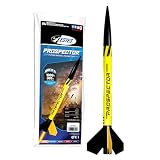
- BEGINNER MODEL-ROCKET-BUILDING KIT: The Estes Prospector launch set offers kids ages 10+ and rocketeer enthusiasts a hands-on introduction to aerospace and physics. It includes rocket parts, design decals, recovery parachute, launch system, and instructions. Each model requires Estes rocket engines, starters, recovery wadding, and 4 high-quality 1.5-volt AA alkaline batteries (sold separately).
- SOARS UP TO 1,000 FT.: The Prospector model rocket features a durable body design that demonstrates aerodynamic principles and can reach a projected altitude of using an Estes rocket engine (sold separately). It can reach a projected altitude of 1,000 ft. (305 m) using a C6-5 Estes rocket engine (sold separately). It is compatible with 1/2A6-2, A8-3 and B6-4 rocket engines.
- READY TO ASSEMBLE: Each beginner rocket kit can be completed in approximately 1 hour or less. Then pair it with the included Estes Porta-Pad II Pad and Electron Beam Controller.
- SAFETY FIRST, FUN ALWAYS: Our rockets and rocket launch accessories are designed to be used with the NAR (National Association of Rocketry) model-rocket safety code. Always ensure you have an appropriate launch site, stand back at least 15 ft., insert the safety key, issue a countdown, and then you can let your rocket fly!
- WE IGNITE IMAGINATIONS: Since 1958, Estes has created educational rocket kits and displays designed for an unforgettable aerospace experience. As a family-owned company, we have grown to offer exciting STEM products that engage aspiring rocketeers and the future minds of aerospace.
Was the sensor explanation confirmed, or only an early theory?
It was initially reported as an unconfirmed possibility. On July 10, 2013, NPR noted that the investigation was still under way. On July 18, Roscosmos’s interagency commission publicly attributed the crash to the reversed installation of the three sensors. The distinction matters: early coverage described an explanation still being checked; the later commission finding made it the official cause.
Quick Recap
Best Value

- Beginner level model rocket kit for ages 10 and up
- Pre-colored plastic parts for quick and easy assembly
- Recommended engines: A8-3, B4-4, B6-4 for 1100 ft max altitude
- Includes shock cord, plastic nose cone, body tubes, pre-assembled fin unit
- Requires separately sold engines, launch pad and controller to fly
Product prices and availability are accurate as of the date/time indicated and are subject to change. Any price and availability information displayed on Amazon at the time of purchase will apply.

