
Do these 3 things before closing this tab:
1Repair Windows errors before they cause bigger problems2Scan for outdated or missing drivers - takes under a minute3Clear out junk files and repair common Windows errorsNo—not as a stand-alone way to authenticate someone. NIST’s current digital identity guidance says, “Biometric comparison based on voice SHALL NOT be used.” More broadly, a voice match can be wrong, and ordinary matching scores do not measure whether an attacker can replay or synthesize someone’s voice. Treat voice as an optional signal at most, not proof of identity.
What NIST’s guidance means for voice authentication
NIST’s Digital Identity Guidelines, Special Publication 800-63-4, explicitly excludes voice comparison as a biometric authentication method. The guidance also says that biometrics, when used, must be part of multi-factor authentication with a physical authenticator, and that users must have a non-biometric alternative.
This is a statement about NIST’s authentication guidance—not a claim that speaker-recognition software cannot distinguish voices, or that every company is legally bound by the guidance. A voice system may still be used for other purposes, such as routing a call or assisting an agent. But a voice match alone should not be treated as a trustworthy authentication decision.
What voice-biometric accuracy scores do—and don’t—tell you
Biometric matching is probabilistic. Two core measures describe ordinary comparison errors:
What’s actually slowing this PC down?
Pick the symptom - the matching free tool is one click away.
#1 Best Overall

- Studio-Quality Sound for Clear Podcast Recording – The K66 USB podcast microphone delivers studio-quality, broadcast-level audio using a high-performance condenser capsule and cardioid pickup pattern that focuses on your voice while reducing unwanted background noise. Designed as a reliable microphone for PC, it features a wide 40Hz–18kHz frequency response and a 46kHz sampling rate to reproduce rich lows, smooth mids, and clear highs for natural, detailed vocals. With –45dB ±3dB sensitivity, it captures balanced sound without distortion during expressive speaking. Ideal for podcasting, voice-over, online classes, meetings, and professional content creation.
- Intelligent Noise Reduction Mode for Cleaner Podcast Audio – This podcast microphone features an advanced Noise Reduction Mode designed for clearer, more focused voice recording in real-world environments. Press and hold the mute button to enable noise reduction (blue indicator). In this mode, the microphone helps reduce keyboard clicks, PC fan noise, air conditioner hum, and background chatter. Default Mode maintains a warm, natural vocal tone for quiet spaces. Designed as a reliable microphone for PC, it allows creators to identify the active mode instantly and adapt as needed, ensuring clear audio for podcasting, gaming, streaming, online classes, meetings, and recording.
- True Plug-and-Play USB Microphone with Wide Device Compatibility – Engineered for effortless plug-and-play use, the K66 USB microphone requires no drivers, apps, or software installation. Simply connect and start recording on Windows PC, Mac, laptops, PS4, PS5, and tablets. Included USB-C and Lightning adapters ensure seamless compatibility with iPhone, iPad, and modern USB-C phones and devices, making it easy to switch between desktop and mobile recording. Ideal for creators working across multiple platforms, this microphone delivers consistent, high-quality audio for YouTube, TikTok, Twitch, Zoom, Discord, OBS Studio, Streamlabs, podcasting, livestreaming, and professional voice recording.
- Real-Time Zero-Latency Monitoring with Adjustable Volume Control – This podcast microphone features real-time, zero-latency monitoring through a built-in 3.5mm headphone jack, allowing you to hear exactly what’s being recorded without delay. Designed as a reliable microphone for PC, it includes a dedicated monitoring volume control that lets you adjust headphone listening levels independently for accurate and comfortable audio monitoring. Real-time feedback helps identify distortion, background noise, or uneven volume before it affects your final recording, making this podcast microphone ideal for podcasting, streaming, online teaching, voice-over work, and professional content creation.
- Precision Audio Adjustment Knobs for Full Sound Control – This podcast microphone gives creators hands-on control with dedicated knobs for microphone volume, monitoring volume, and echo adjustment. Fine-tune mic gain to maintain clear, balanced vocal output, adjust headphone monitoring levels independently for comfortable listening, and add or reduce echo to enhance depth and presence. Designed as a reliable PC microphone, these intuitive physical controls allow fast, on-the-fly adjustments without software, helping identify distortion, background noise, or level inconsistencies instantly. Ideal for podcasting, streaming, ASMR, voice-overs, singing, and professional multi-platform recording.
- False-match rate (FMR): how often the system incorrectly accepts a person who is not the enrolled speaker.
- False-non-match rate (FNMR): how often it incorrectly rejects the enrolled speaker.
Changing the decision threshold generally affects both: a stricter threshold can reduce false matches while increasing false rejections. A headline “accuracy” figure is therefore difficult to interpret without the test protocol, threshold, and both error rates.
NIST’s Fourth Edition sets an FMR of 1 in 10,000 or better across demographic groups for permitted biometric modalities, and recommends an FNMR below 5%. Those figures are not approval for voice; the same guidance explicitly excludes voice comparison.
| Measure | What it addresses | Relevant NIST figure and scope |
|---|---|---|
| FMR | Incorrect acceptance in ordinary biometric comparisons | 1 in 10,000 or better for permitted modalities in NIST’s 2025 Fourth Edition guidance; voice is excluded. |
| FNMR | Incorrect rejection in ordinary biometric comparisons | Below 5% is recommended for permitted modalities in NIST’s 2025 Fourth Edition guidance; voice is excluded. |
| IAPAR | Acceptance of an impostor presentation in a presentation-attack test | Below 0.07 is required for remote collection under NIST SP 800-63A (2025). |
FMR and FNMR describe matching errors, not the full security of an authentication system. NIST warns that FMR “does not provide sufficient confidence in the subscriber’s authentication by itself because it does not account for active impersonation attacks.” An attacker may present a recording, synthetic speech, or another manipulated input; a match score alone does not show whether the input is genuine.
Rank #2
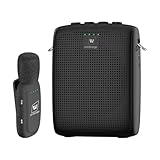
- End Voice Strain & Be Heard Clearly: Designed specifically for educators in small-medium classrooms: 15W powerful amplification ensures your voice cuts through background noise, so you don't need to shout to be heard clearly. Speak naturally all day without vocal cord damage or fatigue-just clip the mic and focus on teaching, not straining your voice. Suitable for teachers, presenters, and public speakers who value comfort over hoarseness
- Ultra-Lightweight & Tangle-Free Comfort: At only 0.64oz, this wireless lavalier mic is lighter than most competing lapel mics-no bulky headsets pressing on your head, no dangling wires restricting your movement. Clip it to your collar, hold it in hand, or use the included strap for versatility: walk around the classroom, write on the whiteboard, or interact with students freely without sacrificing sound quality
- All-Day Power & Truly Simple Setup: Built with a 2600mAh rechargeable battery in the speaker (12-15 hrs of voice amplification) and 300mAh battery in the mic (10+hrs of use)-teachers report using it for 5 consecutive days without charging. The auto power-down feature saves battery when not in use, and the included Type-C dual charging cable lets you charge both units simultaneously for hassle-free prep
- Auto-Pair & Mute Function - No Technical Hassle: Just turn on the amplifier and mic-they pair instantly, no complicated setup or technical knowledge required. Both the speaker and lapel mic have a mute button: pause audio temporarily for private conversations or interruptions without turning off the entire system. Simple, intuitive operation for busy teachers and presenters
- Bluetooth Playback & Versatile Use - Beyond the Classroom: Supports Bluetooth music playback (easily connect to your phone/laptop for background music). Suitable not just for teaching, but also for gym instruction, guided tours, church services, and outdoor events
Can a deepfake or recording fool voice ID?
It is a real presentation-attack risk. Voice is not a secret: a person’s speech can be recorded, replayed, synthesized, or otherwise presented to a verifier. That does not establish that every voice system can be fooled by every deepfake. It means that a system’s ordinary speaker-matching score cannot, by itself, establish resistance to those attacks.
Recommended Free Tools
For remote biometric collection, NIST SP 800-63A requires presentation-attack detection (PAD) testing conformant to ISO/IEC 30107-3:2023 and an impostor attack presentation accept rate (IAPAR) below 0.07. It also requires algorithm and operational test results to be published or provided, along with demographic performance testing. These requirements are a more relevant starting point for attack resistance than a vendor’s general “accuracy” claim.
What a secure deployment needs besides a voice match
Organizations evaluating voice as one component of an identity workflow should assess the complete system, not just its matching algorithm. Relevant controls include:
Rank #3

- 【Powerful & Clear Sound】 TRELC wireless voice amplifier features a premium 3-inch anti-interference horn and DSP intelligent noise-reduction chip, effectively eliminating distortion, feedback, and whistling. Its 10W powerful output can cover up to 10,000 square feet, allowing up to 100 people to hear you clearly and protecting your throat. An ideal Christmas gift for teachers, presenters, and outdoor use.
- 【Wireless Lavalier Mic】 The high-sensitivity wireless microphone captures your true vocal tones and can be clipped onto collars or ties, enabling free movement up to 49 feet from the amplifier without signal loss. Say goodbye to tangled wires and discomfort caused by traditional wired headset mics.
- 【Wireless Speaker & Voice Recorder】 TRELC microphone amplifier can work as a speaker via wireless BT or AUX jack connection to phones, tablets or computers. It supports simultaneous microphone input and music playback. With 260 seconds of voice recording and playback, ideal for classroom use.
- 【Compact & versatile】 Compact and versatile, The wireless megaphone (3.6 x 1.8 x 4.5 inches) features a belt clip, adjustable strap, and shoulder chain for hands-free use. Wear it on your belt, around your waist, crossbody, or place it on a desktop. Combining style, comfort, and convenience for any occasion.
- 【Long Battery Life】 The portable voice amplifier built in 2000 mA rechargeable battery that supports 12–15 hours of continuous use on a single charge. The wireless mic lasts 5–6 hours. Only needs 3~4 hours to fully charge them with the USB-C charging cable.
- A separate physical authenticator: bind the decision to an authenticator that is not simply another voice sample, in line with NIST’s multi-factor approach.
- PAD and attack testing: examine replay, synthetic speech, voice conversion, and injection attacks, and ask for test methods and results—not only a pass/fail claim.
- Endpoint and channel controls: consider whether audio comes from a trusted endpoint and how telephone codecs, microphones, noise, or transmission changes affect both matching and attack detection.
- Representative performance tests: require demographic results and test conditions that resemble actual use, including language, speech duration, enrollment quality, and capture channel.
- Template and data governance: establish consent, retention and deletion rules, protection of stored voice templates, and a way to appeal a rejection or use a non-biometric alternative.
- Recovery paths: ensure account recovery does not fall back to a weaker voice-only check after the stronger factor fails.
Why benchmark results do not transfer neatly between products
There is no single speaker-recognition accuracy percentage that predicts performance across products and environments. Results depend on the channel, language, background noise, audio duration, population, enrollment quality, decision threshold, and whether the evaluation includes attacks. Telephone speech and audio captured from video, for example, are not interchangeable test conditions.
NIST’s 2024 Speaker Recognition Evaluation continued an evaluation series that began in 1996. SRE24 focused on text-independent speaker detection using conversational telephone speech and audio from video. Its results are useful in the conditions tested; they do not establish a universal rate for a particular commercial authentication product or for deepfake resistance.
Free tools Windows power users keep installed
One-click scans. No signup required.
When reviewing a vendor claim, ask for the exact test protocol and operating conditions, both FMR and FNMR at the deployed threshold, demographic breakdowns, and separate PAD results. A single accuracy score without these details is not enough to compare security.
Rank #4

- 【Sound Like a Pro – No Extra Gear Needed】-- Turn any space into your personal studio. This all-in-one microphone combines mic + sound effects + audio control in one device, so you can stream, sing, or record with rich, clear sound—without mixers or complicated setup. Simply adjust mic volume, music volume, and reverb intensity with dedicated buttons. Turn on "Dodge" (smart ducking) feature, background music automatically lowers when you speak.
- 【Plug & Play in Seconds – Designed for Beginners & Everyday Creators】-- No drivers, no setup stress, no technical knowledge required. Sound card for live streaming. Just plug the receiver into your phone, tablet, or computer, and start recording instantly. Works with popular apps like TikTok, Smule, Ins Live, Reels, Whatnot, Twitch, Kick and more, ideal for first-time streamers and content creators. The included receiver has both USB-C and Lightning connectors compatible with iPhone, Android, iOS, Windows and Mac.
- 【Real-Time Monitoring – Hear Exactly What Your Audience Hears】-- Connect the headphones and monitor your voice with zero delay. Adjust your sound on the spot, stay on pitch, and deliver smoother, more confident performances whether you're streaming, recording, or practicing. The mic captures clean, warm vocals while noise reduction cuts out room hum (fans, traffic, AC).
- 【Fun Voice Effects & Sound Effects – Make Your Content Stand Out】-- Tap the Mode button to cycle through: Pop (concert reverb), Professional (clean broadcast), Male (voice deepen), Female (pitch up), Monster (super deep), and Original (natural). Then press buttons 1–6 for applause, laugh track, dramatic sting, and more. Add personality to your livestreams, engage your audience, and make every session more entertaining, perfect for creators who want more than just a basic mic.
- 【Two Ways to Use – Streaming or Karaoke Mode】-- Use headphones for live streaming and recording, or connect to an external speaker (via AUX cable) for a full karaoke experience. One device, two ways to enjoy, perfect for both personal use and group fun. For detailed setup instructions, please refer to the product description below.
How to interpret related standards and forensic guidance
ITU-T X.1097, approved on 2026-03-16, covers telebiometric authentication using speaker recognition. Its scope includes subsystem requirements, deployment models such as voice assistants, threats across speech presentation, feature extraction, comparison, and decision stages, and countermeasures. Its existence provides a framework for analyzing speaker-recognition systems; it does not override NIST’s explicit exclusion of voice comparison in its authentication guidance.
OSAC 2023-N-0023 is a proposed guide to the forensic speaker-recognition landscape, listed in the registry on 2024-12-03. Forensic speaker comparison and consumer authentication answer different questions and operate under different conditions; forensic context should not be treated as proof that a consumer voice login is secure.
Is voice recognition safer than a password?
There is no general basis to say that voice recognition is safer. A password can be changed if exposed; a person cannot readily change their voice. Voice can also be recorded or synthesized, while an ordinary biometric match does not establish that the live speaker is present. Conversely, password security depends on how passwords are chosen, stored, and protected. The meaningful comparison is between complete authentication designs—not voice matching and a password in isolation.
For an authentication decision, follow NIST’s guidance: do not rely on voice comparison, and do not substitute a voice-only check for a physical authenticator and an available non-biometric route.
Quick Recap
Product prices and availability are accurate as of the date/time indicated and are subject to change. Any price and availability information displayed on Amazon at the time of purchase will apply.

