
Fourier series turn a switching waveform into a set of harmonics whose amplitudes can be compared with EMI limits and used to estimate the filter attenuation required. The key is to follow the spectrum’s envelope: an ideal rectangular waveform typically falls at about 20 dB per decade after its first break, while finite rise and fall times add a second break and bring the high-frequency slope to about 40 dB per decade.
Published by EDN on November 19, 2003, Sanjaya Maniktala’s article “The Math Behind the Electromagnetic Puzzle” is the seventh and final installment of Planet Analog’s EMI tutorial series. Its central design idea remains useful: describe the switching waveform mathematically, identify the relevant harmonic envelope, and size the filter against the EMI limits and measurement path rather than trying to suppress every spectral line indiscriminately.
How Fourier series connect a switching waveform to EMI
A periodic waveform with period T can be represented as a DC average plus sinusoidal components at the fundamental frequency and its integer multiples. For a power converter switching at fSW, the harmonics occur at fSW, 2fSW, 3fSW, and so on, where T = 1/fSW. The DC term describes the average value; it is normally set aside when analyzing the conducted-EMI spectrum.
The waveform’s amplitude and shape determine the harmonic magnitudes. For filter design, the useful first view is usually the envelope of those magnitudes—not the phase of each component, nor whether the waveform has been shifted up or down in time. The individual harmonics are discrete, and some may be absent or small, but the envelope shows how much unwanted energy the filter may need to attenuate across frequency.
Free tools Windows power users keep installed
One-click scans. No signup required.
#1 Best Overall

- 𝐋𝐈𝐆𝐇𝐓-𝐏𝐎𝐖𝐄𝐑𝐄𝐃, 𝐍𝐎 𝐁𝐀𝐓𝐓𝐄𝐑𝐈𝐄𝐒 - The first wooden puzzle box that regenerates its energy from ambient light alone. 328 parts and electronics combined into one 2.2 lb mechanical device, ready to play.
- 𝟒𝟎 𝐒𝐓𝐄𝐏𝐒, 𝟗 𝐀𝐇𝐀 𝐌𝐎𝐌𝐄𝐍𝐓𝐒 - An escape room in a box for adults, over 4 hours of brain teasing fun for 1 to 4 players. Difficulty level 4 of 5, this is a brain teaser for seasoned puzzlers.
- 𝐈𝐍𝐒𝐏𝐈𝐑𝐄𝐃 𝐁𝐘 𝐇𝐀𝐑𝐑𝐘 𝐇𝐎𝐔𝐃𝐈𝐍𝐈 - History's greatest escape artist. Illusion, engineering and mystery in one box, designed and engineered in Germany. Can you out-escape Houdini himself?
- 𝐇𝐈𝐃𝐄 𝐀 𝐂𝐀𝐒𝐇 𝐆𝐈𝐅𝐓 𝐈𝐍 𝐒𝐄𝐂𝐎𝐍𝐃𝐒 - A thin pin opens the XXL hidden compartment (3.3 x 2.9 x 1.5 inches), big enough for a watch or jewelry, not just folded notes. It cannot be opened by accident.
- 𝐑𝐄𝐒𝐄𝐓𝐒 𝐅𝐎𝐑 𝐓𝐇𝐄 𝐍𝐄𝐗𝐓 𝐏𝐋𝐀𝐘𝐄𝐑 - Fully resettable, and the puzzle is language independent, so anyone can play. English and German manual included, more languages, hints and solutions by QR code.
What the spectrum of a rectangular waveform looks like
An ideal rectangular pulse train has Fourier coefficients with a sin(x)/x-type form. At low harmonic numbers its envelope is approximately flat; after the first break, the envelope falls at about 20 dB per decade. In voltage terms, that is roughly a tenfold reduction in amplitude for each tenfold increase in frequency.
Pulse width and duty cycle shape the harmonic pattern, including where particular harmonics become small or vanish. But those details do not change the main design emphasis on the envelope. As Maniktala puts it, “For EMI suppression it doesn’t matter if say the odd harmonics are present or the even, or both. We are only concerned with the envelope of the emissions as that is what we need to design the filter and to keep below the EMI limit lines.”
Why real switching edges add a second breakpoint
A physical switch cannot change state instantaneously. Finite, approximately equal rise and fall times turn an ideal rectangle into a trapezoid. That edge time contributes another roll-off to the spectrum: after the second breakpoint, the two effects combine to give an approximate 40 dB-per-decade decline.
Rank #2
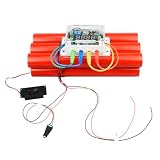
- GAME DESIGN: Interactive escape room prop featuring a countdown timer and wire sequence puzzle to control an electromagnetic lock.
- CHALLENGE MECHANICS: Players must solve the wire plugging sequence within the time limit to successfully open the locked door.
- REALISTIC APPEARANCE: Simulation bomb shape with countdown sound, game failure accompanied by realistic explosion sound, creates tension during gameplay.
- EASY SETTING UP: Set the countdown time and the wire plug sequence step by step refer to the user manual, user also can modify the audio file by yourself.
- INSTALLATION SETUP: Compatible with standard doors, and installation is straightforward and quickly.
| Waveform model | Edge assumption | Breakpoints and envelope | Design significance |
|---|---|---|---|
| Ideal rectangle | Instantaneous transitions | One principal break; approximately 20 dB per decade beyond it | A useful first estimate, but it overstates high-frequency energy when actual edges are finite. |
| Trapezoid | Finite, approximately equal rise and fall times | Two breaks; approximately 40 dB per decade above the second break | Captures the additional high-frequency attenuation caused by finite switching-edge time. |
The locations of the breaks depend on switching period, duty cycle, and rise/fall time. In practical terms, the pulse timing sets the lower-frequency shape change, while edge duration sets the higher-frequency change; shorter edges push their associated roll-off to higher frequencies. The exact break locations should be calculated for the waveform and timing being analyzed rather than assumed from a generic switching frequency.
The Tool Desk
Outbyte Driver Updater FREEFix the driver behind crashes, sound loss and screen glitchesFind Drivers →Outbyte PC Repair FREEClear out junk files and repair common Windows errorsFree Scan →The first breakpoint is not always easy to pick out in a plotted harmonic spectrum. Harmonics occur only at integer multiples of the switching frequency, so a breakpoint can fall between visible lines. The first break is most clearly observable for very narrow duty cycles; with other duty cycles, the discrete samples may obscure it even though the underlying envelope has that change in slope.
How to estimate the differential-mode spectrum
For the differential-mode example, the article approximates FET current as trapezoidal with a flat top. That current waveform is the source used to estimate differential-mode noise. Its harmonics form clusters across the plotted 150 kHz to 30 MHz span; reading the overall envelope is more useful for filter sizing than treating each line as an independent design target.
Rank #3

- This hold hands prop consist of 1 controller with 2 wires and 1 piece of 12v power supply, 2 clips are used as 2 electrodes, One clip for one hand. Adventurers need to use their hands as bridge to unlock.
- The hold hands props support 1-5 people to open lock.
- Owner can conect 2 electrodes separately to 2 big good conductor, also support cut off the clips to fix 2 electrodes on good conductor conveniently.
- Connect 12V EM lock, The red wire of the electromagnetic lock should be connected to NC port of the controller. The black wire of the electromagnetic lock should be connected to COM port of the controller.
- There are 3 ways to reset, owner can choose the suitable reset method to set.
- Set the waveform parameters. Identify the switching frequency, peak-to-peak amplitude, duty cycle, and current rise and fall times for the switching event of interest.
- Locate the harmonic grid. Mark fSW and its integer multiples across the conducted-emissions range being assessed.
- Sketch the envelope. Use the rectangular-wave behavior as the initial approximation, then include the additional high-frequency slope caused by finite edge time.
- Compare the predicted levels with the applicable limit and measurement setup. Start at the lowest relevant frequency, where a required shortfall may demand the greatest filter attenuation.
- Check the assembled design. Account for the actual LISN response and investigate localized excess emissions as potential board-level parasitic problems rather than automatically increasing attenuation everywhere.
How the LISN changes the filter decision
A spectrum estimate alone does not specify the attenuation a filter needs. The measured conducted-noise voltage depends on the noise source, the line impedance presented by the measurement network, the applicable limit line, and the filter between the source and that network. The article therefore treats those together: estimate the emissions, compare them with the limit, and determine the needed attenuation at the relevant frequencies.
As an engineering heuristic, the 2003 article describes LISN impedance below about 500 kHz as falling from roughly 50 ohms toward roughly 5 ohms at very low frequencies, while typical EMI-filter attenuation rises at about 40 dB per decade. Combined with the slope of the limit line, this can create increasing compliance headroom as frequency rises. These are approximate design observations from the article, not present-day regulatory limits or guaranteed values for every LISN and filter.
This reasoning argues against forcing the entire spectrum down to the worst low-frequency margin. If an otherwise adequate filter leaves a narrow, unexpected spike, the cause may be a parasitic coupling path or layout detail. Addressing that path at board level can be more effective than adding broad filter attenuation, which can bring cost, stability, thermal, and implementation penalties.
Rank #4

- There are Simultaneous mode and Sequence mode 2 Playing modes, it is easy to switch the playing modes by the settings switch.
- Support owner revise the trigger sequence of your own. The password support 1-50 times inductions, If the player want to open the lock, he must do rightly according your preset. With a user manual, it is easy to set the MAGNET PROPS step by step.
- It can controll 12V EM lock for escape room game. Connect 12V EM lock, The red wire of the electromagnetic lock should be connected to NC port of the controller. The black wire of the electromagnetic lock should be connected to COM port of the controller.
- There are 3 ways to reset, owner can choose the suitable reset method to set.
- Support users to change audio content, audio format is MP3, no more than 16M.
Common-mode noise: coupling through parasitic capacitance
The common-mode example models a switching FET drain voltage coupling into the earth path through parasitic capacitance Cp. The displacement current divides between line and neutral, producing common-mode noise in the measurement paths. The article presents both a quick Fourier-series approach and a more detailed Laplace-transform treatment.
In this model, the common-mode envelope has a flat pedestal and then rolls off at about 20 dB per decade after the rise-time breakpoint. The article emphasizes that the pedestal does not depend on rise or fall time in its model; edge time determines where the later roll-off begins, not the pedestal level itself.
Worked first-harmonic example
For the article’s example, the input is 100 V, the switching waveform amplitude is A = 200 V, parasitic capacitance is 200 pF, and switching frequency is 100 kHz. Its quick calculation gives a first-harmonic common-mode voltage of 0.4 V, equivalent to approximately 112 dBµV. The conversion is 20 log10(0.4 V / 1 µV), or about 112 dBµV. This is the result for the stated model and values, not a universal common-mode level for a 100 V converter.
Best Value

- The light sensor can identify strong light, player can use flashlight, mobile light or laser pointer to shine it.
- Owner can set the frequency shine sensor to unlock,1-50 frequencies is ok.
- Support owner revise the trigger order of multiple light sensors.
- Red and black line conect to 12v EM lock,when player shine the light sensor in right frequency owner preset,the EM lock will be opened.
- Owner can modify the voice from controller, the password for unlocking also can be changed.
Design the filter as part of the converter
The spectrum is only one part of an EMI solution. The article’s closing point is that filter choices interact with thermal performance, control-loop stability, magnetics, safety requirements, PCB layout, production methods, component technology, cost, and optimization. A filter that meets a conducted-emissions target in isolation can still be unsuitable if it creates another system problem.
Accordingly, use Fourier analysis to identify the likely spectral shape and the attenuation burden, then validate the design in its actual electrical and physical context. The article’s 2003 impedance and slope figures are useful heuristics; current compliance work must use the applicable limit lines, measurement procedure, and equipment for the product and market.
Quick Recap
Product prices and availability are accurate as of the date/time indicated and are subject to change. Any price and availability information displayed on Amazon at the time of purchase will apply.

