
Copying text in an electronic health record (EHR) is not inherently unsafe, but copying it without checking its accuracy, relevance, and source is. Old or incorrect text can be carried forward as if it were newly verified, bury important updates, or end up in the wrong patient’s chart. Safety guidance therefore favors visible, reviewable, carefully governed copying—not a blanket ban.
Why unchecked copy and paste in EHRs can be dangerous
Copied text can make a record look complete while obscuring whether anyone confirmed that the information is still true. When repeated across notes, an error may appear increasingly authoritative even though each repetition traces back to the same unverified entry.
- Stale or irrelevant information: A prior note may describe a condition, medication, or plan that has since changed or no longer matters to the current encounter.
- Errors that propagate: A mistaken statement can persist through later notes, making it harder for clinicians to distinguish a current finding from inherited text.
- Internal inconsistency: New and copied material may conflict, leaving readers unsure which account is accurate.
- Wrong-chart documentation: Text copied into another patient’s record can create a serious integrity risk.
- Note bloat: Long, repetitive notes can make accurate, timely, clinically relevant information harder to find. NIST human-factors participants described this as “hyper-documentation” or “note bloat.”
NIST and ECRI’s human-factors study identified concerns about the integrity of copied information, wrong-chart entry, and excessive documentation that interferes with extracting useful information. The study concluded that the function needs improvement through assurances for the integrity of copied information. NIST, Examining the ‘Copy and Paste’ Function in the Use of Electronic Health Records.
Copying can help when it is controlled
There are legitimate reasons clinicians use copy and paste: it can reduce retyping, save time, support continuity across care, help track complex problems, and reduce transcription errors. The safety question is not simply whether text was copied; it is whether the copied material is identifiable, traceable, and reviewed for the current patient and encounter.
#1 Best Overall

- Microphone grille with optimized structure
- Integrated pop filter
- International products have separate terms, are sold from abroad and may differ from local products, including fit, age ratings, and language of product, labeling or instructions.
The Partnership for Health IT Patient Safety toolkit explicitly rejects prohibiting the function outright: “The literature contains suggestions that copy and paste be prohibited; however, the workgroup does not agree with this position.” Its position supports safeguards rather than unrestricted use or a universal ban. Partnership for Health IT Patient Safety, Health IT Safe Practices: Toolkit for the Safe Use of Copy and Paste (2016).
What the evidence does—and does not—show
Safety organizations have documented plausible hazards and case examples, but the evidence does not establish a universal rate of patient harm from copying. A 2017 systematic review found that, despite regular use, evidence about direct patient-safety risk remained sparse and had significant study limitations. 2017 systematic review.
Rank #2

- Free-floating, decoupled microphone for precise recordings
- Built-in pop filter for perfect sound quality
- Built-in motion sensor for device control by gestures
- Freely configurable function keys for personalised workflow
- Microphone grille with optimised structure for crystal clear sound
The Joint Commission’s July 2021 update reports that a study of diagnostic errors found copy and paste accounted for 2.6% of errors in which a missed diagnosis led patients to seek additional unplanned care. That figure refers to that specific subset of diagnostic errors—not all EHR errors, all copy events, or all patient harm. The update also says the Partnership workgroup’s literature review identified 51 publications; that is a publication count, not 51 studies proving harm. The Joint Commission, “Copy and Paste,” July 2021.
Case reports illustrate how errors can persist without showing how often they occur. AHRQ PSNet describes a case in which a copied abbreviation was misinterpreted as a diagnosis and then persisted in the record. Other cases involve copy-forward and auto-populated text. These features are distinct from manual copying, but all can create documentation-integrity problems when inherited text is not checked. AHRQ PSNet, “Copy-Paste and Copy-Forward Errors” (2018).
Rank #3

- Wireless voice recording Microphone
- You can easily move up to 5 meters or 16 feet away from your workstation and your recordings are safely transmitted to your computer in highest quality, without any interruptions.
How clinicians and health systems can reduce copy-and-paste errors
Make copied text recognizable and traceable
EHRs should make it possible to identify copied or carried-forward material and access its source. Provenance—the origin of the text and when it was recorded—helps a reader judge whether a statement is current or simply inherited. The Partnership toolkit and The Joint Commission both recommend identifying copied material and making its source available.
Revalidate before signing
Before signing a note, the author should check that copied information is accurate for the patient and encounter, still relevant, and consistent with the new assessment and plan. Review should include the surrounding context, not just the copied sentence: a statement can be factually correct in isolation but misleading in a new clinical context.
Rank #4
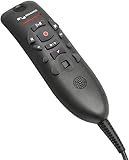
- Speech Recognition: The microphone is designed for speech recognition and dictation in medical and healthcare settings.
- Built-In Microphone: The microphone is built into the device for hands-free operation.
- USB Connectivity: The microphone connects to a laptop or computer via USB for easy setup and use.
- Unidirectional Polar Pattern: The microphone uses a unidirectional polar pattern to pick up sound from a single direction.
- 70dB Signal to Noise Ratio: The microphone provides a high signal to noise ratio of 70dB for clear audio capture.
Train users and monitor patterns
Organizations should train staff in safe use and regularly assess copying practices. Monitoring can help identify patterns such as repeated note bloat, copied content entering the wrong chart, or material being carried forward without meaningful review. The recommendations are organizational and EHR-design measures, rather than consumer software fixes. Partnership for Health IT Patient Safety toolkit; The Joint Commission guidance.
Independent reader supportYour contribution helps us test, update, and keep practical guides available for everyone.What documentation integrity requires
Copy-and-paste safety is part of broader documentation integrity: the record needs accurate content, clear authorship, appropriate governance, and reliable handling of amendments and corrections. AHRQ’s 2024 diagnostic documentation brief notes that clinicians may copy prior notes with minor changes, proliferating unnecessary or irrelevant data. AHRQ, Diagnostic Documentation (2024).
Manual copy and paste, copy-forward, templates, and automatic population are not the same process. Each can introduce inherited text, so controls should make the origin and status of information clear and support review before it is treated as current documentation.
Quick Recap
Product prices and availability are accurate as of the date/time indicated and are subject to change. Any price and availability information displayed on Amazon at the time of purchase will apply.

