
Recommended Free Tools
OMNIVISION’s OV50X is a 50-megapixel image sensor designed for flagship smartphones. It combines a 1-inch optical format, 1.6 µm pixels, and the company’s TheiaCel technology, which OMNIVISION says enables close to 110 dB of single-exposure HDR. The sensor was announced in April 2025; a March 2026 corporate filing says mass production and delivery had begun. No official source cited here identifies a phone that uses it.
What the OV50X is—and what “1-inch” means
The OV50X, identified on OMNIVISION’s product page as OV50X50 (SKU OV50X50-GA3A-004A-Z), is a semiconductor image sensor intended for smartphone manufacturers—not a standalone camera or a consumer-ready camera module. Its 1-inch designation is an optical format, a conventional sensor-size category; it should not be read as a claim that the sensor’s physical diagonal measures exactly one inch.
OMNIVISION announced the component on April 10, 2025, positioning it for premium phones that need high-resolution capture, HDR video, autofocus, and low-light performance. The company describes it as a 50 MP sensor with an 8192 × 6144 active array and 1.6 µm × 1.6 µm pixels.
OV50X specifications at a glance
| Specification | What OMNIVISION states |
|---|---|
| Sensor format and resolution | 1-inch optical format; 50 MP active output; 8192 × 6144 active array |
| Pixel size | 1.6 µm × 1.6 µm |
| Single-exposure HDR | TheiaCel technology; close to 110 dB, according to OMNIVISION |
| Binned output and frame rates | 4-cell binning produces 12.5 MP modes, including 180 fps linear capture and 60 fps three-channel HDR; the brief also lists 90 fps HDR-related operation without specifying its exact mode |
| Video and zoom | Premium-quality 8K video and on-sensor crop zoom are specified |
| Autofocus | 100% coverage quad phase detection (QPD) |
| HDR processing | Dual analog gain (DAG) HDR is specified |
| Sensor construction | PureCel Plus-S stacked-die technology |
| Output interface and format | Up to four-lane MIPI; 10-, 12-, or 14-bit RGB RAW output |
What the HDR and video claims mean
Close to 110 dB of single-exposure HDR
OMNIVISION says TheiaCel extends single-exposure HDR to close to 110 dB. In principle, capturing a wide range of brightness in one exposure can help retain detail in bright highlights and dark areas without combining separately exposed frames. The figure is a manufacturer specification, not an independent measurement established by the cited material.
The Tool Desk
Outbyte Driver Updater FREEScan for outdated or missing drivers - takes under a minuteDriver Scan →Outbyte PC Repair FREERepair Windows errors before they cause bigger problemsFix Now →#1 Best Overall

- Ultra-wide 20mm lens gets it all in the frame, even at arm’s length
- Large 1 inch sensor and F2 lens, for low-light and defocusing backgrounds
- Stay focused with Eye-AF and autofocus tracking technology
- Side-articulating touchscreen LCD for easy to compose selfie shots
- Clear Voice with directional 3-Capsule mic and wind screen accessory
8K is specified, but an 8K HDR mode is not confirmed here
OMNIVISION lists premium-quality 8K video alongside DAG HDR and TheiaCel single-exposure HDR. Those capabilities do not, by themselves, establish that the sensor records 8K and HDR simultaneously in a particular mode. The cited specifications do not state the resolution, frame rate, or operating conditions for an 8K HDR combination.
High frame rates use a lower-resolution binned mode
The stated 180 fps linear and 60 fps three-channel HDR modes are 12.5 MP outputs produced through 4-cell binning, not full-resolution 50 MP capture. OMNIVISION’s brief also mentions 90 fps HDR-related operation but does not provide enough detail to assign that figure to a specific resolution or HDR mode.
Rank #2

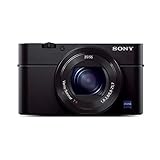
- 20.2 MP 1"-type Exmor R CMOS sensor. 28-100mm equivalent F/1.8-4.9 lens.
- Continuous shooting up to 10 FPS. ISO 160-12800, expandable ISO 100, 125, and 25,600.
- . 1080 60p/24p HD video with full exposure control (MPEG-4/AVCHD)3.0 inch tiltable TFT LCD with 1,229,000 dots
- Raw/JPEG/ Raw+JPEG. Optical zoom : 3.6x (Optical Zoom during movie recording), Digital Zoom : Still images: 20M approx. 14x, 10M approx. 20x, 5M approx. 28x, VGA approx. 54x, Movie: 14x*1.
- Steady-Shot image stabilization. Rear control dial and customizable front control ring.
Why a phone maker might choose this sensor
A 1-inch optical-format sensor and 1.6 µm pixels give manufacturers a relatively large sensor-and-pixel design to work with in a smartphone. OMNIVISION pairs that format with PureCel Plus-S stacked-die construction, which it positions for high resolution and low-light performance, and with QPD autofocus coverage across the array. The design is aimed at combining still-image detail, faster readout, and video features in a flagship camera system.
Those component specifications do not determine how a finished phone will shoot. Lens design, stabilization, image processing, thermal limits, recording settings, and the phone maker’s tuning all affect the result. The cited material includes no independent test-chart results, sample-footage assessment, or controlled comparison with competing sensors, so claims such as “movie-grade” or “best-in-class” should be understood as marketing language rather than verified comparative performance.
Rank #3
- Digital Zoom - 5.8
- Video Capture Resolution - FHD 1080p
Has OV50X entered production, and which phones use it?
OMNIVISION’s April 2025 announcement said the sensor was sampling and targeted mass production in the third quarter of 2025. A corporate filing published in March 2026 says mass production and delivery had begun. That confirms production progress, but it does not establish that a particular smartphone is available to buy.
None of the cited official sources names an OEM launch, retail phone model, consumer availability date, or handset price. Do not assume a phone has the OV50X based on a general “1-inch camera” description; look for confirmation from the phone manufacturer. Because OV50X is a B2B component rather than a retail camera module, the sensor itself is not a consumer purchase option.
Rank #4

- Shoot creatively with legendary Leica Lens optics and a lens control ring
- Capture confidently in low light with a pro-size 1-inch 20MP sensor
- Never miss the shot with 15 frames per second 4K Video to 4K PHOTO play, pause and save
- Connect and share via Bluetooth, Wi-Fi, NFC and cellular* for the ultimate in camera/phone mobility
- View, shoot, and retouch via 4.7" HD touch-screen interface
What to check when a phone with OV50X is announced
The sensor’s specification sheet is only one part of a phone-camera evaluation. A useful handset comparison should establish the actual camera modes and their limits, not infer them from the sensor’s maximum capabilities.
Quick Recap
Best Value

- World's first1 201 MP 1" Exmor RS stacked back illuminated CMOS, High resolution 4K movie recording with direct pixel readout and no pixel binning, Super slow-motion movie3 HFR (High frame rate) up to 960 fps (40x)
- Operating temperature:Approx. 0-40°C (32-104°F).Super-speed Anti-Distortion Shutter at max 1/32000 sec up to 16fps, Bright F18- F28 ZEISS Vario-Sonar T* lens (24-70mm), Fast Intelligent AF thanks to the new Exmor RS CMOS sensor
- Retractable XGA OLED Tru-Finer viewfinder and Sharp 3" multi-angle LCD, Simple connectivity to smartphones via Wi-Fi and NFC w/ camera apps, Dual record of 168MP photos while shooting movie w/ auto settings. Focal length : f is equal to 8.8-25.7mm
- Enhanced pro-video functions and NTSC switchable. Power Consumption : DC3.6 Volt (supplied battery) / DC5.0 Volt (supplied AC Adaptor)
- Confirm the phone maker names OV50X as the sensor in a specific camera.
- Check the camera’s optical format and pixel size, and whether the phone uses the sensor’s full-resolution or binned output.
- Look for stated single-exposure HDR range and the exact resolution and frame rate available with HDR.
- Verify whether 8K recording supports HDR, which frame rates are available, and whether recording is limited by heat, duration, storage, or battery use.
- Assess autofocus behavior, stabilization, lens choice, and the manufacturer’s image-processing pipeline.
- Compare independent footage and finished-phone performance alongside the handset’s price; sensor specifications alone cannot predict image quality.
Product prices and availability are accurate as of the date/time indicated and are subject to change. Any price and availability information displayed on Amazon at the time of purchase will apply.

