
Ambarella’s edge AI platform brings together its CVflow AI acceleration architecture, image and video processing chips, developer software, model packages and engineering support. The goal is to run AI inference on devices such as cameras, vehicles and robots, close to where data is captured, with attention to real-time performance and power use.
What is Ambarella’s Cooper Developer Platform?
Cooper is Ambarella’s developer platform for building products around its AI system-on-chips (SoCs) and accelerators. It groups hardware with software tools and AI model resources, rather than referring to a single chip or a standalone AI model.
Cooper Metal: the hardware layer
Cooper Metal covers Ambarella’s AI SoCs and board-level solutions. Its hardware includes CVflow-equipped parts such as CV7, CV75S and N1, as well as the X7, a standalone CVflow accelerator intended to work with Arm- and x86-based host systems. An M.2 XCalibur card is an option for the X7.
Cooper Foundry: the software layer
Cooper Foundry is the software stack. Ambarella describes it as including compilers, quantization and profiling tools, runtime APIs, model resources and software components for deploying and managing AI workloads on its hardware. The platform also provides engineering support.
Free tools Windows power users keep installed
One-click scans. No signup required.
#1 Best Overall

- AGX Orin 64GB Development Kit makes it easy to get started with AGX Orin. Its compact size, rich interfaces, and AI performance of up to 275 TOPS make it ideal for building advanced AI robots and other autonomous machine prototypes.
- The development kit includes AGX Orin 64GB module and can emulate all Orin modules. It utilizes the Ampere GPU architecture, next-generation deep learning and vision accelerators, high-speed I/O, and fast memory bandwidth. You can leverage the largest and most complex AI models to develop solutions for problems such as natural language understanding, 3D perception, and multi-sensor fusion.
- Jetson runs AI software and provides application frameworks for specific use cases, such as Isaac for robotics, DeepStream for visual AI, and Riva for conversational AI. Using Omniverse Replicator for Synthetic Data Generation (SDG) can save you significant time; while fine-tuning pre-trained AI models from the NGC catalog using the TAO toolkit can further enhance your results.
- Yahboom offers four kits for users to choose from. The AIlarge model voice module utilizes examples of AI large models and multimodal models; it provides 1TB/2TB SSDs with pre-flashed driver image files; and an 8MP USB industrial camera for image processing.
- It offers various online and offline mainstream AI large model development materials. The system is pre-configured with AI vision examples, ROS case studies, and AI large models. It supports offline/online deployment of large models for voice interaction, real-time video analysis, and visual positioning, helping you quickly get started with localized AI agent development.
How does CVflow run AI models at the edge?
CVflow is Ambarella’s computer-vision and AI acceleration architecture. A typical development path begins with a model built or obtained using familiar machine-learning tools, then uses Ambarella’s compiler and optimization tools to prepare it for a CVflow target. At runtime, APIs and software components execute the model on the selected chip or accelerator.
- Choose or train a model. Ambarella describes workflows that can start with models from Caffe, TensorFlow, PyTorch or ONNX-compatible toolchains.
- Compile for the target. The model is mapped to CVflow using Ambarella’s compiler; quantization and profiling tools help prepare and assess the deployment.
- Integrate the runtime. C++ and Python APIs support application integration. Ambarella also describes scheduling and memory-management support for pipelines that use multiple models.
- Profile on the intended device. Evaluate the complete workload on the actual target, including the image or video pipeline and any concurrent models, rather than assuming a model’s desktop performance will translate directly to an embedded product.
For a TensorFlow or PyTorch model, the practical implication is that those frameworks are part of the supported development workflow, not that every model runs unchanged on every Ambarella chip. Confirm the target’s supported operators, model package, runtime and performance requirements with Ambarella before committing to a design.
Rank #2

- 【Core Parameters】★AI Perf: 117/157 TOPS★GPU: 1024-core N-VI-DIA Ampere architecture GPU with 32 Tensor Cores★CPU: 8-core Arm Cortex-A78AE v8.2 64-bit CPU 2MB L2 + 4MB L3★Memory: 16GB 128-bit LPDDR5 | 102.4GB/s★Storage: Supports external NVMe 【Note: This kit does not include a SSD and pre-installed system. User need to provide your own NVMe M.2 SSD of at least 256GB and flash the operating system onto it yourself. 】
- 【Empowered by Large Al Model, Enhanced Human-Computer Interaction】Jetson Orin Super leverages three AI models and incorporates an AI voice interaction module. This multimodal visual system matches the scene being described, enabling environmental awareness and AI visual gameplay. Combined with a large-scale voice module and camera, it enables speech-to-text, semantic analysis, natural conversation, and real-time video analysis, enabling advanced embodied AI applications.
- 【Revolutionize the Industry】Jetson Orin NX modules deliver unmatched performance and efficiency for small, low-power robotics and autonomous machines, making them ideal for drones, handheld devices, and more. The module can be easily used in advanced applications in manufacturing, logistics, retail, agriculture, medical and life sciences, and comes in a highly compact and energy-efficient package.
- 【Revolutionizing AI with Unmatched Performance】The Jetson Orin NX system module adopts the Ampere architecture GPU, a new generation of deep learning and vision accelerators, high-speed I/O, and fast memory bandwidth to support multiple AI application processes. Granular structured sparsity to improve the operating throughput of Tensor Core, and can use larger and more complex AI model development solutions in natural language understanding, 3D perception and multi-sensor fusion.
- 【Tutorial materials provided】The JETSON system based on Ubuntu 22.04 provides a complete desktop Linux environment with accelerated graphics, supporting NVIDI-ACUDA 12.6, TensorRT 10.7.0, cuDNN 9.6.0, OpenCV 4.10.0, etc. The performance on AI LLM, VLM and visual Transformer is significantly improved compared with the previous generation.
How are AI and image processing combined?
Ambarella’s vision-oriented SoCs combine CVflow inference with image signal processing (ISP) and media functions. Depending on the chip, these can include HDR, low-light processing, dewarping, electronic image stabilization, and video encoding and decoding. That integration is relevant when a device must both interpret visual data and deliver a processed or recorded video stream.
For a concrete example, Ambarella’s product documentation specifies the CV52S for 4K processing and says it can record 4KP60 with AI processing at 30 frames per second below 3 W. That is a stated CV52S capability, not a general power figure for Ambarella devices or a guarantee for every AI model and system configuration.
Rank #3

- AGX Orin 64GB Development Kit makes it easy to get started with AGX Orin. Its compact size, rich interfaces, and AI performance of up to 275 TOPS make it ideal for building advanced AI robots and other autonomous machine prototypes.
- The development kit includes AGX Orin 64GB module and can emulate all Orin modules. It utilizes the Ampere GPU architecture, next-generation deep learning and vision accelerators, high-speed I/O, and fast memory bandwidth. You can leverage the largest and most complex AI models to develop solutions for problems such as natural language understanding, 3D perception, and multi-sensor fusion.
- Jetson runs AI software and provides application frameworks for specific use cases, such as Isaac for robotics, DeepStream for visual AI, and Riva for conversational AI. Using Omniverse Replicator for Synthetic Data Generation (SDG) can save you significant time; while fine-tuning pre-trained AI models from the NGC catalog using the TAO toolkit can further enhance your results.
- Yahboom offers four kits for users to choose from. The AIlarge model voice module utilizes examples of AI large models and multimodal models; it provides 1TB/2TB SSDs with pre-flashed driver image files; and an 8MP USB industrial camera for image processing.
- It offers various online and offline mainstream AI large model development materials. The system is pre-configured with AI vision examples, ROS case studies, and AI large models. It supports offline/online deployment of large models for voice interaction, real-time video analysis, and visual positioning, helping you quickly get started with localized AI agent development.
Which Ambarella chips support vision-language models?
Ambarella’s 2025 ISC West release demonstrated DeepSeek reasoning models on CV7 and N1. Separately, Ambarella’s 2026 Form 10-K says one N1 SoC can support transformer models of up to 34 billion parameters. These statements indicate that the platform is being positioned for workloads beyond conventional vision detection, but they do not establish that every vision-language model, model variant or application will run on either chip at a useful speed or power level.
For a specific vision-language deployment, verify the exact model, quantization, supported operations, input pipeline, runtime package and measured throughput with Ambarella. A maximum model-size statement alone does not tell you response latency, concurrent-stream capacity or application-level accuracy.
Rank #4
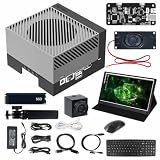
- AGX Orin 64GB Development Kit makes it easy to get started with AGX Orin. Its compact size, rich interfaces, and AI performance of up to 275 TOPS make it ideal for building advanced AI robots and other autonomous machine prototypes.
- The development kit includes AGX Orin 64GB module and can emulate all Orin modules. It utilizes the Ampere GPU architecture, next-generation deep learning and vision accelerators, high-speed I/O, and fast memory bandwidth. You can leverage the largest and most complex AI models to develop solutions for problems such as natural language understanding, 3D perception, and multi-sensor fusion.
- Jetson runs AI software and provides application frameworks for specific use cases, such as Isaac for robotics, DeepStream for visual AI, and Riva for conversational AI. Using Omniverse Replicator for Synthetic Data Generation (SDG) can save you significant time; while fine-tuning pre-trained AI models from the NGC catalog using the TAO toolkit can further enhance your results.
- Yahboom offers four kits for users to choose from. The AIlarge model voice module utilizes examples of AI large models and multimodal models; it provides 1TB/2TB SSDs with pre-flashed driver image files; and an 8MP USB industrial camera for image processing.
- It offers various online and offline mainstream AI large model development materials. The system is pre-configured with AI vision examples, ROS case studies, and AI large models. It supports offline/online deployment of large models for voice interaction, real-time video analysis, and visual positioning, helping you quickly get started with localized AI agent development.
Where is Ambarella’s edge AI platform used?
Ambarella identifies applications across several sectors, including:
- Video security and smart cities: intelligent cameras, access control, retail monitoring and city systems.
- Automotive: advanced driver-assistance systems (ADAS), electronic mirrors, drive recorders, driver and cabin monitoring, and autonomous driving systems.
- Robotics and industry: robotics, industrial equipment and inspection.
- Edge infrastructure: edge servers and other systems that process data near its source.
These are application areas Ambarella lists; they are not a promise that a particular chip, model or safety certification is suitable for every product in those categories.
Quick wins for a faster PC:
Fix the driver behind crashes, sound loss and screen glitchesFind Drivers →Repair Windows errors before they cause bigger problemsFix Now →Best Value

- ESP32-P4-WIFI6-DEV-KIT Development Board, Based On ESP32-P4 and ESP32-C6. It features rich Human-Machine interfaces, including MIPI-CSI (with integrated Image Signal Processor), MIPI-DSI, SPI, I2S, I2C, LED PWM, MCPWM, RMT, ADC, UART, TWAI, etc. Additionally, it supports USB OTG 2.0 HS, Ethernet port and SDIO Host 3.0 for high-speed connectivity.
- The ESP32-P4 chip integrates the Digital Signature Peripheral and a dedicated Key Management Unit, ensuring secure data and operations. Specifically designed for high-performance and high-security applications, the ESP32-P4-WIFI6-DEV-KIT meets the requirements of Human-Machine interaction, efficient edge computing, and IO expansion.
- Supports AI Speech Interaction: Allows access to online large model platforms such as DeepSeek, ChatGPT, etc. Reserved PoE Module Header: More Flexible for Power Supply. Connect to a PoE Module for PoE Power Supply: Provides Both Network Connection And Power Supply for ESP32-P4-WIFI6-DEV-KIT board with Only One Ethernet Cable.
- High-performance MCU with RISC-V 32-bit dual-core and single-core processors. 128 KB HP ROM, 16 KB LP ROM, 768 KB HP L2MEM, 32 KB LP SRAM, 8 KB TCM. 32MB PSRAM in the chip's package, with onboard 16MB Nor Flash. Adtaping 2*20 GPIO headers with 28 x remaining programmable GPIOs.
- Powerful image and voice processing capability. Provides image and voice processing interfaces including JPEG Codec, Pixel Processing Accelerator, Image Signal Processor, H264 encoder. Commonly used peripherals such as MIPI-CSI, MIPI-DSI, USB 2.0 OTG, Ethernet, SDIO 3.0 TF card slot, microphone, speaker header and RTC battry header, etc.
How should you choose an Ambarella platform option?
Start with the application’s actual workload rather than a single headline performance figure. The relevant choice may be an integrated vision SoC, a board-level solution or a standalone accelerator paired with a host, depending on the product architecture.
| Decision factor | What to establish |
|---|---|
| Workload and model | Identify the models, input sizes, operators, precision and whether the application needs conventional computer vision, transformer inference or multiple models in a pipeline. |
| Power and performance | Measure the complete workload against the product’s power and real-time requirements. Do not generalize a figure quoted for one chip or test configuration to another. |
| Image and video pipeline | Check resolution, frame rate, HDR or low-light needs, stabilization, dewarping, encode/decode requirements and the number of simultaneous streams. |
| Hardware form | Determine whether an integrated SoC, board-level design or X7 accelerator with an Arm or x86 host best fits the system. |
| Software compatibility | Confirm framework workflow, supported model formats and operators, runtime availability, compiler requirements and the APIs needed by the application. |
| Product requirements | Assess safety and security needs, lifecycle and supply expectations, reference-design availability and access to engineering support. |
What do Ambarella’s performance and shipment figures mean?
Ambarella reported more than 30 million cumulative edge-AI SoCs shipped in 2025. This is a company-reported cumulative shipment figure across its edge-AI SoCs; it does not specify the installed base of any one product or the performance of a particular deployment.
For the CV75S family, Ambarella said in 2024 that CVflow 3.0 delivers three times the performance of the prior generation. That comparison is specific to the stated CV75S family claim and should not be treated as a universal multiplier for all CVflow chips or workloads.
Quick Recap
Product prices and availability are accurate as of the date/time indicated and are subject to change. Any price and availability information displayed on Amazon at the time of purchase will apply.
What’s actually slowing this PC down?
Pick the symptom - the matching free tool is one click away.

