
Windows Errors? Fix Them Before They Spread
Repair common Windows errors and clear accumulated junk for a smoother, more stable PC - no reinstall needed.Free scan · no reinstallOutdated Drivers Are Slowing You Down
One free scan finds every outdated or missing driver and matches the right update for your exact hardware.Free scan · exact hardware matchRISC-V had a big week in February 2022 because Intel made a substantial commitment to support it, while Nvidia’s proposed Arm acquisition had just collapsed. Together, those developments raised RISC-V’s profile as an alternative to Arm—not as an instant replacement, but as another architecture that chip designers and customers could take seriously.
What made the week significant?
The news was a cluster of strategic signals, not the launch of a new consumer processor. Intel said its foundry business would support designs based on x86, Arm, and RISC-V, and it named partnerships with SiFive, Esperanto, Andes Technology, and Ventana Microsystems. That made RISC-V part of a broader manufacturing and design strategy rather than a standalone experiment.
At the same time, the collapse of Nvidia’s proposed acquisition of Arm prompted some customers to reconsider how much they wanted to depend on Arm. The combination put RISC-V in a sharper competitive spotlight.
What did Intel announce about RISC-V?
Intel joined RISC-V International as a premier member and said Intel Foundry Services (IFS) would support customers building chips around multiple instruction-set architectures. The announcement presented this as a multi-architecture foundry approach: customers could pursue x86, Arm, or RISC-V designs through Intel’s manufacturing and support ecosystem.
Free tools Windows power users keep installed
One-click scans. No signup required.
#1 Best Overall

- Flexible MCU Board: Incorporate the ESP32-C3 32-bit RISC-V chip, operating up to 160 MHz, mounted multiple development ports,
- Developer Friendly: Compatible with Arduino IDE, MicroPython, CircuitPython, PlatformIO, ESP IDF, Zephyr, Matter, ESPNow, Meshtastic, WLED, ESPHome, Home Assistant, Ubidots
- Outstanding RF performance: Complete Wi-Fi functions and Bluetooth Low Energy, while supporting communication over 100m with anFL antenna
- Elaborate Power Design: 4 working modes as low as 44 μA in deep sleep mode, while supporting lithium battery charge management
- Thumb-sized Design: 21 x 17.5mm, Seeed Studio XIAO series classic form factor
Intel also announced partnerships with SiFive, Esperanto, Andes Technology, and Ventana Microsystems. These relationships were intended to connect RISC-V designs with foundry services and related development support.
The proposed $1 billion ecosystem investment
Intel Capital and IFS announced a $1 billion investment in areas including intellectual property, software tools, chip architectures, advanced packaging, wafer shuttles, customer designs, development boards, and software infrastructure. RISC-V adoption was among the goals of this 2022 initiative; the announcement did not mean that the entire amount was earmarked exclusively for RISC-V.
Rank #2
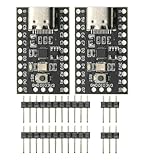
- CH32V003 Development Minimum System Board for Nano RISC-V CH32V003F4U6 Chip TYPE-C USB 22Pin
- on-board 24MHz Crystal oscillator
- Power by TYPE-C USB
That range matters because a processor architecture needs more than a specification: designers need usable IP, tools to build and verify systems, ways to prototype, and a route to manufacture. Intel’s announcement targeted several parts of that broader chain.
Why did Nvidia’s failed Arm deal matter?
Nvidia’s proposed acquisition of Arm faced regulatory opposition and ultimately collapsed. Arm then pursued an IPO. The failed deal also changed how some customers viewed Arm’s neutrality: they considered whether ownership by a major chip company could affect access to Arm technology or the interests of other licensees. This concern increased attention on RISC-V, although it did not establish that customers had broadly switched architectures.
Rank #3

- The ESP32-C3 SUPERMINI is positioned as a high-performance, low-power, cost-effective IoT mini development board, suitable for low-power IoT applications and wireless wearable applications
- It is equipped with a rich set of interfaces, including 11 digital I/Os that can be used as PWM pins and 4 analog I/Os that can be used as ADC pins.
- It supports four serial interfaces, including UART, I2C, and SPI.
- The ESP32-C3 features a 32-bit RISC-V CPU, including an FPU (Floating Point Unit) capable of 32-bit single-precision
- Package: 2PCS ESP32-C3 MINI Development Board ESP32 SuperMini ESP32 C3 WiFi Module
RISC-V’s open instruction-set model offers an alternative governance and licensing path. That can appeal to organizations seeking more control over processor design, but it does not by itself provide the software compatibility or established ecosystem that Arm already had.
Does RISC-V threaten Arm?
RISC-V is a credible competitor, but the 2022 announcements did not show that it had displaced Arm or was about to do so. The two architectures offer different trade-offs, and the right choice depends on a project’s software needs, customization goals, licensing strategy, and available implementation support.
Rank #4

- ESP32-C6 WiFi 6 microcontroller development board adopts ESP32-C6-WROOM-1-N8 module, which is equipped with RISC-V 32-bit single-core processor, up to 160MHz main frequency, built-in 8MB Flash
- Integrates WiFi 6, Bluetooth 5 and and IEEE 802.15.4 (Zigbee 3.0 and Thread) wireless communication, with superior RF performance
- Integrates rich peripherals including SPI, UART, I2C, I2S, LED PWM, SDIO and other interfaces, compatible with the pinout of ESP32-C6-DevKitC-1-N8 development board, more convenient to use and expand a variety of peripheral modules
- Onboard CH343 and CH334 USB HUB chips, supports USB and UART development at the same time via a USB-C port
- Comes with online examples and tutorials for ESP-IDF development environment
| Factor | RISC-V | Arm |
|---|---|---|
| Licensing and openness | Open ISA model, allowing implementers to build compatible processor designs. | Commercial licensing model. |
| Customization | Designers can use extensions and integrate accelerators to tailor a system. | Emphasizes standardized designs and compatibility across its ecosystem. |
| Software ecosystem | Expanding, but the announcements did not establish parity with Arm. | Established software compatibility and developer base were cited as advantages. |
| Foundry and implementation support | Intel announced multi-ISA foundry support and partnerships with four RISC-V companies. | Arm designs remain an option under Intel’s announced multi-architecture foundry strategy. |
| Strategic neutrality | Its open model drew added interest amid customer concerns following the proposed Nvidia-Arm deal. | The proposed acquisition collapsed; Arm subsequently pursued an IPO. |
Arm CEO Rene Haas said the company treated RISC-V “absolutely” as a formidable competitor, noting its open-source movement and use alongside accelerators. In a separate 2022 statement, Haas claimed more than 15 million developers were working on Arm projects. That is an attributed claim by Arm’s CEO, not an independently audited measure of the overall developer market.
Arm’s strongest near-term response was its existing software compatibility and ecosystem. RISC-V’s opportunity was to offer flexibility and customization, especially where designers could build the software and hardware stack around a particular use case.
Best Value

- Ample PSRAM Storage – The development board offers 8MB PSRAM, providing substantial extra memory for handling more complex tasks, large data buffers, and advanced processing.
- Enhanced Multi-Tasking Capability – With the additional 8MB PSRAM, the ESP32-C5-WIFI6-KIT can efficiently manage multiple protocol stacks simultaneously, ensuring smooth operation in multi-tasking IoT environments.
- Support for Medium-Load Applications – The 8MB PSRAM allows the ESP32-C5 to handle medium-load applications more effectively, making it ideal for scenarios requiring real-time data processing or continuous communication.
- Seamless Performance – The increased memory improves the overall performance and responsiveness of the device, particularly when running applications with larger memory footprints or more demanding computations.
- Future-Proof for Complex Projects – With 8MB of PSRAM, developers are better equipped to build scalable, high-performance solutions that support both current and future IoT use cases, offering flexibility for future-proofing designs.
Can you buy a RISC-V product?
The announcements covered industry strategy, foundry support, partnerships, and ecosystem investment; they did not name a specific consumer product to buy. RISC-V is an instruction-set architecture, not a single processor or product brand. A RISC-V chip or development board may be available from individual vendors, but availability and capabilities depend on the particular product. These announcements alone are not a buying recommendation.
What was the likely outcome?
The strategic picture pointed toward coexistence among x86, Arm, and RISC-V rather than one architecture immediately winning. Intel’s stated interest in supporting all three also fit a future in which systems combine different kinds of processors or accelerators, potentially using advanced packaging and chiplet designs. The February 2022 announcements showed increased investment and attention; they did not, by themselves, establish future market share or guarantee commercial success for any architecture.
Quick Recap
Product prices and availability are accurate as of the date/time indicated and are subject to change. Any price and availability information displayed on Amazon at the time of purchase will apply.

