
What’s actually slowing this PC down?
Pick the symptom - the matching free tool is one click away.
Not as a confirmed product launch. A 2024 report says Kioxia’s technology roadmap projected 1,000 wordline layers and 100 Gbit/mm² of NAND die density by 2027. That is evidence of a reported development target—not proof that Kioxia committed to selling 1,000-layer flash to customers in 2027.
What the 2027 target actually means
Blocks & Files reported that Kioxia’s roadmap, presented at the 2024 IEEE International Memory Workshop (IWM), projected 1,000 wordline layers and 100 Gbit/mm² die density by 2027. The original presentation was not available to verify the exact language or qualifications, so the figure is best described as a reported roadmap projection rather than a launch promise. Blocks & Files’ account of the roadmap.

A roadmap target, a demonstrated structure, sample shipments, volume production, and customer availability are separate milestones. The report supports the first of those: a target attributed to a technology roadmap. It does not establish that a commercial 1,000-layer product would be available in 2027.
What Kioxia has disclosed since then
Kioxia’s later company disclosures describe technologies well below 1,000 layers, while emphasizing density and manufacturing economics as broader design goals.
| Disclosure | What it says | What the milestone establishes |
|---|---|---|
| Kioxia 9th-generation TLC, July 30, 2026 | 1Tb TLC devices using a 230-layer stacking process; sample shipments commenced. | Sample shipments—not a 1,000-layer product or proof of mass-market availability. Kioxia announcement. |
| Kioxia and SanDisk next-generation QLC, August 4, 2026 | A 332-layer architecture, bit density above 37 Gb/mm², and a 4.8 Gb/s NAND interface, as reported by the companies. | An announcement of next-generation QLC technology, not evidence of commercial 1,000-layer availability. The release describes its survey basis and limits on test conditions. Joint announcement. |
These disclosures do not establish that Kioxia has no other development work underway. They do show that the cited product and technology milestones are not evidence of a commercially available 1,000-layer device.
Why layer count is not the whole story
More stacked layers can raise the amount of data stored in a given device, but stacking higher also adds manufacturing complexity. Kioxia’s 2025 Integrated Report states: “If the number of stacked layers exceeds 1,000, costs increase further.” The report also describes longer production times and higher manufacturing costs as layer counts rise. Kioxia Holdings Corporation, Integrated Report 2025.
Rank #2
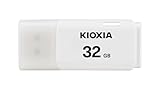
- The simple housing of the TransMemory U202 USB flash drives makes this storage medium your reliable daily companion
- Thanks to the simple enclosure of the TransMemory U202 USB flash drives, you can take this storage everywhere every day.
- Despite its small design, the TransMemory U202 USB flash drives offer plenty of space up to 128GB of storage for photos, music, videos, documents and more.
- Kioxia
In its June 2026 Investor Day presentation, Kioxia said its density strategy extends beyond adding layers: it combines lateral shrinkage with optimized layer counts and balances stacking against chip size, investment costs, and power efficiency. That is why a larger layer number by itself does not demonstrate a lower-cost, more efficient, or more commercially mature product. Kioxia Investor Day materials.
An alternative architecture is also in development
The 2025 Integrated Report says Kioxia is developing a structure that places memory cells horizontally, with commercialization targeted for the early 2030s. That target concerns the horizontal-cell structure; it is not a date for a 1,000-layer flash launch.
Rank #3

- Interface: Support USB 3.2 Gen 1 Super Speed
- Cap type model with strap hole
- Amazon.co.jp Exclusive Model
- Made in Japan
- Warranty period: 1 year from date of purchase
How to judge future NAND roadmap claims
When comparing technology announcements, check more than the headline layer count:
- Development stage: Is the figure a roadmap projection, a demonstrated design, sample shipment, volume production, or customer availability?
- Cell type: Is the device TLC, QLC, or another cell type?
- Density and footprint: What bit density is claimed, and how large is the die or chip?
- Performance and efficiency: Are interface speed and power efficiency disclosed, and under what stated conditions?
- Manufacturing economics: Are cost, investment requirements, production time, or yield addressed?
A higher layer count answers only one part of that comparison. It cannot, on its own, tell you whether a device is ready to ship or offers better practical value.
Quick Recap
Best Value
Rank #4

- High-speed USB 3.0 performance of up to 150MB/s(1) [(1) Write to drive up to 15x faster than standard USB 2.0 drives (4MB/s); varies by drive capacity. Up to 150MB/s read speed. USB 3.0 port required. Based on internal testing; performance may be lower depending on host device, usage conditions, and other factors; 1MB=1,000,000 bytes]
- Transfer a full-length movie in less than 30 seconds(2) [(2) Based on 1.2GB MPEG-4 video transfer with USB 3.0 host device. Results may vary based on host device, file attributes and other factors]
- Transfer to drive up to 15 times faster than standard USB 2.0 drives(1)
- Sleek, durable metal casing
- Easy-to-use password protection for your private files(3) [(3)Password protection uses 128-bit AES encryption and is supported by Windows 7, Windows 8, Windows 10, and Mac OS X v10.9+; Software download required for Mac, visit the SanDisk SecureAccess support page]
Product prices and availability are accurate as of the date/time indicated and are subject to change. Any price and availability information displayed on Amazon at the time of purchase will apply.

