
Recommended Free Tools
Authenticated delegation lets an AI agent act on authority granted by a person or organization while keeping the agent’s own identity visible to the systems it accesses. The receiving service should be able to determine both whose authority is being used and which agent is acting. OAuth 2.0 Token Exchange, standardized in IETF RFC 8693, provides a general foundation for representing subject and actor relationships. It is not, by itself, a complete security profile for autonomous agents.
What authenticated delegation means
In a delegated request, a principal grants an agent some authority, and the agent uses that authority to perform work. The principal may be a person or an organization; the agent is the actor making the request. A resource server—the API or service protecting the requested data or action—needs a verifiable account of both roles.
That distinction matters for accountability. A log that records only the principal can obscure which agent performed an action. A log that records only the agent can omit whose authority supported it. A useful delegation record connects the principal, the acting agent, the authorization grant, and the resource action.
Delegation is different from impersonation
RFC 8693 distinguishes delegation from impersonation. With delegation, the agent remains identifiable as the actor and acts on behalf of a separate subject. With impersonation, the actor is made indistinguishable from the subject within the token’s rights context. The specification describes delegation this way: “With delegation semantics, principal A still has its own identity separate from B, and it is explicitly understood that while B may have delegated some of its rights to A, any actions taken are being taken by A representing B.” This is wording from RFC 8693, not a statement attributed to an individual.
#1 Best Overall

- AI-Powered Raspberry Pi Robot Dog — PiDog: Powered by Raspberry Pi (5/4B/3B+/3B/Zero 2W), OpenClaw, and multi-LLMs like ChatGPT, Gemini, Grok, DeepSeek, Qwen & Ollama. With 12 servos, camera, gyroscope, hearing & touch sensors, PiDog can see, listen, talk, move, and interact intelligently. Supports OpenCV, MediaPipe, TTS & STT, app control, FPV & Python. A great STEM robotics gift for students, makers & tech enthusiasts—perfect for birthdays and holidays. (Raspberry Pi not included)
- Realistic Dog-like Movements: PiDog's 12 powerful servos enable 32 dog-like actions, including walking, sitting, standing, shaking its head, wagging its tail, and performing playful tricks, closely mimicking a real dog and providing an engaging experience. This is an AI development robot product designed for engineers, suitable for ages 15 and above
- Rich Sensor Suite for Interactive Experiences: PiDog features ultrasonic, touch, gyroscope, sound, camera, speaker and microphone. These provide it with advanced hearing, vision, and touch, enabling it to see, detect obstacles, respond to touch, and recognize sounds, making interactions highly engaging
- AI-Powered Interactions with OpenClaw & Multi-LLMs. PiDog combines voice, vision, and gesture recognition for immersive AI experiences. Powered by OpenClaw and multi-LLMs like ChatGPT, Gemini, Grok, DeepSeek, Qwen, Doubao, and Ollama (local LLMs), it can understand questions, respond naturally through TTS & STT, recognize math problems, interpret hand gestures, and hold smart conversations. OpenClaw also enables customizable AI behaviors and personalized robotics development, helping users create their own intelligent robotic companion
- Comprehensive Learning Resources and Support: PiDog offers detailed online documentation, video tutorials, prompt technical support, and an active forum community, ensuring beginners can easily complete all projects and enjoy a great experience
How the authorization flow works
RFC 8693 defines a general OAuth token-exchange mechanism. An authorization server decides, under its own policy and configuration, whether to issue a token for a requested resource and scope. Agent-focused profiles propose additional context and safeguards, but their details are not universal requirements of RFC 8693.
- A principal authorizes bounded work. The system identifies the intended task and the authority available for it. The grant should be no broader than needed for that work.
- The agent authenticates as itself. A workload identity or other credential helps establish which agent controls the credential. A name or claimed agent identifier alone does not prove control of that identity.
- The agent requests an appropriately scoped token. The exchange identifies the subject whose authority is represented and the actor that will perform the action. The authorization server evaluates the request against policy rather than treating the requested authority as automatically approved.
- The resource server validates and authorizes the request. It checks the token and applies its own access rules for the resource and action. Token claims are inputs to this decision, not a replacement for enforcement.
- A downstream handoff preserves the delegation context. If another agent takes over part of the task, the authorization path should retain the relevant subject and actor identities and limit the downstream authority to what was actually delegated.
This is an architectural pattern combining RFC 8693’s general exchange model with proposals in agent-specific drafts. Implementations can differ; the pattern should not be read as a claim that every system supports every step or claim format.
What must be checked at each service boundary
Authentication and authorization answer different questions. Authentication establishes which workload controls a credential; authorization decides whether that workload may perform a particular action on a particular resource. A valid identity is not, on its own, permission to act.
Rank #2

- Optimized AI Arm Kit for LeRobot & Hugging Face Projects – The SO-ARM101 is an upgraded low-cost robotic arm servo motor kit designed for AI robotics enthusiasts and developers. Fully compatible with LeRobot and Hugging Face frameworks, it supports imitation learning and reinforcement learning, making it ideal for real-world robotics applications. (3D-printed parts not included.)
- Enhanced Wiring & Performance – Compared to the SO-ARM100, the SO-ARM101 features improved wiring to prevent disconnection at joint 3 and eliminates range-of-motion limitations. The leader arm uses optimized gear ratio motors for smoother performance—no external gearboxes required.
- Real-Time Leader-Follower Functionality – New real-time tracking allows the leader arm to follow the follower arm, enabling human intervention and correction during reinforcement learning (RL) training. Perfect for hands-on AI robotics development and research.
- Open-Source, DIY-Friendly & Nvidia-Compatible – Developed by TheRobotStudio, this open-source AI Arm kit integrates seamlessly with the LeRobot platform, offering PyTorch-based datasets, simulation, training, and deployment tools. Fully compatible with Nvidia Jetson edge devices, including reComputer Mini J4012 Orin NX 16 GB.
- Comprehensive Learning Resources – Includes detailed open-source assembly and calibration guides, testing tutorials, and deployment instructions. From wiring to AI training, get everything you need to start building, teaching, and optimizing your robotic arm for grasping and placing tasks.
- Token integrity and issuer: Validate that the token is intact and came from an issuer trusted for the deployment.
- Audience and lifetime: Confirm that the token is intended for the receiving service and has not expired.
- Actor and subject: Interpret delegation claims according to the chosen profile, keeping the principal and acting agent distinct where delegation semantics apply.
- Credential binding: Where required by the profile, validate proof of possession, such as an mTLS- or DPoP-based mechanism, rather than relying only on possession of a bearer token.
- Local authorization policy: Decide whether the identified agent can perform the requested action under the relevant task, scope, resource, and context constraints.
- Audit context: Record enough information to connect the principal, agent actor, grant, and resource action while following the organization’s audit and retention rules.
These checks need to happen at the resource boundary. A task description, scope, or capability claim does not enforce itself; the receiving service must validate the applicable claims and make an authorization decision.
Quick wins for a faster PC:
Repair Windows errors before they cause bigger problemsFix Now →Scan for outdated or missing drivers - takes under a minuteDriver Scan →Identity and credentials for agent workloads
Agent identity can be represented through OAuth client identity, an OpenID Connect subject and issuer, a SPIFFE ID backed by a SPIFFE Verifiable Identity Document (SVID), or another managed workload-identity system. The right choice depends on the environment and trust boundaries. NIST’s February 2026 concept paper discusses OAuth/OIDC for authorization and authentication, SPIFFE/SPIRE for workload identity and attestation, SCIM for identity lifecycle, and NGAC for fine-grained access control. The paper frames an enterprise project; it is not a finalized implementation guide.
IETF WIMSE interim slides from 2026 discuss workload credentials, SPIFFE SVIDs, token exchange, mTLS, message proofs, and human-in-the-loop flows. They indicate areas of working-group discussion, not a single complete deployed standard for agent delegation. A short-lived credential bound to a workload and supported by an appropriate proof mechanism is a relevant design direction, but the exact mechanism must be selected and enforced by the deployment.
Rank #3
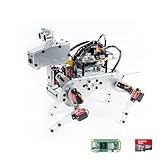
- Raspberry Pi AI Robot: powered by Raspberry Pi (5/4B/3B+/3B/Zero 2W), features 12 servos and sensors for vision, hearing, and touch. Integrated with ChatGPT-4o, it responds to complex queries. With app control and FPV, users can manage and see its view in real-time. It supports Python programming
- Realistic Movements: 12 powerful servos enable 32 actions, including walking, sitting, standing, shaking its head, wagging its tail, and performing playful tricks, closely mimicking a real and providing an engaging experience
- Rich Sensor Suite for Interactive Experiences: features ultrasonic, touch, gyroscope, sound, camera, speaker and microphone. These provide it with advanced hearing, vision, and touch, enabling it to see, detect obstacles, respond to touch, and recognize sounds, making interactions highly engaging
- Engaging Interactions with ChatGPT-4o: with ChatGPT-4o enables voice interactions and visual recognition, making it smarter and more responsive. Users can have natural conversations, solve math problems via the camera, and interpret gestures, creating diverse and fun interactions
- Comprehensive Learning Resources and Support: offers detailed online documentation, video tutorials, prompt technical support, and an active forum community, ensuring beginners can easily complete all projects and enjoy a great experience
Options and standards maturity
The established protocol foundation and the agent-specific proposals are at different maturity levels. The dates and draft status below are those stated in the cited documents; Internet-Drafts can change, expire, or be replaced.
| Document or approach | Status and date | What it contributes | Important limit |
|---|---|---|---|
| OAuth 2.0 Token Exchange, RFC 8693 | IETF Proposed Standard, published January 2020 | General HTTP/JSON token-exchange mechanism; covers impersonation and delegation semantics and subject/actor roles. A JWT act claim can represent an actor chain. |
It is a general OAuth mechanism, not a complete AI-agent security profile. Issuance remains subject to authorization-server policy and configuration. |
| Agent Authorization Profile (AAP) for OAuth 2.0, draft-01 | Internet-Draft published February 7, 2026; stated expiry August 11, 2026 | Proposes agent identity, task context, capabilities, oversight, delegation, and audit claims; recommends mTLS or DPoP proof of possession and discusses token exchange for delegation or privilege reduction. | Its listed expiry has passed as of October 3, 2026. Check the IETF archive for a successor; do not assume this draft remains current or universally implemented. |
| KAIF, draft-00 | Internet-Draft published July 19, 2026; stated expiry January 20, 2027 | Proposes combining RFC 8693, SPIFFE workload identity attestation, and operator-assigned authorization tiers for bounded transactions that cross boundaries. | An author’s proposal, not an adopted IETF standard. |
| Credential Delegation Protocol for AI Agents, draft-00 | Internet-Draft; publication and expiry dates not stated here | Proposes combining token exchange, proof of possession, rich authorization requests, and CIBA. It describes credential wrapping, consent, cascading revocation, and audit chains without defining new token formats or grant types. | These are proposal details pending review and adoption, not settled interoperability guarantees. |
| NIST NCCoE concept paper | Concept paper, February 2026 | Frames enterprise work on software and AI-agent identity and authorization, including OAuth/OIDC, SPIFFE/SPIRE, SCIM, and NGAC. | Project framing, not a finalized implementation guide. |
| IETF WIMSE interim slides | Working-group discussion material, 2026 | Surveys workload credentials, SPIFFE SVIDs, token exchange, mTLS, message proofs, and human-in-the-loop flows. | Slides are not a normative specification. |
Handling chains of agents
When one agent delegates part of a task to another, the receiving service needs more than a statement that the work originated with a particular principal. It needs a way to evaluate the acting agent and the authority carried through the handoff. RFC 8693 discusses representing an actor chain with an actor claim. Agent-specific drafts explore additional chain metadata, credential binding, and revocation mechanisms, but no particular chain format is established here as universally interoperable.
What’s actually slowing this PC down?
Pick the symptom - the matching free tool is one click away.
Before deployment, decide how many handoffs are allowed, how each downstream agent is authenticated, and how authority is reduced or checked at each step. Also define what happens if authorization is withdrawn while work is in progress. A token’s expiry alone does not settle active revocation behavior, especially across multiple services or administrative domains.
Rank #4

- 【End-to-End Imitation Learning】Hiwonder SO-ARM101 robot arm is an embodied intelligent hardware platform compatible with the Lerobot open-source framework. It provides developers with streamlined access to shared code, templates, and pre-trained models to explore the latest advancements in AI research.
- 【Dual-Camera Vision System】Equipped with both a gripper-mounted camera and an external camera, the system supports both precise manipulation and environmental awareness for accurate imitation learning.
- 【Hiwonder High-Performance Bus Servos】Featuring 12 high-torque bus servo motors with magnetic feedback, the Hiwonder SO-Arm101 robotic arm delivers smooth, stable motion, eliminating issues like power deficiency and jitter.
- 【Professional Control & Debugging】Integrated with the Hiwonder BusLinker V3.0 debugging board, the system supports servo scanning, real-time status monitoring, and trajectory control. The professional PC software simplifies device calibration and debugging, making it accessible for both researchers and hobbyists.
- 【Open-Source Compatibility】The SO-ARM101 robotic arm is designed to be fully compatible with the LeRobot open-source project. We acknowledge the contributions of the open-source community; all trademarks and copyrights belong to their respective owners.
How to compare an implementation design
No cited source provides a quantitative performance comparison or proves interoperability among the agent-specific proposals. Compare designs against the actual trust boundaries and enforcement points in your environment:
| Decision area | Questions to answer |
|---|---|
| Maturity | Is the design based on a published RFC, an Internet-Draft, a vendor profile, or local conventions? What happens if a draft changes? |
| Agent identity | How is the workload identified—through OAuth client identity, OIDC, SPIFFE/SPIRE, or another managed identity—and who operates that identity system? |
| Credential binding | Is a bearer token sufficient for this boundary, or does the profile require mTLS, DPoP, or another proof-of-possession mechanism? |
| Authorization precision | Can policy constrain the task, capability, resource, and context, or does it rely mainly on broad scopes? |
| Chain semantics | Can the system retain and validate the subject and each actor in a multi-hop handoff? |
| Lifetime and revocation | How long do credentials last, how is authorization withdrawn, and what do services do with already-issued credentials? |
| Auditability | Can logs link the human or organizational subject, each agent actor, the grant, and the resource action? |
| Operational burden | What changes are required for key lifecycle, authorization-server policy, resource-server validation, consent, and failure handling? |
Common failure modes to avoid
- Forwarding a broad user bearer token to every agent. This can obscure the acting agent and carry more authority than a downstream task needs. Prefer an authorization-server decision for the relevant resource and scope, with subject and actor context preserved where the chosen profile supports it.
- Trusting an identifier without authenticating its controller. A string that names an agent is not proof that the requester controls that agent’s credentials. Establish the workload identity and validate the required credential proof.
- Treating token claims as automatic permission. The resource server still needs to validate claims and enforce local policy.
- Leaving cross-domain trust implicit. Make clear which issuers and operators are trusted, what each service validates, and how authority is bounded across administrative boundaries.
- Ignoring task drift and prompt injection. These are system and policy risks to account for; the cited standards and project materials do not quantify an agent-specific threat rate.
- Assuming revocation or consent works the same in every draft. Specify revocation, asynchronous consent, audit retention, and delegation-depth behavior for the deployment rather than relying on a proposal’s unimplemented mechanisms.
What is established—and what is still emerging
RFC 8693 is the established general-purpose building block for OAuth token exchange and delegation semantics. It gives systems a vocabulary and mechanism for representing a subject and an actor, but the authorization server and resource server still have policy decisions to make. Agent-specific profiles and multi-system compositions are emerging Internet-Drafts or discussion materials, not a finalized, universally implemented AI-agent delegation standard.
The available sources establish neither real-world interoperability among these drafts nor adoption, latency, effectiveness, or security-incident statistics. An architecture should therefore be judged by its enforceable identity, authorization, chain, and audit behavior—not by the existence of a draft name or a claimed agent identifier.
Free tools Windows power users keep installed
One-click scans. No signup required.
Quick Recap
Product prices and availability are accurate as of the date/time indicated and are subject to change. Any price and availability information displayed on Amazon at the time of purchase will apply.

