
A pod can have SR-IOV virtual-function (VF) interfaces on multiple network rails and still fail to communicate across them. The missing piece may be a route or policy-routing rule, but the right fix depends on the pod’s interface addresses, rail subnets, gateways, routing profile, and the surrounding network. Without those details, there is no safe universal route command.
What “multi-rail” and SR-IOV mean in this setup
NVIDIA’s DOCA documentation describes the SR-IOV CNI plugin as provisioning VF network devices into pods: “The SR-IOV Container Network Interface (CNI) plugin provisions Virtual Function (VF) network devices into the Pods.” The plugin works with a device plugin and a metaplugin such as Multus.
Multus participates in attaching secondary networks to a pod and passes allocated device identifiers to delegate CNI plugins. A NetworkAttachmentDefinition can identify a device resource through an annotation. The NVIDIA Kubernetes Launch Kit uses “multi-rail” to mean enabling more than one east-west rail, and documents destination-based and source-based routing options.
Why cross-rail communication can fail
Having multiple interfaces does not establish how traffic should leave the pod. A packet’s path depends on the pod’s addresses and route tables, any policy-routing rules, the selected routing profile, and whether the network fabric can carry traffic to the destination. Replies also need a valid return path; forward routing alone does not establish that responses use the expected rail.
Quick wins for a faster PC:
Scan for outdated or missing drivers - takes under a minuteDriver Scan →Clear out junk files and repair common Windows errorsFree Scan →Fix the driver behind crashes, sound loss and screen glitchesFind Drivers →#1 Best Overall

- 6 Pin to 8 Pin PCIe Adapter: Connect a 6-pin male PCIe power plug from a compatible power supply to the 8-pin PCIe power input on a supported graphics card. Confirm the connector types before ordering
- For Compatible Low-Power GPUs: Use the PCIe power adapter only when the power supply and its 6-pin PCIe connection provide sufficient power for the graphics card. Check the documented power requirements of the PSU and GPU before installation
- 8 Pin to 6 Pin PCIe Adapter: The GPU power adapter changes a 6-pin PCIe connection into an 8-pin connector but does not increase the PSU wattage, current capacity, or available power. It is not suitable for bypassing GPU power requirements
- Secure PCIe Connections: The 8-pin male connector features a locking latch, while the 6-pin female connector uses a keyed housing to support proper alignment and help prevent accidental disconnection
- Convenient 2-Pack: Use the two PCIe adapter cables with separate compatible systems or keep one as a spare. Compatible with select Gigabyte, Radeon, and Sapphire graphics cards with an 8-pin PCIe power input. Check the GPU power requirements before use. Not compatible with CPU/EPS 8-pin ports
The Launch Kit documents routing profiles, not a one-size-fits-all route for every topology. A concrete route cannot be inferred without the interface names, subnet prefixes, gateways, and intended source-and-destination pairs. Applying a guessed default route or source rule can send traffic onto the wrong rail or leave replies asymmetric.
Gather the pod and deployment facts before changing routes
- Identify the attached interfaces and addresses. Inspect the pod’s network interfaces and determine which secondary network attachment supplied each one. Record each interface name, address, and prefix.
- Capture routes and policy rules. Record the pod’s route table and policy-routing rules, including which table or interface a rule selects. Do not assume that the main routing table describes all traffic paths.
- Map intended traffic. For each failing flow, note the source address, destination address, expected rail, and whether the destination is on-link or reached through a gateway.
- Check the network attachment and CNI chain. Confirm the NetworkAttachmentDefinition, allocated device resource, and delegate CNI plugins in use. Compare those components with the selected routing profile.
- Check both directions. Establish that the chosen rail can reach the destination and that the destination’s reply can return through the expected interface and path.
These observations distinguish a missing pod route from a mismatch in the CNI profile, an unreachable gateway, or an invalid return path. They also provide the information needed to choose a route or policy without guessing.
Rank #2

- COMPATIBILITY: PCIe 16x riser adapter designed for GPU extension, supporting PCIe 3.0 standard with male to female connection
- 90-DEGREE DESIGN: Innovative L-shaped design enables right-angle GPU mounting, perfect for space-constrained PC cases
- DUAL PACK VALUE: Includes two identical PCIe extension adapters for multiple GPU setups or backup purposes
- PROTECTION FEATURES: Built-in slot protection mechanism helps prevent accidental damage during installation and removal
- CONSTRUCTION: Durable blue PCB with reinforced turquoise mounting bracket ensures stable connection and reliable performance
Choose routing behavior to match the traffic design
The Launch Kit offers two routing approaches. The choice should follow the workload’s traffic requirements and the network design, not a general assumption that all cross-rail traffic needs source-based routing.
| Question | Destination-based routing | Source-based routing |
|---|---|---|
| What triggers route selection? | The destination address and matching routes determine the path. | Source-based policy is used when traffic needs to be routed according to its source; confirm the specific profile’s rules and tables. |
| When might it fit? | When destinations or prefixes map cleanly to the intended rails. | When traffic from different source interfaces must remain on their corresponding rails. |
| Documented CNI detail | The Launch Kit documents this as a routing option. | In the documented Launch Kit profile, the sbr CNI plugin is added outside Spectrum-X. This is profile-specific; check the Launch Kit version and deployment profile before applying it. |
| What still needs validation? | That the selected route reaches the destination and the return path works. | That source-based rules select the intended table and both forward and return paths work. |
The reference does not determine which option is correct for a particular cluster. Verify the behavior against the versions and configuration actually deployed, including the NVIDIA Network Operator, Launch Kit, CNI plugins, and Kubernetes.
Rank #3
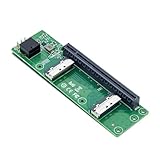
- High-speed data transfer : The adapter is designed for use with ssd that use MICO 8x connectors, allowing for fast and reliable data transfer at speeds of up to 24 Gbps.Easy to use: Simply plug in the MCIO 74 Pin end of the adapter into your device and the MCIO 74pin/38pin end into your external hard drive, and you're ready to go.
- One detachable PCIE PCI-Express 8x motherboard can be connected,The converter can be installed into the system internally through the MCIO interface.Only supports motherboards with detachable PCI-E channels.Control the operation of two disks based on the motherboard PCIE channel,The motherboard without PCIE signal split can only recognize one disk.
- What is mini cool edge Io (MCIO): MCIO adapters are designed for data center, networking and telecommunications markets that use SAS, PCIe, Ethernet and othersignal protocols.
- The solution can support adapter to board and card to board applications in system, which include chip to chip, chiptomodule, chip to board and card edge option.High-performance adapter for networking and server equipment: The MCIO Mini Cool Edge IO is designed to support a wide range of protocols, including SAS, PCIe, Ethernet, and more, ensuring optimal performance for your equipment.
- Built-in multiple sets of high-power DC modules for sustainable and stable work; Industry standards: Support for SAS 3.0/4.0, PCIe Gen 3/4/5, 25G Ethernet, and 56GT/s PAM4 means that you can trust that your equipment will perform at optimal levels without any signal loss or degradation.
What information is needed to prescribe a route
Before writing an exact route or policy rule, collect at least the pod’s interface names and addresses, the prefixes for each rail, the relevant gateways, the current route tables and policy rules, and the intended source-and-destination pairs. Also identify the routing profile and CNI chain. Without those values, an example command would encode assumptions that may not fit the network.
Once those facts are known, compare the intended path with the pod’s actual route and rule selection, confirm gateway reachability on the selected interface, and verify the destination-side return path. Change only the route or policy that the comparison shows is missing or incorrect.
Quick Recap
Best Value

- 【PCIe 4.0 x4 High-Speed Performance】This Pcie Oculink Riser Card Supports PCIe 4.0 x4 with 64Gbps bandwidth. Native direct connection brings ultra-low latency and improved performance over regular Thunderbolt for eGPU, enterprise NVMe SSD and high-speed peripherals
- 【Broad Compatibility】Backward compatible with PCIe 3.0. Ideal for eGPU, high-speed NVMe storage and server expansion. Plug-and-play, works smoothly with Windows and Linux systems
- 【PCIe 4.0 x4 to Oculink SFF-8611 8612 4i】This adapter board converts PCIe 4.0 X4 interface to OCuLink port, standard 4i design (not 8i), compatible with copper cable and optical fiber cable. Widely match most mainstream OCuLink devices, deliver stable high-speed short-distance transmission. (Cables are not included.)
- 【Stable & Reliable Build】Adopts 10U gold-plated pins and high-frequency low-resistance high-temperature resistant PCB board. Built-in circuit protection blocks current backflow from external GPU to safeguard motherboard. Equipped with signal boosting parts to reduce signal loss and interference, delivers steady full-speed performance. Durable connectors support frequent plugging for long-term stable use.
- 【Package Include】a PCIe 4.0 x4 to OCuLink Riser Card with Low & Full Profile PCI Brackets
Rank #4

- 1)MCIO to PCIe 5.0 Host Interface Adapter:This adapter converts a motherboard's internal SFF-TA-1016 (MCIO) 8i port into a standard PCIe 5.0 x8 slot, enabling the connection of PCIe devices like GPUs and SSDs directly through the Mini Cool Edge IO interface.
- 2)Unlock High-Speed Device Connectivity:Designed to leverage the full bandwidth of PCIe 5.0, it facilitates high-speed data transfer for compatible devices, supporting advanced configurations like Intel VROC for NVMe RAID arrays.
- 3)Enterprise-Grade Performance & Flexibility:Built for data center and networking environments, the MCIO standard supports multiple protocols including PCIe, SAS, and high-speed Ethernet, ensuring robust performance with support for the latest signal standards.
- 4)Integrated Power & Simple Installation:Features built-in high-power DC modules for stable operation. Installation is straightforward: simply connect the MCIO cable from the motherboard to the adapter and install your PCIe card.
- 5)Universal Form Factor Compatibility:Includes both low-profile (8cm) and standard (12cm) brackets, ensuring mechanical compatibility with a wide range of server chassis and workstation systems.
Product prices and availability are accurate as of the date/time indicated and are subject to change. Any price and availability information displayed on Amazon at the time of purchase will apply.

