
What’s actually slowing this PC down?
Pick the symptom - the matching free tool is one click away.
NASA does not steer Curiosity with a live joystick. Rover planners at NASA’s Jet Propulsion Laboratory (JPL) study images, choose a destination, mark safe routes and hazards, then send the rover a sequence of commands. Curiosity carries out those instructions with onboard software that estimates its motion, checks nearby terrain and can choose a safe local path.
How does NASA plan a Curiosity drive?
Planners use stereo images from the rover’s cameras to build a view of the terrain and decide how Curiosity should proceed. They can send a drive instruction in several ways:
- Blind drive: Travel a specified distance and direction without making route choices along the way.
- Waypoint navigation: Head toward designated points while steering clear of marked keep-out zones.
- Autonomous navigation: Proceed toward a destination while the rover evaluates nearby terrain and selects safe movements within the limits set by planners.
People choose the destination and operating bounds; Curiosity makes some of the immediate driving decisions. As rover planner and mobility engineer Mark Maimone put it in JPL’s “Leave the Driving to Autonav” transcript: “Humans are still in the loop. We’re going to tell her where to go. Curiosity is going to decide how to get there.”
How does Curiosity move and estimate its position?
When following a blind-drive instruction, Curiosity estimates distance from wheel rotations. NASA’s Learn About Me: Curiosity page says one full wheel revolution without slipping covers nearly 25 inches (63 centimeters). That is an estimate based on the wheel turning as expected, not a guarantee of the distance traveled over loose or uneven ground.
#1 Best Overall
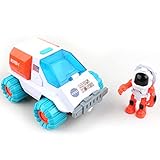
- GET READY FOR ADVENTURE: Open the cockpit and place the astronaut inside, push the button to get the engines' flashing lights and make realistic sound, place the other astronaut inside the space rover and explore outer space using this vehicle, equipped with satellite dish, camera, detector and solar panel. Now you can start your space adventure and explore outer space.
- TAKE ME TO OUTER SPACE: Comes with 9.5 x 7.5 (approx.) inch spaceship, 7 x 8 inches (approx.) space rover car, two Astronaut figures and two 1.5V AA Alkaline batteries.
- FEATURES: Extended turning mechanical arm that's stored behind the compartment opens and closes doors, Rolling wheels, Lights and Sounds, Opens and closes Canopy, and Transparent window. Compatible with our other space toys from Space Adventure Series Mars Mission collection.
- OUR SPACE TOYS: made from non-toxic ABS plastic the space toys design with rounded corners for child’s safety.
- FOR KIDS AGES: 3 years and up
The rover also combines gyroscope and accelerometer readings with measured wheel rotations to estimate its position and orientation. These onboard measurements let it track progress between communications with Earth.
How does Curiosity detect wheel slip?
Curiosity uses visual odometry as a check on wheel-based estimates. It compares Navcam images taken before and after movement, matching surface features to estimate how far the rover actually moved. If that visual estimate disagrees with the distance implied by wheel rotations, the difference can reveal wheel slip.
Rank #2

- ✅【Meaningful Design】Inspired by the action of human exploration on Mars and the Moon, this very different cosmic exploration vehicle style remote control car was created, unfolding the sail panel can automatically turn on the light effect, if closed to save power consumption, and comes with a model astronaut.
- ✅【The Best Gift of Enlightenment】This RC toy car is suitable for children from 4 years old and up, cultivating kids' interest in the future of science and space, having fun, and being educational. It is the best space gift for birthdays, children's days, Christmas, Easter, summer camp activities, and back to school.
- ✅【Rich Control Gameplay】The RC cars have special 6 wheels (4 drive wheels + 2 auxiliary wheels) and can be controlled by a combination of remote controls to achieve a variety of movements [1]. Forward and backward movement. [2]. Lateral movement. [3]. Turning around in place. [4]. Sideways adjustment of body direction. [5]. DEMO auto-drive mode.
- ✅【Adaptable to Multiple Terrains】Powerful damping springs and high-torque wheels allow the remote control cars to drive and climb over rough terrain, both indoors and outdoors and are not prone to rollovers.
- ✅【Strong Signal, No Interference】Using a high-quality 2.4 GHz remote control, the actual test effective control distance of 30 meters (no exaggerated propaganda) is very responsive. The signal stability and control distance are much stronger than the traditional infrared remote control.
Planners set how frequently the rover performs these checks and how much slip is acceptable before it should stop driving for the day. JPL reports that visual odometry has been used on more than 90% of Curiosity drives and converged successfully in 99.6% of its first 20,682 attempts. Those figures describe the use and performance reported by JPL for those drives and attempts, not a guarantee for every future drive.
How does Curiosity avoid rocks and steep slopes?
During autonomous navigation, the rover processes stereo images from its navigation and hazard cameras to identify obstacles such as large vertical steps, steep slopes and rough terrain. It can then choose a route around hazards while continuing toward the destination selected by the planners.
Recommended Free Tools
Rank #3

- IGNITE SPACE EXPLORATION PASSION: Dive into the world of Martian engineering with the Perseverance Mars Rover, an immersive NASA-inspired STEM toy. Assemble and operate a real working Mars rover powered by a powerful motor, equipped with a movable robotic arm, strong grip, and powerful torque, offering the excitement of Martian exploration up close.
- UNVEIL STEM WONDERS: Unbox the future of learning with the Perseverance Mars Rover kit, containing 71 pieces and a 60-page educational and instructions booklet. Aimed at kids aged 8 and above, this kit is more than just a toy—it's a gateway to hands-on STEM education, fostering curiosity and understanding in robotics, mobility systems, electrical connections, and transmission systems, among other disciplines.
- MASTER SPACE MISSION CONTROL: Embark on a journey of discovery as you assemble and control the Perseverance Mars Rover model. With its DC motor capable of driving uphill and crossing uneven surfaces, children simulate Martian exploration missions, learning about the intricacies of mobility systems and experiencing the excitement of space missions on the Red Planet.
- EMPOWER FUTURE INNOVATORS WITH STEM EDUCATION: Inspire the next generation of scientists and engineers with the Perseverance Mars Rover. Through interactive play, children not only gain valuable insights into robotics, engineering, and space exploration but also develop essential skills like hand-eye coordination and concentration, laying the foundation for future STEM careers and innovations.
- BOND THROUGH COSMIC ADVENTURES: Bring families and friends together with the Perseverance Mars Rover kit, fostering teamwork and collaboration as they tackle assembly challenges and simulate Martian exploration missions. Spark lively discussions about space exploration and science, creating lasting memories filled with learning and fun.
JPL describes a hazard-checking pattern in which Curiosity may stop after every 0.5 meter of travel, or travel up to 1.5 meters between checks when nearby terrain is judged safe. At a check, it takes four sets of images, evaluates potential hazards and selects its next safe movement. The spacing varies with the rover’s assessment of the terrain; it is not a fixed distance for every drive.
Independent reader supportYour contribution helps us test, update, and keep practical guides available for everyone.How do commands get from Earth to Mars?
Curiosity cannot be driven continuously from Earth, so it must execute much of a plan between communications contacts. Commands are uploaded as lists or sequences, while data return to Earth through either a direct radio link or a relay through a Mars orbiter. The timing of a particular command depends on the geometry of Earth, Mars and the spacecraft, available relay passes and mission scheduling; there is no single universal command latency.
Rank #4

- Hot Wheels 2014 Hw City Planet Heroes Mars Rover Curiosity 71/250
- Orbiter relay: Curiosity most often communicates through an approximately 400 MHz UHF antenna and Mars Odyssey or Mars Reconnaissance Orbiter. Relays are useful for returning larger volumes of data, such as panorama imagery.
- Direct Earth link: The rover’s steerable high-gain antenna can communicate directly with Earth and is useful for smaller command lists, including instructions to wake and drive.
JPL describes these communication paths on its mission communications page. Because contacts are scheduled opportunities rather than a continuous connection, onboard software is essential to carrying out a drive safely between them.
Does Curiosity make science decisions autonomously?
Some autonomy also supports science work. JPL’s AEGIS system can examine and rank targets, select one that meets criteria specified by scientists, and command ChemCam observations without waiting for a new decision from Earth. JPL says AEGIS has been in routine use on Curiosity since May 2016. This is a separate capability from autonomous driving: the system selects qualifying science targets, while human scientists set the criteria.
The Tool Desk
Outbyte PC Repair FREEClear out junk files and repair common Windows errorsFree Scan →Outbyte Driver Updater FREEScan for outdated or missing drivers - takes under a minuteDriver Scan →Quick Recap
Product prices and availability are accurate as of the date/time indicated and are subject to change. Any price and availability information displayed on Amazon at the time of purchase will apply.

