
What’s actually slowing this PC down?
Pick the symptom - the matching free tool is one click away.
For small, occasional messages, Bluetooth Low Energy (BLE) is usually the best starting point for a battery-powered device. UWB can use less energy than BLE for certain short ranging exchanges, while conventional Wi-Fi (IEEE 802.11) often uses more energy during active communication. None is universally lowest-power: the result depends on the task, radio mode, airtime, sleep behavior, retries, and the energy used by the device’s processor.
What does “power consumption” mean for a wireless device?
Power is the rate at which a device uses energy; energy is what its battery must supply over time. A radio that draws more power while transmitting can still use less energy for a particular task if it finishes much faster. Conversely, a low-power radio can drain a battery if it has to listen, scan, retry, or take many measurements for a long time.
For a useful comparison, estimate energy for the same completed task—not just a headline transmit-power figure. Include transmit and receive time, sleep and idle periods, failed attempts, and, where possible, the processor and power-conversion overhead. Keep the payload, range, success criterion, and measurement frequency the same.
- Energy per task: joules for one message, ranging fix, or transaction.
- Active power and airtime: how much power the radio uses while working and how long the exchange lasts.
- Idle and sleep energy: often decisive when a sensor wakes infrequently.
- Retries and processing: weak links or extra measurements can outweigh a radio’s nominal advantage.
How do the published power figures compare?
The figures below describe different things and come from different sources; they are context, not a controlled head-to-head benchmark. In particular, the Bluetooth specification’s transmit-power range is not a measurement of a whole device’s battery draw.
#1 Best Overall

- Bluetooth 5.4 + Broad Compatibility - Provides Bluetooth 5.4 plus EDR technology and is backward compatible with Bluetooth V5.3/5.0/4.2/4.0/3.0/2.1/2.0/1.1.
- Faster Speed, Extended Range - Get up to 2x faster data transfer and 4x broader coverage compared to Bluetooth 4.0 — perfect for smooth audio streaming and stable connections.
- EDR and BLE Technology - This Bluetooth dongle is quipped with enhanced data rate and Bluetooth low energy, UB500 has greatly improved data transfer speed and operates at the optimal rate of power consumption
- Nano-Sized - A sleek, ultra-small design means you can insert the Nano Bluetooth receiver into any USB port and simply keep it there regardless of whether you are traveling or at home
- Plug & Play with Free Driver Support - Plug and play for Windows 8.1/10/11 (internet required). Supports Win7 (driver required and can be downloaded from website for free). Download the latest driver from TP-Link website to utilize Bluetooth 5.4
| Technology or mode | Published figure | What the figure means |
|---|---|---|
| Bluetooth Low Energy | 0.01 mW (-20 dBm) to 100 mW (+20 dBm) | LE radiative transmit-power range in Bluetooth Core Specification 6.2, accessed in 2026. It is a radio output range, not continuous device consumption. |
| Short-range Bluetooth | About 1–2.5 mW | Indicative transmit-power range in an IEEE Innovation at Work report from 2017. The report cautions that the values are estimates and radios do not transmit continuously at full power. |
| Cellular/Wi-Fi | About 100–1,000 mW | Indicative transmit-power range for cellular and Wi-Fi in the same 2017 IEEE report, with the same caveat. It is not a universal Wi-Fi measurement or a direct comparison of energy per task. |
| 802.11ba wake-up radio | Less than 100 microwatts | Power draw described for the wake-up radio in an IEEE Innovation at Work preview from 2017. This specialized low-power architecture is not the conventional Wi-Fi data radio. |
| UWB | 27/31 Mbps transfer rates cited by FiRa | Rates cited in FiRa’s Technical FAQ, accessed in 2026, for IEEE 802.15.4z. These are transfer rates, not power measurements; short airtime can matter to energy use. |
When is Bluetooth Low Energy the lower-power choice?
BLE is designed for low-power communication and is a strong fit for beacons, wearables, control links, and sensors that exchange small amounts of data intermittently. The Bluetooth SIG describes short packets, multiple physical-layer options, and low-duty-cycle operation as part of that design. BLE operates in the 2.4 GHz ISM band.
BLE power is configurable rather than fixed. Bluetooth Core Specification 6.2 defines LE 1M as mandatory and LE 2M and coded PHYs as optional, and permits local adjustment of output power to manage consumption or interference. The permitted radiative transmit power runs from 0.01 mW (-20 dBm) to 100 mW (+20 dBm); that range does not tell you what a particular device draws in normal use. Connection interval, scan behavior, payload size, retransmissions, and the host processor all affect battery life.
Rank #2
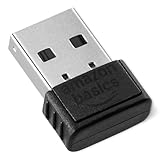
- INSTANT BLUETOOTH ACCESS: Bluetooth dongle adapter receiver for PCs converts non-Bluetooth devices into Bluetooth-capable with simple USB connection
- WIDE COMPATIBILITY: Supports Bluetooth 5.4 and is backwards compatible with Bluetooth 5.3/5.2/5.1/5.0/V4.2/4.0/3.0/2.1/2.0/1.1; ONLY works with Windows 8.1, 10, and 11
- MULTI-DEVICE CONNECTION: Connect up to 6 devices simultaneously; Not compatible with all other operation systems e.g. Mac, Linux, Chrome, Unix, Playstation(PS), Windows 7 and below; Nano bluetooth receiver can be plugged in via any standard USB port
- ENHANCED PERFORMANCE: EDR and BLE technology offers enhanced data rate/transfer speed and low energy consumption
- SYSTEM REQUIREMENTS: Not compatible with all other operation systems e.g. Mac, Linux, Chrome, Unix, Playstation(PS), Windows 7 and below; Disable any built-in Bluetooth of the device before use this product, refer to the user manual for detail
Can UWB use less energy than Bluetooth?
Yes, for some ranging patterns. FiRa says UWB can use less power than BLE in transmit-only or synchronized two-way modes. Its explanation is task-specific: short packets and fast transfers—FiRa cites 27/31 Mbps for IEEE 802.15.4z—can reduce airtime. A ranging solution may also need fewer samples or less post-processing than a positioning approach based on BLE or Wi-Fi.
UWB is most compelling when secure, precise ranging or positioning is central to the product. It is not automatically more efficient for every data exchange. The number of ranging rounds, pulse-repetition settings, listening time, and processing requirements matter. IEEE 802.15.4z adds physical-layer coding options and MAC support for time-of-flight ranging.
Crashes, No Sound, or Screen Glitches?
Random freezes, missing sound and display glitches usually trace back to one bad driver. Find and replace yours safely.Free scan · under a minuteWindows Errors? Fix Them Before They Spread
Repair common Windows errors and clear accumulated junk for a smoother, more stable PC - no reinstall needed.Free scan · no reinstallRank #3

- Upgraded Bluetooth 5.3 Adapter: This bluetooth adapter for pc uses the latest upgraded Bluetooth 5.3 BR+EDR technology, greatly improves the stability of the connection data transfer speed, reduces the possibility of signal interruption and power consumption.
- Up to 5 Devices Sync Connected: UGREEN Bluetooth dongle for PC supports up to 5 different types of Bluetooth devices to be connected at the same time without interfering with each other, such as Bluetooth mouse/keyboard/mobile phone/headphones, etc. If Bluetooth audio devices of the same type (such as speakers/headphones) are connected, only one device can play music.
- Plug and Play: The Bluetooth adapter is developed for Windows systems only and does not support other systems. No driver installation is required under Windows 11/10/8.1. NOTE: Win 7, Linux and MacOS System are NOT supported.
- Mini Size: An extremely compact Bluetooth stick that you can leave on your laptop or PC without removing it.The compact size does not interfere with other USB ports. Convenient to carry, no space occupation.
- What Can I do if the Bluetooth adapter can not work?: Ensure there are no other Bluetooth devices installed on the computer. If there are, disable all existing Bluetooth devices in "Device Manager", then insert the adapter and try again. (For detailed information please read the user manual)
Is Wi-Fi always more power-hungry?
No. Conventional Wi-Fi data radios commonly use more energy while actively communicating than BLE does for a small sporadic message, but “Wi-Fi power” is not a single fixed value. The IEEE’s 2017 indicative figures put cellular/Wi-Fi transmit power above short-range Bluetooth, while warning that the estimates vary and radios are not transmitting continuously at full power. Actual device energy depends on how long it stays active, its sleep behavior, link conditions, and the job being done.
Low-power 802.11 architectures also exist. IEEE material on 802.11ba describes a wake-up radio drawing less than 100 microwatts. That is a specialized wake-up function, not a claim that a conventional Wi-Fi data radio operates at that level. Wi-Fi can still be the practical choice when throughput, IP networking, or existing WLAN infrastructure matters more than minimizing the energy of each small message.
Rank #4

- This Bluetooth adapter for PC utilizes the latest Bluetooth 6.0 EDR technology, delivering faster data transfer speeds, seamless high-quality audio/video streaming, and efficient large-file transfers.
- Up to 5 Devices Sync Connected: This Bluetooth dongle for PC supports up to 5 different types of Bluetooth devices to be connected at the same time without interfering with each other, such as Bluetooth mouse/keyboard/mobile phone/headphones, etc. Note: If Bluetooth audio devices of the same type (such as speakers/headphones) are connected, only one device can play music.
- Ultra-High Data Transfer Speeds: With Bluetooth 6.0 technology, this bluetooth dongle will bring us a faster speed experience. And Bluetooth 6.0 is backward compatible with Bluetooth5.4/5.3.
- EDR and BLE Technology - This Bluetooth dongle is equipped with enhanced data rate and Bluetooth low energy, it wil optimize energy.
- Plug and Play: The Bluetooth receiver is developed for Windows systems only and does not support other systems. No driver installation is required under Windows 11/10/8.1. NOTE: Linux and MacOS , Win 7 System are NOT supported.
Which technology should you choose for a battery-powered device?
| Choose | When it fits | Account for |
|---|---|---|
| BLE | Small, infrequent payloads; beacons; control links; broad phone compatibility; long periods asleep. | Scan and connection schedules, radio output power, retransmissions, and processor overhead. |
| UWB | Secure, precise ranging or positioning is a core requirement, and exchanges can remain short. | Ranging frequency and rounds, listening time, pulse-repetition settings, and host processing. |
| 802.11 / Wi-Fi | Higher throughput, IP connectivity, or an existing WLAN is the priority. | Active transfer time as well as idle and sleep energy; distinguish the data radio from any specialized wake-up radio. |
In some designs the choice is not exclusive. FiRa profiles commonly pair UWB with BLE out-of-band signaling, allowing each radio to serve a different role. The best arrangement depends on the product’s discovery, data-transfer, and ranging needs.
Independent reader supportYour contribution helps us test, update, and keep practical guides available for everyone.How to make a fair power comparison
- Define the task. Specify the payload or ranging result, required success rate, range, and how often the device must complete it.
- Name the radio mode. Record the PHY and relevant settings, transmit power, and whether the device is scanning, connected, ranging, or using a wake-up radio.
- Measure the whole cycle. Include transmission, reception, listening, retries, sleep, and host processing where possible—not only peak or transmit power.
- Compare energy per successful task. Use joules per delivered message or completed ranging fix under the same conditions, and note the hardware, firmware, and test conditions.
- Check the deployment trade-off. Include infrastructure and integration needs alongside battery use; a radio that costs more energy may still be the right choice for the network or function required.
There is no established universal, apples-to-apples benchmark ranking BLE, UWB, and mainstream 802.11 across identical hardware, payload, range, retries, and duty cycle. Treat general rankings as use-case tendencies, not guarantees for a specific device.
Quick Recap
Best Value

- Bluetooth 5.4 dongle: Applies the latest Bluetooth 5.4+EDR technology, compatible with Bluetooth 5.3/5.2/4.2/4.2 LE/4.0/2.1+EDR, and supports Dual mode (BR/EDR+ Bluetooth Low Energy) to achieve low energy consumption and high speed. Quick response and better anti-interference.
- Plug & Play: USB wireless Bluetooth is not limited by network and location, no need to install drivers, just plug the USB wireless adapter into your computer, you can use it directly. You can use the Bluetooth function at any time. Greatly improve your work efficiency and save your time.
- Long Range Bluetooth Adapter: The USB Bluetooth 5.4 dongle uses Class 1 radio technology, equipped with extra long antenna, and the transmission range in the open area can reach 500ft/150m, Bluetooth connections are no longer affected by distance. Note: The actual transmission range will be affected by physical obstructions and wireless interference.
- Fast Transmission Rate: This upgraded Bluetooth 5.4 adapter features EDR technology and Bluetooth Low Energy (BLE) configuration up to 3Mbps, which greatly improves transmission rates and reduces the loss of transmission efficiency due to interference in the 2.4GHz band. Enables fast, no delay wireless data connections between your computer and Bluetooth devices.
- System Support: The upgraded Bluetooth 5.4 dongle has a wide range of applications. You can connect up to 5 devices at the same time using Bluetooth wireless. Such as Bluetooth speakers,keyboards,headsets,mice, and Bluetooth printers,etc. Only supports Windows 11/10/8.1, Not compatible with Mac OS, Linux,car stereo systems,XBOX,ps4 or TVs.
Product prices and availability are accurate as of the date/time indicated and are subject to change. Any price and availability information displayed on Amazon at the time of purchase will apply.

