
A seven-axis robot can route its elbow around fixtures and obstacles while keeping its tool pointed at the work. In electronics production, that extra freedom can help in tight spaces and complex approaches—but it is not what gives a robot a delicate touch. Force or torque sensing paired with compliant control lets a robot detect contact and adjust how it moves. Buyers should distinguish a true seven-joint arm from a six-axis robot on a rail or mobile platform, then compare sensing, reach, payload, programming and integration for the job at hand.
What the seventh axis does
A conventional six-axis arm can orient its tool in many ways, but its joints constrain how it reaches a given position and orientation. A true seven-axis arm adds a redundant joint, usually at the elbow. Because the robot has another way to configure its arm while maintaining the same end-effector pose, it can move the elbow around a fixture, wall or other obstruction.
That extra degree of freedom can make it easier to plan complex trajectories in narrow factory or semiconductor-fab spaces. EE Times Asia reported in 2023 that KUKA’s LBR iiwa can move its arm out of the way for an end-of-arm-tool position, helping reduce the risk of a joint reaching a mechanical limit or singularity. Redundancy does not make every path possible or remove the need for collision and motion planning; it gives the system another configuration to use.
“Seven axis” can mean two different things
- Seven-joint arm: The arm itself has seven joints, commonly including a redundant elbow. This is the meaning when discussing elbow clearance and alternative arm configurations.
- Six-axis arm with a seventh external axis: A six-axis robot rides on a rail, robot transfer unit or autonomous mobile robot. The added movement comes from the platform, not a seventh joint in the arm.
The KMR iiwa example described for electronics manufacturing is a cobot paired with a mobile platform, so it illustrates the second meaning. The distinction matters: an external axis can extend where a robot works, while an additional arm joint changes how the arm can reach and orient its tool.
#1 Best Overall

- 7-Axis High-Precision Bionic Motion – Features coordinated 7-axis movement for flexibility and accuracy. Enables dexterous reach-around operations in confined spaces and multi-angle fine-tuning of the end effector, supporting smooth path planning and reliable repeat positioning under complex working conditions.
- High-Rigidity Integrated Body – Constructed with a composite of metal and high-strength engineering plastic, balancing lightweight design with structural rigidity. Provides good deformation resistance, maintains stability during long-hour continuous operation across various scenarios, and offers a solid mechanical foundation for high-precision motion output.
- Compact, Lightweight & Plug-and-Play – Desktop-class lightweight design weighing 5.5 kg, easy to set up and move. Plug-and-play operation, suitable for space-constrained labs and classrooms.
- Open-Source Programming & Expandable Interfaces – Control programs and interfaces are open-sourced for iterative development. Supports rapid swapping of various end effectors at the arm tip (note: gripper not included), accommodating diverse research and project needs.
- Versatile for Research, Education & Collaborative Tasks – Designed for scientific research and educational scenarios. Supports dual-arm collaboration for sorting and assembly, self-maintenance operations, and simulation of household tasks, serving as a practical tool for exploring service robotics applications.
Why sensing matters for a light touch
Dexterity and touch solve different problems. The extra axis helps position and route the arm; force and torque sensing, combined with compliant control, helps it respond when the tool meets resistance. That response can be useful when inserting a component, plugging a connector or handling a delicate part. A robot described as force-controlled is not automatically safe for every contact task: the application still needs suitable tooling, programming, risk assessment and safety measures.
Product claims should be read as vendor specifications, not as independent comparisons. Flexiv describes the Rizon 4 as using whole-body force sensing for force-controlled precision on delicate tasks. ATOMROBOT says its SkyArms AR-A7 has torque sensors in every joint and a minimum detectable force of 0.5 N, and lists compliant plugging, soft assembly and collision detection among its capabilities. The 0.5 N figure is the vendor’s stated minimum detectable force; it is not, by itself, a measure of achievable assembly accuracy or safe contact force.
Rank #2

- Spark Your Creativity with Robotic Arm: Hiwonder-xArm1S is a high-quality desktop robot arm capable of remote-control grasping, object transportation, custom actions, graphical programming, and more. It serves as the ideal platform for building and showcasing creative projects and for learning about bionic robotics.
- Intelligent Servo: Hiwonder-xArm1S is equipped with 6 high-precision intelligent serial bus servos that provide position, voltage and temperature feedback. These powerful servos deliver strong torque, enabling the robot arm to grasp objects weighing up to 500g with ease.
- Premium Structure Design: The robot arm is constructed from an exquisite aluminum alloy bracket. The base is fortified with high-torque servos and industrial-grade bearings, guaranteeing exceptional stability.
- Various Control Methods: It supports PC, phone app, mouse, PS2 wireless control, and you can also control the robotic at your fingertips. With these control methods, Hiwonder-xArm1S would bring more methods of play and study, perfect for realizing your innovative programming ideas and coding study.
- Versatile Action Editing: Hiwonder-xArm1S provides various action editing methods through a user-friendly interface, including PC, app, and offline manual editing. This versatility allows you to easily create a wide range of robot applications.
Where seven-axis systems fit in electronics production
Wafer handling in semiconductor fabs
EE Times Asia reported in 2023 that Infineon’s Villach, Austria, fab uses 17 KUKA LBR iiwa robots to transfer cassettes carrying 200-mm or 300-mm wafers through more than 1,000 production steps. The reported steps include deposition, implantation, etching and measurement. It is a concrete example of robots moving material through a complex fab workflow; it does not establish that every such transfer requires a seven-joint arm.
Electronics assembly and inspection
Reported electronics tasks include placing motherboards, inserting heatsinks, screwing boards into desktop-PC housings, and transferring circuit boards from production to quality control or conveyors. For insertion, fastening and finishing, force sensing may help manage contact; for approaching crowded fixtures, redundant-arm dexterity may help with the path. ATOMROBOT lists delicate inspection, micro-assembly and surface finishing, while Flexiv lists contour tracking, component insertion and screw fastening.
Rank #3
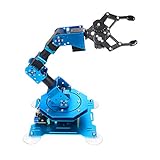
- Spark Your Creativity with Robotic Arm: Hiwonder-xArm1S is a high-quality desktop robot arm capable of remote-control grasping, object transportation, custom actions, graphical programming, and more. It serves as the ideal platform for building and showcasing creative projects and for learning about bionic robotics.
- Intelligent Servo: Hiwonder-xArm1S is equipped with 6 high-precision intelligent serial bus servos that provide position, voltage and temperature feedback. These powerful servos deliver strong torque, enabling the robot arm to grasp objects weighing up to 500g with ease.
- Premium Structure Design: The robot arm is constructed from an exquisite aluminum alloy bracket. The base is fortified with high-torque servos and industrial-grade bearings, guaranteeing exceptional stability.
- Various Control Methods: It supports PC, phone app, mouse, wireless PS2 Wireless Controller, and you can also control the robotic at your fingertips. With these control methods, xArm robotic Arm would bring more methods of play and study, perfect for realizing your innovative programming ideas and coding study.
- Versatile Action Editing: Hiwonder-xArm1S provides various action editing methods through a easy-to-use interface, including PC, app, and offline manual editing. This versatility allows you to easily create a wide range of robot applications.
Packaging, logistics and machine tending
FANUC robots are reported boxing, sealing, labeling and transporting finished PCs, keyboards and mice. A six-axis FANUC arm can gain a seventh external axis by riding a rail or robot transfer unit, allowing the system to travel along a production area.
Productive Robotics describes its OB7 as a teach-by-touch seven-axis cobot for loading and unloading CNC machines, including batches as small as five to ten parts, and says it can run unattended. Company president Zac Bogart told EE Times, “A cobot can squeeze time out of machines that aren’t being used due to the skills shortage.” Bogart also said a job shop can teach the OB7 a job by hand and run parts the same day. Those are company statements about its product and use case, not independently verified production results.
Rank #4

- Multi-axis robotic arm: Featuring a multi-axis design, it is suitable for dynamic robotic applications
- Metal frame construction: Constructed from durable metal materials, ensuring the robotic arm is structurally robust and long-lasting
- Large dimensions and powered base: The robotic arm’s large dimensions and powered base ensure stability and rigidity
- Multi-axis robotic arm: Capable of diverse movements and control
How the named robots compare
The available figures below come from vendor descriptions and are not a head-to-head test. Payload and accuracy figures should not be treated as directly comparable without matching test conditions, tooling and measurement methods.
| Robot | Sensing and stated capabilities | Payload and reach | Accuracy or force figure | Programming or application notes |
|---|---|---|---|---|
| Flexiv Rizon 4 | Flexiv describes whole-body force sensing and force-controlled precision for delicate tasks. | 4 kg payload; 876 mm reach, as listed by Flexiv. | ±0.05 mm repeatability, as listed by Flexiv. | Flexiv lists contour tracking, component insertion and screw fastening. Programming details are not stated in the supplied product information. |
| ATOMROBOT SkyArms AR-A7 | ATOMROBOT says torque sensors are embedded in every joint; listed applications include compliant plugging, soft assembly and collision detection. | 10 kg payload, as listed by ATOMROBOT; reach not stated in the supplied product information. | ±0.05 mm repeat positioning accuracy and a minimum detectable force of 0.5 N, as stated by ATOMROBOT. These are different measures from repeatability. | ATOMROBOT lists delicate inspection, micro-assembly and surface finishing. Programming details are not stated in the supplied product information. |
| Productive Robotics OB7 | Productive Robotics describes it as a teach-by-touch seven-axis cobot for CNC loading and unloading. | Payload and reach are not stated in the supplied product information. | Accuracy and force-sensing figures are not stated in the supplied product information. | The company describes hand-guided teaching and says it can be used for small batches and unattended CNC tending. |
How to choose a system for a cramped, high-mix line
Axis count alone is a poor selection rule. Start with the work envelope and contact demands, then check the complete cell, controls and operating pattern.
Free tools Windows power users keep installed
One-click scans. No signup required.
Best Value

- ADVANCED TELEOPERATION CONTROL – Designed for AI researchers and robotics engineers, this 6DOF teaching pendant enables precise teleoperation for Aloha and LeRobot frameworks. With 0.8ms ultra-low latency and 5-8mm control precision, capture high-quality imitation learning datasets for embodied intelligence research. Perfect for human-robot interaction studies.
- HIGH-PERFORMANCE WIRELESS CONTROL – Features UART communication protocol with 0.8ms response time per ID and multi-axis dynamic suppression algorithm. Supports angle feedback with optional force feedback and vision auxiliary modules upgrade. Compatible with ROS1/ROS2 and MoveIt for seamless integration with mainstream industrial and collaborative robots.
- MULTI-SCENARIO APPLICATIONS – Ideal for teleoperation research, imitation learning data collection, industrial control, collaborative robotics, and mobile robot integration. Controls bus servo motors, servo motors, and robotic arms on mobile platforms. Supports 3/4/5/6-axis teaching with one-button synchronization and locking functions.
- LIGHTWEIGHT & PORTABLE DESIGN – Weighing only 1430g with 388mm arm reach, this foldable teaching arm offers ergonomic grip for fatigue-free extended use. Ultra-compact when folded for easy transport and storage. Human-centric design with intuitive trigger-controlled gripper and one-button operation for seamless control experience.
- FULLY OPEN-SOURCE & COMPREHENSIVE SUPPORT – Complete ROS1/ROS2 control code and communication interface documentation provided. Includes modular examples and tutorials for beginners. CH340/CH343 driver installation guide included. Technical support available for setup, programming, and project development. Start your AI robotics journey today.
- Define the motion problem. Map the tool poses and approach paths the job requires. If the arm must route around fixtures while preserving tool orientation, investigate a redundant seven-joint arm. If it needs to cover a longer line or several stations, assess whether a rail or mobile platform is the relevant external axis.
- Identify the contact problem. For insertion, plugging, screw fastening or delicate finishing, ask what force or torque sensing is present and how compliant control is configured. Request the conditions behind any detection threshold, accuracy or force-control claim.
- Check payload, reach and tooling together. A published payload or reach is only one part of fit. Confirm that the robot can handle the actual component, gripper and cable arrangement through the required path; specifications for the Rizon 4 and AR-A7 were not established under common test conditions.
- Match programming to changeover frequency. Productive Robotics describes hand-guided teaching for the OB7. For other candidates, establish whether operators will use hand-guiding, visual blocks or an SDK, and how the method fits the line’s maintenance and programming resources. The available product information does not establish equivalent programming details for all three robots.
- Validate safety and integration. Review applicable safety standards and certifications for the exact robot and application; no certification comparison is established here. Also confirm mounting options, power and communications interfaces, controller compatibility, guarding or collaborative operation requirements, and how the robot interacts with people and other equipment.
- Test representative work before committing. A practical evaluation should use the actual fixture, tooling, parts and cycle sequence, including the tightest approach and likely contact conditions. Compare reliable task completion and changeover demands rather than axis count or a single vendor accuracy number.
What the evidence does not establish
The cited deployment and vendor specifications illustrate possible uses, but they do not establish a universal productivity gain, total cost of ownership, or a winning robot for every electronics line. No independent head-to-head performance test or total-cost-of-ownership study is available in the evidence summarized here. Treat manufacturer figures and application descriptions as starting points for a cell-specific evaluation.
Quick Recap
Product prices and availability are accurate as of the date/time indicated and are subject to change. Any price and availability information displayed on Amazon at the time of purchase will apply.

