
Philips moved ARM technology into catalog microcontrollers with the LPC2100 family: the first named parts were the LPC2104, LPC2105 and LPC2106, built around an ARM7TDMI-S core. The move offered developers a route from 8-bit and 16-bit controllers to 32-bit processing without giving up the familiar, low-cost microcontroller model.
What Philips announced—and what “standard end” meant
On 13 March 2002, Philips and ARM announced a common embedded-controller architecture combining the ARM7TDMI-S processor core with Philips’ 0.18-micron CMOS embedded-Flash process. Philips was extending ARM beyond custom ASIC and system-on-chip designs into standalone, catalog-style microcontrollers that customers could select for ordinary embedded products. “Standard” here describes that catalog-product approach, not a new industry standard or a promise that every device shared identical hardware.
Philips said the process enabled operation down to 1.2 V, compared with the then-current 0.25-micron, 2.5 V standard. The company also claimed faster throughput, doubled on-chip memory density, higher I/O bandwidth and lower power. Those are Philips’ claims about its process and architecture in the 2002 announcement, not independent measurements or a guarantee that every system would operate at 1.2 V.
The architecture combined a common design with ARM PrimeCell peripherals, EmbeddedICE-RT debugging and Embedded Trace Macrocell support. For product developers, shared memory mapping, interrupt handling, flash programming and debugging were intended to make devices in the family easier to approach with common tools and software.
#1 Best Overall

- with pre-soldered header Raspberry Pi Pico. RP2040 microcontroller chip designed by Raspberry Pi in the United Kingdom
- Dual-core Arm Cortex M0+ processor, flexible clock running up to 133 MHz. 264KB of SRAM, and 2MB of on-board Flash memory.
- Castellated module allows soldering direct to carrier boards. USB 1.1 with device and host support. Low-power sleep and dormant modes. Drag-and-drop programming using mass storage over USB. 26 × multi-function GPIO pins.
- 2 × SPI, 2 × I2C, 2 × UART, 3 × 12-bit ADC, 16 × controllable PWM channels.Accurate clock and timer on-chip.Temperature sensor.
- Accelerated floating-point libraries on-chip.8 × Programmable I/O (PIO) state machines for custom peripheral support
Which LPC2100 parts came first?
EE Times reported the LPC2104, LPC2105 and LPC2106 as the initial devices for 16- and 32-bit applications. Philips Semiconductors’ 2003 product information, as reported by EE Times, gives the LPC2104’s detailed specifications below. The available figures do not establish all corresponding specifications for the LPC2105 and LPC2106.
| Part | Flash | SRAM | Core and operating frequency | Documented distinction |
|---|---|---|---|---|
| LPC2104 | 128 kB, zero-wait-state flash at 60 MHz | 16 kB | ARM7TDMI-S; 60 MHz | RTC, watchdog, PLL, PWM, I2C and SPI; 48-pin LQFP or MicroLeadFrame package. Source: EE Times reporting Philips Semiconductors, 2003. |
| LPC2105 | Not stated in the cited EE Times/Philips Semiconductors 2003 information | 32 kB | ARM7TDMI-S; 60 MHz family operating frequency | More SRAM than the LPC2104, intended to help with connectivity workloads. Source: EE Times reporting Philips Semiconductors, 2003. |
| LPC2106 | Not stated in the cited EE Times/Philips Semiconductors 2003 information | 64 kB | ARM7TDMI-S; 60 MHz family operating frequency | More SRAM than the LPC2104, intended to help with connectivity workloads. Source: EE Times reporting Philips Semiconductors, 2003. |
The three devices shared a memory map, interrupt controller, flash programming and update mechanism, peripherals and debug facilities, according to EE Times. That commonality mattered as much as the processor: teams could target different memory capacities without starting from entirely unrelated device architectures. Philips positioned the larger SRAM options for uses such as TCP/IP and other connectivity workloads.
Rank #2

- The Raspberry Pi Pico is a beginner-friendly microcontroller board that uses MicroPython to give you a taste of the Internet of Things and microcontrollers. The RP2040 is a well-designed microprocessor that can be utilized in almost any Internet of Things project. It has enough power to complete the task quickly.
- 【Raspberry Pi RP2040 Microcontroller】Raspberry Pi Pico features Dual-core ARM Cortex M0+ processor, flexible clock running up to 133 MHz. With 264KB of SRAM, and 2MB of on-board Flash memory.Supports up to 16 MB of off chip flash memory via a dedicated QSPI bus
- 【Multiple Software Support】Pico has rich and complete software support, it comes with a complete Rasberry Pi official C/C++ SDK, Micropython SDK.The programming and burning of Pico need to be carried out on the computer. Supported operating systems and computers include:Raspberry Pie with Raspberry Pi OS,Other platforms equipped with Debian based Linux system Computer with MacOS, Computers with Windows, etc.
- 【Rich Hardware Interface】Raspberry Pi Pico has 30 GPIO pins, 4 pins for analog signal input and 26 × multi-function GPIO pins, 2 × SPI, 2 × I2C, 2 × UART, 3 × 12-bit ADC, 16 × controllable PWM channels.USB 1.1 supported by host and device, The installation mode can be flexibly selected by users to facilitate welding with other development boards.
- 【Build Project in Tiny Size】Only 2.1cm*5.1cm ( as small as your thumb). Pico has been designed to use either soldered 0.1" pin-headers or can be used as a surface-mountable 'module'.
Why Philips wanted 8-bit and 16-bit developers to move up
Philips presented the LPC2100 as a “smooth, low-cost migration path” from 8-bit and 16-bit microcontrollers to 32-bit devices. The practical appeal was more processing capability and the possibility of reusing software and development knowledge, while keeping a standard MCU form factor and approach rather than commissioning a custom chip. Migration was a product strategy, not a guarantee that an existing program would run unchanged: the core, peripherals, memory map and development setup still had to fit the application.
Contemporary coverage described planned sampling in late 2002 and volume production in early 2003, initially emphasizing automotive and dial-up networking/TCP-IP applications. The stated application range across Philips and industry coverage included automotive cabin controls, industrial and medical devices, software modems, display monitors, audio entertainment, connectivity and battery-powered consumer products. These are intended or discussed markets, not evidence that every LPC2100 device included every interface those products might need.
Recommended Free Tools
Rank #3

- Ample Memory and Non-Welding Design** featuring 64KB Flash and 20KB SRAM, this smallest system microcontroller is ideal for a wide range of applications, from simple to advanced embedded systems
- High-Performance STM32F103C8T6 Development Board** with ARM 32-bit Cortex-M3 MCU, running at 72MHz, perfect for complex and demanding projects, offering robust performance and reliability
- Easy USB Connectivity and Power Supply** via Micro USB, this ARM 32-bit MCU development board simplifies communication and power, making it highly compatible with modern devices and easy to integrate into your projects
- Robust I/O Resources and Debugging Support** with essential circuits including a crystal oscillator and SWD debugging, this learning module ensures reliable operation and efficient troubleshooting, perfect for both beginners and experienced developers
- ersatile and Ideal for Arduino Projects** this STM32F103C8T6 development board supports rapid prototyping and DIY projects, making it an excellent choice for students, hobbyists, and professionals looking to build and test their ideas quickly
How the LPC2000 family expanded
Later LPC2000 derivatives added memory-rich options and CAN support, extending the family’s fit for automotive and industrial buses. EDN described the expanded line as retaining the ARM7TDMI-S core and Philips’ 0.18-micron embedded-Flash process, with operation reaching up to 60 MHz. That broad family description should not be read as a complete specification for any particular derivative; peripheral sets, memory sizes and package details vary by part and require the specific device documentation.
When comparing an LPC2000 device with another controller, check the exact core and clock, flash and SRAM capacity, voltage and power requirements, peripheral set (including CAN, ADC, USB, Ethernet or serial interfaces), package and pin count, debugging and in-system programming support, software compatibility, and present-day lifecycle status. A family name alone does not establish that a particular chip has a needed peripheral or remains available.
Rank #4
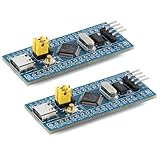
- Powerful 32-bit ARM Cortex-M3 CPU with a maximum frequency of 72MHz, the STM32F103C8T6 Microcontroller Development Board delivers exceptional performance and efficiency for your projects, ensuring smooth and fast execution
- Integrated 64KB Flash memory and 20KB SRAM on the STM32F103C8T6 Microcontroller Development Board, providing ample storage and memory for complex applications and data processing tasks
- Type-C Interface for easy and reliable connectivity, the STM32F103C8T6 Microcontroller Development Board offers modern and convenient USB communication, simplifying data transfer and power supply in your development environment
- 20 GPIO Pins available on the STM32F103C8T6 Microcontroller Development Board, offering extensive I/O capabilities for a wide range of peripherals and sensors, making it versatile for various project requirements
- Advanced features like 12-bit ADC, DMA controller, and multiple low-power modes, the STM32F103C8T6 Microcontroller Development Board ensures high precision, efficient data handling, and energy savings, ideal for both beginners and experienced developers
What development tools and boards were documented?
ARM announced a RealView Developer Kit with compilation tools, a debugger and JTAG interface support for ARM and Thumb instruction sets. Embedded Trace support was intended to shorten development cycles by giving developers more visibility into program execution.
Keil’s MCB2130 evaluation board provides a separate, concrete example of LPC2000-era hardware: it used the LPC2138 and exposed 512 kB of flash, 32 kB of RAM, timers, ADC, DAC, PWM and GPIO. It is an LPC213x board, not a board built around one of the original LPC2104/2105/2106 parts. Its listed components describe that evaluation board, not the entire MCU family.
The Tool Desk
Outbyte Driver Updater FREEFix the driver behind crashes, sound loss and screen glitchesFind Drivers →Outbyte PC Repair FREERepair Windows errors before they cause bigger problemsFix Now →Can you still buy an LPC2104 or an LPC2000 development board?
The historical product information establishes that Philips made the LPC2104 and that Keil documented an LPC2138-based MCB2130 evaluation board. It does not establish current stock, an official replacement, or lifecycle status. Treat any present-day offer as a seller-specific listing, not proof of current manufacturer support.
Before buying a legacy MCU or board, verify the exact part number and package, seller reputation, device markings and date codes, whether the listing is for the chip or a complete board, and whether the required tools and programming interface are included. Check that the board’s target MCU and exposed peripherals match the project; an LPC213x board may be useful for ARM7 evaluation but is not interchangeable with an LPC2104 design by default.
Quick Recap
Product prices and availability are accurate as of the date/time indicated and are subject to change. Any price and availability information displayed on Amazon at the time of purchase will apply.

