
The Tool Desk
Outbyte Driver Updater FREEFix the driver behind crashes, sound loss and screen glitchesFind Drivers →Outbyte PC Repair FREEClear out junk files and repair common Windows errorsFree Scan →Yes. A Raspberry Pi Pico can communicate with a LoRa radio module over SPI, but the base Pico has no LoRa modem built in. Add a compatible radio—such as an SX1276-based RFM95W breakout—and connect its power, SPI and control pins. The right frequency variant, antenna and software support depend on your region and project.
What the Pico does—and what the LoRa module adds
The original Raspberry Pi Pico is built around the RP2040 microcontroller. Raspberry Pi lists a dual-core Arm Cortex-M0+ processor running at up to 133 MHz, 264 kB of SRAM, 2 MB of on-board flash, 26 multifunction GPIO pins, two SPI controllers, two I2C controllers, two UARTs and 16 PWM channels on its Pico product page. Those resources let the Pico run your application and exchange commands and data with a radio; the radio module provides the LoRa transmission and reception hardware.
A documented LoRaWAN example pairs a Pico with a Semtech SX1276 radio, including Adafruit RFM95W breakout boards in 868 MHz and 915 MHz versions. The Waveshare project describes its implementation as enabling LoRaWAN communication on a Pico or another RP2040 board with an SX1276 module: Pico-LoRa project. Check the actual radio model carefully: a LoRa library or project that supports SX1276 does not automatically support every LoRa chipset.
Which hardware setup should you choose?
Pico plus a separate breakout
A Raspberry Pi Pico RP2040 plus an SX1276 LoRa module is a flexible learning setup. The RFM95W breakout is a named SX1276-based option, with 868 MHz and 915 MHz variants documented for the example project. A separate module makes the SPI connections visible and lets you change radio boards, but it also means you must wire and package the radio yourself.
#1 Best Overall

- This product requires a 3.7V 600mAh rechargeable lithium battery for operation, which is not included. Please purchase it separately
- Raspberry Pi Pico Compatibility: The Pico-LoRa-SX1262-XXXM is an expansion module designed for Raspberry Pi Pico, based on the SX1262, offering improved performance over the SX127X series.
- LoRaWAN Protocol Support: It supports the LoRaWAN protocol, enabling seamless connections to LoRa gateways and services like TTN and ChirpStack, with easy access to LoRa Cloud.
- Advanced Modulation and Long-Range Communication: The module supports LoRa, FSK, and GFSK modulations, providing excellent anti-blocking performance and long-range communication, with a high receiving sensitivity of up to -148dBm.
- Stable Operation in Extreme Conditions: Equipped with a temperature-compensated crystal oscillator, it ensures reliable performance in extreme high and low-temperature environments, with a programmable emitting power of up to 22dBm.
Integrated RP2040 and LoRa board
A Feather RP2040 RFM95 combines an RP2040 board and an RFM95 radio, reducing loose wiring and packaging work. It commits you to that board’s layout and radio configuration, so check its library support, antenna connector, frequency variant, available GPIO and power requirements before choosing it. The comparison dimensions here are based on the board and project descriptions; no comparative performance measurements are established.
| Setup | What it offers | What to verify |
|---|---|---|
| Pico plus SX1276/RFM95W breakout | Separate MCU and radio; visible, changeable SPI wiring. | Breakout frequency, voltage/current needs, antenna, pin assignments and library support. |
| Feather RP2040 RFM95 | RP2040 and RFM95 radio in an integrated board. | Board frequency variant, antenna connection, supported software, usable GPIO and power budget. |
How to wire an SX1276 breakout to the Pico
The reference project uses these Pico connections. Treat them as its example wiring, not a universal pinout for every breakout or application.
Rank #2

- Part Number: Pico-LoRa-SX1262-915M
- SX1262 LoRa node module for Raspberry Pi Pico, LoRaWAN protocol support, choice of frequency band
- The Pico-LoRa-SX1262-XXXM is LoRa node expansion module designed for Raspberry Pi Pico based on SX1262 with better performance than the SX127X series. The LoRa modulation technology solves the balancing problem between transmission distance, interference immunity, and power consumption that traditional solutions aren't able to deal with.
- It supports LoRaWAN protocol, which allows it to connect the TTN, ChirpStack servers through a LoRa gateway to use LoRa Cloud service fast and easily.
- Standard Raspberry Pi Pico header, supports Raspberry Pi Pico series boards. Supports LoRaWAN protocol, different frequency bands are available
| Pico connection | Radio connection |
|---|---|
| 3.3 V | VCC |
| GND | GND |
| GPIO18 | SCK |
| GPIO19 | MOSI |
| GPIO16 | MISO |
| GPIO7 | DIO0/G0 |
SPI carries data between the microcontroller and radio. DIO0/G0 is a radio signal line used by the example. The cited reference does not establish a single chip-select, reset or interrupt assignment for every board; confirm those connections in the selected board’s wiring instructions and the code you intend to run. Also check the breakout’s voltage and current requirements and make sure its antenna connection and antenna are suitable for its frequency.
What software can run the project?
The Pico can be programmed in C, C++, MicroPython or an Arduino-compatible environment. Raspberry Pi’s documentation notes that a Pico does not run Linux or support removable storage; it is a microcontroller board, not a Linux-based Raspberry Pi computer: Raspberry Pi Pico documentation.
Do these 3 things before closing this tab:
1Scan for outdated or missing drivers - takes under a minute2Clear out junk files and repair common Windows errors3Fix the driver behind crashes, sound loss and screen glitchesRank #3

- Note: Raspberry Pi PICO board is not included. This is 915M Hz LORA HAT for Pico .
- Note: The difference between 868MHz and 915MHz depends on the antenna. The antenna determines the frequency band. This LoRa module is equipped with a 915MHz antenna. The frequency band of this module is 915M (902-930MHz). The test code is available in the English WIKI manual.
- This is a LoRa node expansion module designed for Raspberry Pi Pico, based on the SX1262 which delivers superior performance compared to the SX127X series. LoRa modulation technology resolves the balance issue among transmission range, anti-interference capability, and power consumption that cannot be addressed by conventional solutions.
The cited LoRaWAN reference project is a C implementation based on a Semtech end-device stack, so its existence does not mean that the same code runs unchanged under MicroPython or Arduino. Select a software stack that supports both your radio chipset and the protocol you need. LoRa describes a radio technology; LoRaWAN is a network protocol built for LoRa radios. A point-to-point LoRa link and a LoRaWAN device have different software and network requirements.
Does Pico W’s wireless support replace LoRa?
No. Pico W adds 2.4 GHz Wi-Fi and Bluetooth 5.2, but those are separate radio technologies and do not replace an SX127x or SX126x LoRa modem. If your project needs LoRa, plan for a compatible LoRa radio even when using a Pico W. Raspberry Pi lists Pico and Pico W variants on its Pico product page.
Rank #4
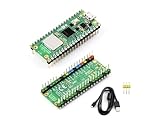
- RPi Pico 2 W Microcontroller Board (pre-soldered header (color-coded)), Based on Official RP2350 Chip, Dual-core & Dual-architecture Design. Upgraded hardware from Pico 2 with wireless communication, onboard antenna, features 2.4GHz 802.11n WIFI and Bluetooth 5.2.
- Adopts unique dual-core and dual-architecture design: dual-core Arm Cortex-M33 processor and dual-core Hazard3 RISC-V processor, flexible clock running up to 150 MHz.
- Onboard Infineon CYW43439 wireless chip, supports WIFI 4 wireless and Bluetooth 5.2.
- 520KB of SRAM, and 4MB of on-board Flash memory.
- Castellated module allows soldering direct to carrier boards. USB 1.1 with device and host support. Low-power sleep and dormant modes. Drag-and-drop programming using mass storage over USB.
Check frequency, antenna and power before buying
The example hardware is offered in distinct 868 MHz and 915 MHz variants; they are not interchangeable choices to make casually. Choose the frequency configuration permitted for your location and compatible with the network or other radios you intend to use. Confirm the exact module variant, antenna frequency, antenna connector and permitted transmit-power configuration against current local rules and the seller’s current product listing.
- Confirm the module uses a chipset supported by your intended library or LoRaWAN stack.
- Match the radio’s frequency variant and antenna to your region and use case.
- Check supply voltage and current requirements for the breakout or integrated board.
- Review chip-select, reset and radio interrupt/DIO assignments, then account for the GPIO those connections consume.
- Check header format and physical fit if you plan to use a breadboard, enclosure or integrated board.
What range and speed should you expect?
There is no single reliable distance or data-rate figure for a Pico-plus-LoRa build. Results depend on the antenna, spreading factor, transmit power, duty cycle, terrain and interference. No independent, owner-dated range, throughput, battery-life or reliability measurement is established for this exact combination, so treat any specific number as a claim about particular equipment and test conditions—not a guaranteed result for your build.
Quick Recap
Best Value

- Core1121 HF Dual-Band LoRa Module is a long-range, ultra-low-power transceiver, based on the third-generation low-power LoRa transceiver LR1121, supports Sub-GHz (150MHz ~ 960MHz), S-band (1.9GHz ~ 2.1GHz), and 2.4GHz ISM frequency bands
- Connects to the cloud via LoRa or LoRaWAN protocol through a gateway, enabling low-power wide-area networking (LPWAN). Supports LoRa, (G)FSK, and LR-FHSS modulation schemes, compatible with SX126X/SX127X series for easy product upgrades
- LR1121 supports both LoRa Chirp Spread Spectrum (CSS) and Frequency Hopping Spread Spectrum (FHSS) technologies, with modulation coverage across Sub-GHz, S-band, and 2.4GHz ISM frequency bands. Suitable for IoT applications such as industrial telemetry, smart home, remote data acquisition
- SPI communication interface, supports mainstream MCU platforms for seamless integration and migration.Integrates AES-128 encryption engine to enhance data security. Onboard TCXO crystal oscillator ensures frequency stability under extreme temperature conditions
- Comes with online development resources and manual (examples for ESP32 / Raspberry Pi / STM32 / Raspberry Pi Pico). Please feel free to contact us if you have any question
Product prices and availability are accurate as of the date/time indicated and are subject to change. Any price and availability information displayed on Amazon at the time of purchase will apply.

