
Crashes, No Sound, or Screen Glitches?
Random freezes, missing sound and display glitches usually trace back to one bad driver. Find and replace yours safely.Free scan · under a minutePC Slower Than It Used to Be?
A free scan shows the junk files, broken settings and background clutter dragging Windows down - then fixes them in one click.Free scan · Windows 10 & 11STMicroelectronics became Quintauris’s sixth shareholder on 29 August 2024, joining a semiconductor-industry effort to turn the open-standard RISC-V instruction-set architecture into compatible, industry-ready products. Quintauris’s initial focus is automotive, with planned expansion into mobile and IoT; the announcement described goals, not a processor launch.
Why did STMicroelectronics join Quintauris?
Quintauris was established in December 2023 to advance adoption of products based on RISC-V, an open-standard instruction-set architecture (ISA). An ISA defines the instructions a processor can execute; it is not itself a processor or a finished product. RISC-V was originally developed by researchers at the University of California, Berkeley, in 2010. Quintauris’s 2024 announcement framed ST’s addition as a way for major semiconductor companies to collaborate on exploring RISC-V’s potential across industries.
Quintauris says it aims to develop reference architectures and help create compatible solutions across industries. In practical terms, shared architectural guidance can help companies build products and software that work together instead of requiring every supplier to solve compatibility independently. That is the company’s stated purpose; the announcement did not establish that a particular processor had shipped or that interoperability outcomes had already been achieved.
Who owns Quintauris?
At the time of the 29 August 2024 announcement, Quintauris named six shareholders:
#1 Best Overall

- Flexible MCU Board: Incorporate the ESP32-C3 32-bit RISC-V chip, operating up to 160 MHz, mounted multiple development ports,
- Developer Friendly: Compatible with Arduino IDE, MicroPython, CircuitPython, PlatformIO, ESP IDF, Zephyr, Matter, ESPNow, Meshtastic, WLED, ESPHome, Home Assistant, Ubidots
- Outstanding RF performance: Complete Wi-Fi functions and Bluetooth Low Energy, while supporting communication over 100m with anFL antenna
- Elaborate Power Design: 4 working modes as low as 44 μA in deep sleep mode, while supporting lithium battery charge management
- Thumb-sized Design: 21 x 17.5mm, Seeed Studio XIAO series classic form factor
- Robert Bosch GmbH
- Infineon Technologies AG
- Nordic Semiconductor ASA
- NXP Semiconductors
- Qualcomm Technologies, Inc.
- STMicroelectronics
The release identifies the shareholders but does not disclose their ownership percentages, investment amounts, or whether those details have changed since the announcement.
What is Quintauris doing with RISC-V?
Quintauris describes itself as a single source for reference architectures and support for compatible, cross-industry solutions. Its initial application focus was automotive, with planned expansion to mobile and IoT. The objective is to help move RISC-V from an open specification toward products and software ecosystems that suppliers can use across markets. That is a direction of work, not evidence that a mass-market Quintauris processor was available in 2024.
Rank #2
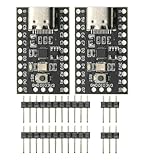
- CH32V003 Development Minimum System Board for Nano RISC-V CH32V003F4U6 Chip TYPE-C USB 22Pin
- on-board 24MHz Crystal oscillator
- Power by TYPE-C USB
There have been later developments since ST joined:
- 8 May 2025: Quintauris and SEGGER announced a partnership to develop RISC-V products and technology and support mass deployment in automotive, health, IoT, and high-performance computing. Read the partnership announcement.
- 24 February 2026: Quintauris announced a shareholder-endorsed capital increase. The company said it would support platform specifications, software-ecosystem expansion, and deeper engagement with industry partners, especially in automotive and other performance-critical markets. The announcement did not state an amount. Read the capital-increase announcement.
What RISC-V hardware can you try?
If you want to experiment with RISC-V, look for a RISC-V development board: a physical platform for testing hardware and software. RISC-V International maintains information about developer-board programs and lists Orange Pi RV2 among active programs. Board availability and suitability depend on the specific project, so check the board’s documentation and supported software before choosing one. See RISC-V International’s developer-board information.
Rank #3

- The ESP32-C3 SUPERMINI is positioned as a high-performance, low-power, cost-effective IoT mini development board, suitable for low-power IoT applications and wireless wearable applications
- It is equipped with a rich set of interfaces, including 11 digital I/Os that can be used as PWM pins and 4 analog I/Os that can be used as ADC pins.
- It supports four serial interfaces, including UART, I2C, and SPI.
- The ESP32-C3 features a 32-bit RISC-V CPU, including an FPU (Floating Point Unit) capable of 32-bit single-precision
- Package: 2PCS ESP32-C3 MINI Development Board ESP32 SuperMini ESP32 C3 WiFi Module
When comparing boards or other RISC-V options, check the target market (such as IoT or general embedded use), reference-profile and compatibility support, software-toolchain maturity, safety and security needs, performance and power limits, board availability, and ecosystem support. An evaluation board is a way to explore a platform; it is not evidence that the hardware belongs to Quintauris or meets automotive production requirements.
STMicroelectronics also sells STM32 Nucleo evaluation boards through its eStore, but STM32 boards are ST products and should not be mistaken for Quintauris or RISC-V hardware. See ST’s STM32 Nucleo boards.
Quick Recap
Best Value

- Ample PSRAM Storage – The development board offers 8MB PSRAM, providing substantial extra memory for handling more complex tasks, large data buffers, and advanced processing.
- Enhanced Multi-Tasking Capability – With the additional 8MB PSRAM, the ESP32-C5-WIFI6-KIT can efficiently manage multiple protocol stacks simultaneously, ensuring smooth operation in multi-tasking IoT environments.
- Support for Medium-Load Applications – The 8MB PSRAM allows the ESP32-C5 to handle medium-load applications more effectively, making it ideal for scenarios requiring real-time data processing or continuous communication.
- Seamless Performance – The increased memory improves the overall performance and responsiveness of the device, particularly when running applications with larger memory footprints or more demanding computations.
- Future-Proof for Complex Projects – With 8MB of PSRAM, developers are better equipped to build scalable, high-performance solutions that support both current and future IoT use cases, offering flexibility for future-proofing designs.
Rank #4

- ESP32-C6 WiFi 6 microcontroller development board adopts ESP32-C6-WROOM-1-N8 module, which is equipped with RISC-V 32-bit single-core processor, up to 160MHz main frequency, built-in 8MB Flash
- Integrates WiFi 6, Bluetooth 5 and and IEEE 802.15.4 (Zigbee 3.0 and Thread) wireless communication, with superior RF performance
- Integrates rich peripherals including SPI, UART, I2C, I2S, LED PWM, SDIO and other interfaces, compatible with the pinout of ESP32-C6-DevKitC-1-N8 development board, more convenient to use and expand a variety of peripheral modules
- Onboard CH343 and CH334 USB HUB chips, supports USB and UART development at the same time via a USB-C port
- Comes with online examples and tutorials for ESP-IDF development environment
Product prices and availability are accurate as of the date/time indicated and are subject to change. Any price and availability information displayed on Amazon at the time of purchase will apply.

