
Do these 3 things before closing this tab:
1Repair Windows errors before they cause bigger problems2Scan for outdated or missing drivers - takes under a minute3Clear out junk files and repair common Windows errorsA high-accuracy window monitor helps protect a power rail by detecting undervoltage and overvoltage closer to the load’s actual limits. That leaves more of the rail’s tolerance budget available for regulation error, ripple, and transients—but the monitor does not regulate the supply or improve it by itself. For two rails that include a 0.8 V core or a 1.2 V rail, the MAX16193 is a candidate; for a single rail with diagnostic features, consider the MAX16138; for a rail that also needs watchdog monitoring, consider TI’s TPS3850.
What a window monitor does—and what it cannot do
A window-voltage supervisor compares a supply rail with both an undervoltage (UV) threshold and an overvoltage (OV) threshold. When the rail leaves the configured window, the device asserts a reset or fault output so a processor, FPGA, ASIC, or other load can be held out of operation beyond its permitted supply range.
Threshold accuracy determines how much margin must be reserved between the load’s allowed range and the monitor’s trip points. A more accurate supervisor can make that protection boundary tighter and leave more of the load’s tolerance available for power-supply variation. It does not correct DC error, suppress ripple, or compensate for a transient; those remain power-supply design problems.
How accuracy affects the usable rail tolerance
Start with the load’s permitted rail range, then allocate that tolerance among DC regulation error, ripple, and transient response. Analog Devices gives a representative FPGA-core budget of ±3%, divided into ±1% for each of those three contributors. The monitor’s threshold error must also fit within the permitted range: a trip threshold that is too far inside the load’s limit can trigger unnecessarily, while one too far outside may not protect the load in time.
#1 Best Overall
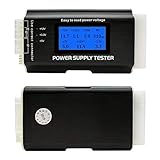
- [8-in-1 ATX Power Supply Tester] -- Support test 20-pin ATX / 24-pin ATX / HDD (IDE) / Floppy 4-pin / PCI-e 6-pin / 4-pin / EPS 8-pin (NOTE: can not fit for PCI-e 8-pin) / SATA connectors
- [Aluminum Alloy Enclosure] -- Light and Easy to Carry, High Strength, Nice Thermal Conductivity & Corrosion Resistance
- [1.8'' LCD Screen] -- Outputted Voltages shows on the 1.8'' LCD Screen, Easy to Read ( The 1.8'' LCD Screen was Powered by 20-pin / 24-pin Connector ), Note: The Product Screen Has a Load of Scratches All Over It?Because The Screen is Easy to Scratch, We Put a Protective Film on It, If You Think It's Not Beautiful, You Can Tear It Off by Yourself
- [Beep Alarm] -- When your power supply test value is beyond normal range, the Power Supply Tester would issue a buzzer alarm, Easy to Know
- NOTE: The voltage of 20pin / 24pin connectors is displayed by the LCD Screen, as "+3.3V", "+12V1", "+5V", "-12V", "5VSB", "PG" (except "+12V2" on LCD Screen); The voltage of PCI-e 6P / 4P / EPS P8 connectors is displayed by the LCD Screen as "+12V2"
As a worked example, Analog Devices calculates that a nominal 0.9 V rail with ±4% tolerance and a 0.3%-accurate supervisor has an approximately ±3.7% usable power-supply operating window. This is the tolerance left after accounting for the supervisor’s threshold accuracy; it is not a promise that the power supply will achieve that regulation or transient performance.
In a 2025 article, Analog Devices reported that available window-supervisor threshold accuracy had improved from about ±1.5% to ±0.3%, and identified MAX16193 as a ±0.3% dual-channel device across temperature. Compare accuracy over the full temperature range—not just a typical or room-temperature figure—against the load’s limits and the rest of the error budget.
Rank #2
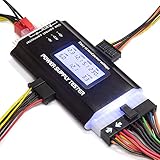
- ✅Comprehensive Power Supply Testing: Efficiently test a wide range of power supply units (PSUs) including ATX, ITX, IDE, HDD, SATA, and BTX, ensuring your components are functioning correctly.
- ✅Digital LCD Display: The clear LCD screen provides real-time readouts of voltage levels, allowing you to easily monitor and diagnose potential issues with your power supply.
- ✅User-Friendly Interface: Designed for both beginners and professionals, this power supply tester is easy to use, with simple plug-and-play functionality that requires no advanced technical knowledge.
- ✅Accurate Voltage Readouts: Get precise measurements of various voltage rails including +12V, +5V, +3.3V, and more, ensuring your power supply is delivering the correct voltage to your PC components.
- ✅Portable and Compact Design: Lightweight and compact, this tester is easy to carry and store, making it an essential tool for system builders, repair technicians, and PC enthusiasts.
Compare the MAX16193, MAX16138, and TPS3850
These parts target different designs. The ranges and features below are those stated in the cited Analog Devices and Texas Instruments material; package, qualification, and availability information was not stated there and must be checked against the current datasheet and authorized-source listing for the exact part number.
| Device | Monitoring and thresholds | Accuracy and operating temperature | Additional functions and outputs | Other comparison details |
|---|---|---|---|---|
| MAX16193 | Dual channel: IN1 covers 0.6–0.9 V and IN2 covers 0.9–3.3 V. Selectable UV/OV windows are ±2% to ±5%. | ±0.3% threshold accuracy; −40°C to +125°C operation. | Open-drain or push-pull reset options. | Reset delay, quiescent current, package, qualification, and availability: not stated in the Analog Devices product information cited here. |
| MAX16138 | Single window; factory-set thresholds from 0.5 V to 5 V; selectable tolerance windows from ±2% to ±9%. | ±0.7% threshold accuracy; operating-temperature range: not stated in the Analog Devices product information cited here. | Built-in self-test (BIST), latched OV-fault output, and 5 μs OV response. | Reset-output type and delay, quiescent current, package, qualification, and availability: not stated in the Analog Devices product information cited here. |
| TPS3850 | Selectable threshold voltages; specific nominal threshold range and UV/OV window settings: not stated in the Texas Instruments product information cited here. | 0.8% reset-threshold accuracy; −40°C to +125°C operation. | Programmable window watchdog. | 10 μA typical supply current. Reset-output details, package, qualification, and availability: not stated in the Texas Instruments product information cited here. |
Which supervisor fits a 0.8 V or 1.2 V rail?
For a low-voltage rail, check the channel range
The MAX16193’s IN1 range of 0.6–0.9 V includes a nominal 0.8 V rail. Its IN2 range of 0.9–3.3 V includes a nominal 1.2 V rail. That makes it a candidate when one design needs to monitor both a low core rail and a higher I/O rail. Confirm that the required trip points fall within the device’s selectable window settings and the load’s actual allowed range.
Free tools Windows power users keep installed
One-click scans. No signup required.
Rank #3
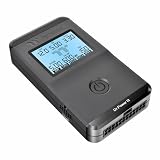
- 【Right Tool for the Job】A great addition to any tool kit for someone working on a PC. The Dr. Power III Pro can check a connection for continuity, provide real-time voltage and PG readings, and alert for detected faults with audible and display alerts.
- 【Real-Time Data】Capable of delivering real-time data for +12V, +5V, +3.3V, and +5Vsb outputs as well as providing a PG (power good) signal measured in ms (milliseconds) for help identifying issues with power supplies.
- 【PCIe Gen 5.1 Sense】Able to detect the the sideband SENSE0/SENSE1 signals for the correct identification of power able to be delivered (150W, 300W, 450W, 600W) to a modern GPU.
- 【Fault Warnings】 Easily identify issues thanks to the active alert system, able to alert the user with both an audible beep to draw attention along with the display turning red and indicating where the fault was detected.
- 【Color Display】On top of being updated to test the newest ATX 3.1 v3.1 spec PSUs, the Dr. Power III Pro also brings a color screens for some extra eye grabbing notifications.
For a single monitored rail with self-test or a latched OV fault
The MAX16138 is the candidate to evaluate when one monitored rail and its diagnostic features matter more than dual-channel monitoring. Its stated features include BIST, a latched overvoltage-fault output, and a 5 μs overvoltage response. Verify the relevant datasheet thresholds, output behavior, temperature limits, and response conditions for the particular design.
For a watchdog alongside supply supervision
The TPS3850 combines a window supervisor with a programmable window watchdog. Its watchdog function may suit a system that needs to detect a failure to provide the expected timing signal as well as monitor supply voltage. Its stated reset-threshold accuracy is 0.8%; compare that figure and the device’s selectable threshold options with the rail’s total error budget.
Rank #4

- 1️⃣【4-Digit Display & Power Calculation】: The Jesverty SPS series features a big bright 4-digit LED display that shows measured values of V/A/W that the unit outputs in real-time. The display resolution is up to 0.01V, 0.001A, and 0.1W.
- 2️⃣【Auto C.V. and C.C. Mode】: The Jesverty SPS series can be used as a constant-voltage*(C.V.) power supply and constant-current*(C.C.) power supply even when the load is changed. It switches automatically between CV mode and CC mode according to the changes in the load.
- 🌟Note: The V and A settings you set are the crossover point at which the mode switches.
- 3️⃣【Compact Body & Lightweight】: The Jesverty SPS series measured only 7.1(D)x3.35(W)x6.1(H)inches and weight of approx. 2.5lbs. It saves space on your workbench and can be moved around without any frustration.
- 4️⃣【Reliability and Safety】: The Jesverty SPS series is built with high-quality materials and reliable circuit designs that include multiple protection functions, such as short-circuit protection, over-load protection, grounding terminal, temperature-regulated fan, etc. to ensure performance and extend the lifespan.
Design and verify the monitor before choosing a part
- Define the load limits. Record the minimum and maximum permitted rail voltage, including relevant operating conditions, and divide the allowed variation among DC regulation, ripple, and transient response.
- Include monitor accuracy. Choose a supervisor whose threshold accuracy is specified across the design’s full operating-temperature range. Check whether the threshold accuracy and window settings leave adequate margin at both limits.
- Match the actual rail and trip window. Confirm the nominal rail lies within the device’s threshold range and that selectable UV/OV settings can implement the required trip points. For MAX16193, for example, check the intended rail against the IN1 or IN2 range rather than relying on the device’s general supply-monitoring description.
- Check the reset or fault interface. Verify output polarity and type, delay, drive capability, and pull-up voltage against the processor or other load. Open-drain outputs require an appropriate pull-up; confirm that its voltage and resulting logic levels are compatible with every connected device.
- Validate special functions and operating conditions. If the application depends on watchdog timing, BIST, a latched fault, or a stated response time, verify the conditions and behavior in the current datasheet. Do not assume a feature behaves identically across devices.
- Confirm the exact purchasable part. Check the current datasheet revision, package suffix, qualification requirements, authorized source, and stock before selecting a production component.
Limits of the available specifications
The figures above do not establish a complete, like-for-like selection across reset delay, output drive, package, qualification, or current stock. Those details are not stated for all three candidates in the product information cited here. Obtain them from the current manufacturer datasheet and confirm availability for the exact package and suffix before finalizing a design.
Quick Recap
Best Value
- The LCD power tester is a powerful power test device. This power tester only needs to be connected to the ATX connector of the power supply to easily and intuitively know whether the output of each power supply is normal. It can detect ATX, BTX, ITX, TFX computer power supply, and can display various voltage and PG values in liquid crystal to quickly detect the performance of computer power supply.
- The LCD displays various parameters such as output voltage and PG. When each parameter exceeds the normal value, the buzzer will sound a warning and the corresponding value will flash.
- It can measure the voltage of each group of power supply 3.3V/+5V/+12V/-12V/SB+5V/PG, and also measure the output wire P4/P6/P8/SATA/IDE, external DIE/SATA/P6/P8 is the light Displayed, there is no LCD voltage. Only the 24pin or 20pin will have the LCD voltage.
- It has LCD intuitive and accurate display voltage (+/-0.01V), automatic fault alarm, complete test interface, small and beautiful appearance, and many test functions. It is the best choice for quickly detecting PC power.
- Support 20Pin, 24Pin ATX interface / SATA interface / 4Pin, 8Pin interface / PCI-E graphics card 6Pin interface / floppy drive interface / ATE hard disk interface.
Product prices and availability are accurate as of the date/time indicated and are subject to change. Any price and availability information displayed on Amazon at the time of purchase will apply.
The Tool Desk
Outbyte PC Repair FREERepair Windows errors before they cause bigger problemsFix Now →Outbyte Driver Updater FREEScan for outdated or missing drivers - takes under a minuteDriver Scan →
