
The Tool Desk
Outbyte Driver Updater FREEScan for outdated or missing drivers - takes under a minuteDriver Scan →Outbyte PC Repair FREERepair Windows errors before they cause bigger problemsFix Now →Dukosi’s 54-cell battery energy storage system (BESS) reference design is a proof of concept, not a retail-ready battery product. Announced on March 11, 2025, it demonstrates how the company’s cell-monitoring system could collect synchronized voltage and temperature data across a BESS rack that Dukosi says can operate in a 900–1500 V context. The company argues that cell-level visibility and a contactless architecture can support safety, reliability and sustainability; the announcement does not independently prove those outcomes.
What the 54-cell reference design is
Dukosi announced the design on March 11, 2025, and demonstrated it at Embedded World in Nuremberg. Developed with eInfochips, an Arrow Electronics company, it is an end-to-end BMS proof of concept for battery energy storage systems. The demonstration was shown at Arrow Electronics’ booth. Dukosi’s announcement says its 54-cell configuration is suitable for a 900–1500 V BESS rack.


The design combines Dukosi’s Cell Monitoring System (DKCMS), its C-SynQ communications protocol, and an industry-standard BMS host processor. Dukosi presents the reference design as a way for Arrow customers to accelerate development using DKCMS. The announcement does not establish public pricing, a general availability date, or an online ordering channel.
How Dukosi describes the monitoring architecture
In Dukosi’s account, monitors capture voltage and granular temperature measurements at each cell. Data from all cell monitors is captured synchronously and delivered with deterministic latency to a System Hub, which interfaces with the BMS host processor. These are vendor-reported characteristics: the announcement provides no independent benchmark or quantified comparison with another BMS architecture.
Crashes, No Sound, or Screen Glitches?
Random freezes, missing sound and display glitches usually trace back to one bad driver. Find and replace yours safely.Free scan · under a minutePC Slower Than It Used to Be?
A free scan shows the junk files, broken settings and background clutter dragging Windows down - then fixes them in one click.Free scan · Windows 10 & 11Contactless communication and scaling
Dukosi describes DKCMS as a contactless, near-field communication approach. Its BMS designer material says the approach removes the complex wiring harness while avoiding drawbacks Dukosi associates with far-field wireless systems. The company also says cell monitoring continues when the main BMS controller is in a low-power state, and that the system can wake that controller if needed.
Dukosi says the system can be scaled by adding cells and extending a bus antenna, and can support different capacities and chemistries. These are descriptions of the company’s architecture, not independently validated results for every configuration or chemistry.
Why Dukosi says cell-level sensing matters for safety
The safety argument is that individual voltage and temperature data can make cell conditions visible sooner and support cell-level fault detection and diagnosis. That visibility may help a BMS identify an abnormal cell rather than relying only on measurements gathered at a module or pack level. Dukosi connects the reference design with battery safety and reliability, but reports no safety incidents avoided, certification results, or measured reduction in risk. Those benefits remain claims about the architecture’s potential, not demonstrated outcomes from this proof of concept.
What “more sustainable” means here
Dukosi’s sustainability rationale is that detailed cell information and a simpler battery architecture may help extend useful battery life and enable more efficient system design. Its broader company material discusses lifetime traceability and battery-lifecycle benefits, but the 2025 BESS announcement supplies no measurements for lifecycle extension, material savings, emissions reductions, or recycling improvements. Sustainability should therefore be read as a proposed benefit, not a quantified result for this design.
How to compare this approach with wired and wireless BMS designs
Dukosi’s vendor-authored comparison material identifies wired, wireless and contactless chip-on-cell approaches. It suggests useful questions for evaluating architectures, but does not provide an independently controlled comparison showing that the 54-cell design outperforms alternatives.
| Comparison question | What to examine |
|---|---|
| Where is data measured? | At the cell, module or pack level—and how much cell-specific visibility the system provides. |
| How does data travel? | The communication method, latency behavior and isolation requirements. |
| What physical connections are required? | Wiring, connectors and associated components, including the implications for assembly and service. |
| How does the design scale? | Whether added cells, capacities or chemistries require changes to the monitoring and communication setup. |
| What lifecycle information is available? | Whether the architecture supports traceability and practical battery service over time. |
These are evaluation dimensions, not a verdict that DKCMS wins each category. The public announcement does not give the comparative measurements needed to make that determination.
Independent reader supportYour contribution helps us test, update, and keep practical guides available for everyone.What the demonstration does—and does not—establish
- It demonstrates: a 54-cell BESS proof of concept combining DKCMS, C-SynQ and a BMS host processor, developed with eInfochips and shown at Arrow’s booth.
- Dukosi says it is designed for: a 900–1500 V BESS rack context, synchronized per-cell voltage and temperature capture, and deterministic data delivery to a System Hub.
- It does not establish: independently measured safety improvements, longer battery life, emissions or material reductions, or a product’s commercial availability.
A separate March 2026 announcement describes a Dukosi–STMicroelectronics 16-cell Battery Passport proof of concept, including secure cell-to-cloud data and individual damaged-cell replacement. That is a different demonstrator and should not be confused with the 54-cell BESS design. Dukosi’s 2026 announcement covers that later project.
Quick Recap
Best Value
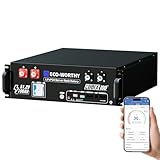
- UL9540 | UL1973 | CEC LISTED - Completed comprehensive testing by Intertek and has officially earned three key North American safety certifications.And has met the standards set by the California Energy Commission.The outstanding performance in design, electrical safety, and thermal runaway management,providing users with greater quality assurance.
- Home Energy Storage System: Built with high-quality Grade A LiFePO4 cells for reliable power, exceptional cycle life, and consistent safety. Designed for multiple uses: emergency backup during outages, daily home backup, and with solar panels, continuous power for off-grid cabins.
- Closed-Loop Communication Battery: ECO-WORTHY 48V (51.2V) server rack battery features integrated CAN/RS485 interfaces and multiple communication protocols, enabling communication with leading integrated solar inverters for more intelligent system operation. Built-in Bluetooth and WiFi functionality allow you to easily monitor battery status via ECO-WORTHY APP.
- Space-Saving Rack Design: This 48V 100AH lithium battery is perfectly compatible with server racks and supports vertical mounting for maximum space efficiency. By paralleling up to 32 units (up to 163.8kWh), you can expand power capacity to meet any need.
- Complete Plug-and-Play Kit: We include every accessory you need: parallel cables, communication cables, grounding wires, protective terminal covers, screws, and a user manual. Unbox, install, and start enjoying clean power—it's that easy.
Product prices and availability are accurate as of the date/time indicated and are subject to change. Any price and availability information displayed on Amazon at the time of purchase will apply.

