
What’s actually slowing this PC down?
Pick the symptom - the matching free tool is one click away.
A 2021 study demonstrated a 2 × 2 array of one-transistor SRAM cells built with single-gated feedback field-effect transistors (FBFETs). The authors reported promising cell-level retention, read, endurance and standby-power results. But the small array is a research demonstration—not proof of a drop-in, commercially deployed replacement for conventional CMOS SRAM. Fewer transistors per cell could help memory density, but transistor count alone does not determine how much usable memory fits on a chip.
How can SRAM store a bit with one transistor?
A conventional six-transistor SRAM cell uses multiple transistors to hold and access a bit. The 2021 demonstration took a different approach: it used a single-gated feedback field-effect transistor, or FBFET, as the storage device. The feedback behavior is central to the proposed one-transistor cell; it is not simply a conventional six-transistor cell with five devices removed.
The study fabricated a 2 × 2 array and reported reading a selected cell without disturbing the half-selected cells in that array. That is evidence that the cells could operate together at a small array scale. It does not establish how a much larger memory would behave or how its access and control circuits would affect total chip area.
What did the 2021 FBFET study report?
The authors reported the following results for their one-transistor FBFET SRAM. They are results for the studied devices, not guarantees for every one-transistor SRAM architecture.
#1 Best Overall

- ESP32-S3-DEV-KIT-N16R8 development board adopts ESP32-S3-WROOM-1 series module with 32-bit LX7 dual-core processor, capable of running at 240 MH. Integrated 512KB SRAM, 384KB ROM, 8MB PSRAM, 16MB FLASH memory
- ESP32-S3 Microcontroller 2.4GHz Wi-Fi Development Board integrated 2.4GHz Wi-Fi and Bluetooth LE dual-mode wireless communication
- Type-C connector, easier to use. Onboard CH343 and CH334 chips can meet the needs of USB and UART development via a Type-C interface
- Rich peripheral interfaces, compatible with the pinout of ESP32-S3-DevKitC-1 development board, offers strong compatibility and expandability
- Supports ESP-IDF, Arduino, MicroPython, can easily and quickly get started and apply it to the product
| Measure | Reported result | What it describes |
|---|---|---|
| Retention | More than 900 seconds | Reported individual-cell retention. |
| Read behavior | Nondestructive reading for 10,000 seconds | Reported individual-cell read result; the authors also reported nondestructive selected-cell reading in the 2 × 2 array without disturbing half-selected cells. |
| Endurance | 108 cycles | Reported endurance for the studied device. |
| Estimated standby power | 0.7 pW holding “0”; 6 nW holding “1” | Authors’ state-dependent standby-power estimates. |
These figures are encouraging but should be read with the scale and evidence type in mind: the physical array contained four cells, and the numeric results are the study authors’ reports. They do not by themselves establish production-scale reliability, a manufacturing process, or independent replication.
Does one transistor mean six times the memory density?
No. A one-transistor cell has a lower transistor count than a six-transistor cell, but that does not translate directly into a sixfold reduction in memory area. The cell’s physical footprint depends on device layout and process integration, while a working memory also needs circuitry to select cells, read and write data, and connect the array to the rest of the chip. The 2 × 2 result does not establish the area of a production memory macro or its peripheral circuitry.
Rank #2
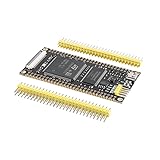
- Experience high-speed processing with a 480MHz STM32H743 Core Board, offering 2M Flash and 1M SRAM for efficient development tasks
- Expand your storage capabilities effortlessly with QSPI driving W25Q64 and 16-bit wide 32MB SDRAM supported on this STM32 Development Board
- Seamlessly control your projects with a reset button, a BOOT button, a user LED, a Type C interface, and reserved SWD and serial ports
- Utilize 97 IO ports (some used by the core board) for versatile connectivity options on the STM32H743IIT6 Learning Board
- Operate in extreme conditions from -40°C to 85°C, making this System Board ideal for a wide range of applications
A historical IBM result illustrates why raw area figures need context. Subbanna and colleagues reported a 6.9 μm² embedded SRAM cell using 0.25 μm design-rule salicide CMOS; functionality was also demonstrated at 0.35 μm design rules. That 1996 result is useful background on embedded CMOS SRAM, but its cell area is not a fair direct density comparison with the later FBFET array: the devices, processes and demonstrations differ.
How does it compare with established six-transistor SRAM?
Conventional six-transistor SRAM remains an active design space, with trade-offs among read stability, leakage and writing. For example, He and colleagues reported an asymmetric 6T cell fabricated in 0.13 μm partially depleted SOI CMOS. Against a symmetric 6T baseline, it improved measured read stability by 43% and reduced cell leakage by 24%, while requiring additional write current.
Rank #3

- 2.4GHz Dual Mode WiFi + Bluetooth Development Board
- Support LWIP protocol, Freertos;ESP32 is a safe, reliable, and scalable to a variety of applications
- SupportThree Modes: AP, STA, and AP+STA
- Ultra-Low power consumption, Compatible with Arduino IDE
- 1PCS 30Pin ESP32 Development Board 2.4GHz WiFi Dual Cores Microcontroller Integrated with Antenna RF Low Noise Amplifiers Filters
That result is not a head-to-head comparison with the FBFET cells: it concerns a different architecture, process and study. It shows why device count alone is not enough to judge a memory design. A practical comparison also needs compatible measurements of array behavior, read disturb, write current and margin, power, process integration and scale.
What about other one-transistor SRAM proposals?
“One-transistor SRAM” does not identify one universal device or maturity level. Dutta and colleagues’ 2021 paper on one-transistor bipolar SRAM presented a macro-compact model built from MOSFETs, a bipolar junction transistor and passive components, calibrated with TCAD results at the 28 nm technology node. This was a modeling study, not evidence of a fabricated 28 nm product or the same FBFET array architecture.
Rank #4
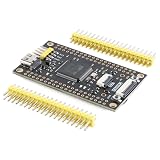
- Experience lightning-fast processing with the STM32H750VBT6 Core Board, boasting a powerful 480MHz main frequency and ample 128K Flash, 1M SRAM for seamless operation. Unlock endless possibilities for your projects
- Seamlessly expand your device's memory with the external W25Q64, offering a generous 8M-byte capacity. Effortlessly navigate through your tasks with the convenient 1 reset button, 1 user button, and 1 BOOT button included
- Stay connected with ease using the versatile Type-C interface, while the SPI LCD and camera interface enhance your project's functionality. With 73 10-pin extensions available, your customization options are limitless
- Ensure reliable performance in any environment with an operational temperature range of -30°C to 80°C. The precision of the 25MHz main clock crystal and 32.768KHz RTC crystal guarantee accurate timekeeping for your applications
- Effortlessly integrate peripherals with the 2*4Pin header extension for SWD and serial communication. The direct connection from the Type-C interface to STM32's USB simplifies your setup, while the FPC 10P and 20P interfaces offer compatibility with various screens and cameras
Keeping the proposals distinct matters: the FBFET paper reports a fabricated small array, while the bipolar SRAM paper reports a compact model. Neither should be treated as proof that a commercially available one-transistor SRAM has replaced conventional CMOS SRAM.
Independent reader supportYour contribution helps us test, update, and keep practical guides available for everyone.What would establish a practical density advantage?
The FBFET result makes a case for further investigation, not a settled production advantage. To judge whether this approach could pack more usable memory into CMOS, readers would need evidence beyond the transistor count and four-cell array, including:
Best Value

- 2.4GHz Dual Mode WiFi + Bluetooth Development Board
- Support LWIP protocol, Freertos
- SupportThree Modes: AP, STA, and AP+STA
- Ultra-Low power consumption, Compatible with Arduino IDE
- ESP32 is a safe, reliable, and scalable to a variety of applications
- larger arrays showing reliable selection and read/write behavior across many cells;
- the total area of the memory macro, including access and peripheral circuitry;
- write voltage, current and margin alongside retention and read-disturb behavior;
- power and reliability results under clearly specified operating conditions; and
- evidence of process integration and manufacturing suitability.
Until those questions are answered, the sound conclusion is narrow: a 2021 study demonstrated a four-cell FBFET-based one-transistor SRAM array and reported notable cell-level results, but it did not establish a production-ready or commercially deployed CMOS SRAM replacement.
Quick Recap
Product prices and availability are accurate as of the date/time indicated and are subject to change. Any price and availability information displayed on Amazon at the time of purchase will apply.

