
The KDnuggets ComfyUI Crash Course is a beginner guide to building generative-media workflows with connected visual nodes. It covers installation choices, the parts of a model, a basic text-to-image graph, and ways to extend it for editing. Its practical starting point is to learn in the cloud if you do not already have suitable local hardware, then consider a local setup if you need more control. That is the course’s recommendation, not a rule for every user.
What the KDnuggets ComfyUI Crash Course covers
Shittu Olumide’s course, published January 26, 2026, introduces ComfyUI as a free, open-source, node-based interface and backend for Stable Diffusion and other generative models. Rather than treating image generation as a single prompt box, it presents a workflow as a graph: each node performs an operation, and connections pass data from one operation to another. The course walks through setup, the main model components, core nodes, and image-generation techniques. Read the course on KDnuggets.

The official ComfyUI project describes workflows across image, video, audio, 3D, and text, alongside desktop, manual local, and paid cloud options. Its repository is a rolling project page, so check it for current installation and support details before following setup instructions. ComfyUI on GitHub.
Should you use ComfyUI in the cloud or install it locally?
The course recommends cloud access for learning the interface before deciding whether to run ComfyUI locally. Cloud avoids the need to provide and configure a suitable local machine, while local operation can offer more control and work offline after setup. The better fit depends on your budget, hardware, internet access, and desired models and nodes.
#1 Best Overall
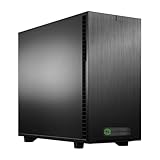
- Core Ultra 9 285K 3.7GHz (Up To 5.7GHz Turbo) 24 Core 125W
- 128GB DDR5 ECC Reg (2x64GB)
- GeForce RTX 5090 32GB GPU
- 10G + 2.5G Networking + WiFi 7
- Onboard AQtion AQC113C 10GbE LAN
| Consideration | Cloud | Local |
|---|---|---|
| Hardware barrier | Less reliance on your own graphics hardware; the provider supplies the managed environment. | Requires hardware suited to the models and workflows you intend to run. |
| Cost | Can involve ongoing subscription or service costs. | May require upfront hardware spending; the course notes the possibility of lower long-term costs, not a guarantee. |
| Internet | Depends on an internet connection. | Can work offline after installation and model setup. |
| Control and data handling | Runs in a managed service environment; check the provider’s current terms and data practices. | Gives you more control over the local setup and files. |
| Setup and updates | Less local installation and maintenance work, though what is available depends on the service. | Requires hands-on installation, model management, and updates. |
| Models and custom nodes | Availability depends on the service. Comfy Cloud offers supported preinstalled nodes; the Custom Nodes Manager is unavailable there. | Offers local model and node management; the Custom Nodes Manager is the recommended installation and management route for local and Desktop environments. |
The course names RunComfy as a cloud option, while the official project also describes paid Comfy Cloud. Availability, prices, and terms can change, so review each provider’s current details before choosing.
For learning graph concepts, you do not need to buy a GPU first if you use a cloud environment. If you plan to run models locally, check the requirements for the specific model and workflow instead of treating any single hardware list as a universal ComfyUI minimum.
Rank #2

- PLEASE NOTE: Exporting an NVIDIA RTX Pro 6000 GPU outside the US requires strict adherence to the U.S. Export Administration Regulations (EAR) and issuance of an export license from the Bureau of Industry and Security (BIS). Compliance and Know Your Customer (KYC) screening may be required as a condition of order acceptance. [NVIDIA Blackwell Streaming Multiprocessor] The new SM features increased processing throughput, and new neural shaders that integrate neural networks inside of programmable shaders | DLSS 4: Multi Frame Generation ensures ultra-smooth frame pacing for lifelike simulations.
- [Double-Flow-Through Design] The RTX PRO 6000 Blackwell features a double-flow-through cooling design, optimizing efficiency and airflow to sustain peak performance under 600W power loads. | [5th Gen Tensor Cores] Deliver up to 3X the performance of the previous generation and support for FP4 precision for faster AI model processing times with reduced memory usage, enabling local fine-tuning of LLMs and generative AI | [4th Gen Ray Tracing Cores] Double the ray-triangle intersection rate of the previous generation to create photoreal, physically accurate scenes and immersive 3D designs with RTX Mega Geometry, which enables up to 100X more ray-traced triangles.
- [PCIe Gen 5] Support for PCIe Gen 5 provides double the bandwidth of PCIe Gen 4, improving data-transfer speeds from CPU memory and unlocking faster performance for data-intensive tasks like AI, data science, and 3D modeling. | [GDDR7 Memory] With 96 GB of GPU memory and 1.8 TB ps bandwidth, it can tackle massive 3D and AI projects, fine-tune AI models locally, explore large-scale VR environments, and drive larger multi-app workflows.
- [DisplayPort 2.1] Achieve unparalleled visual clarity and performance, driving high resolution displays at up to 8K at 240 Hz and 16K at 60 Hz. Increased bandwidth enables seamless multi-monitor setups while HDR and higher color depth support ensures superior color accuracy for precision work, such as video editing, 3D design, and live broadcasting.
- [Universal MIG] Divide a single RTX PRO 6000 Blackwell into multiple isolated instances, each with dedicated resources, allowing for concurrent execution of multiple workloads, optimized GPU utilization, and secure isolation of different applications or users. [WARRANTY] 3 YR Manufacturer's Warranty. Bulk OEM Packaging. Retail Packaging is NOT included.
How a basic ComfyUI text-to-image workflow works
A simple graph takes a model and prompt text, uses them to create latent image data, then converts that data into an image file. The course highlights these starting concepts:
- CheckpointLoader: loads a checkpoint containing the model components needed by the workflow.
- CLIP Text Encode: turns positive and negative prompt text into conditioning that guides generation.
- KSampler: samples latent data using the conditioning and settings such as seed, step count, CFG, and denoise.
- VAE Decode: converts the sampled latent representation into a visible image.
- Save Image: writes the generated image to an output file.
In graph order, the core path is: load a compatible model, encode the prompts, sample a latent image, decode it with a VAE, and save the result. Each connection matters because it determines which data reaches the next operation. KSampler settings affect how generation proceeds; they do not replace the model or prompt inputs.
Rank #3
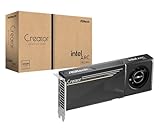
- System Compatibility Note: 2-slot card, 271x112x39mm, single 8-pin power, 200W TDP. Verify chassis clearance and PSU capacity before purchase.
- Dedicated Support: Please contact us directly through Amazon for any product questions or assistance you may require.
- 24GB GDDR6 on 192-Bit Bus: Massive 24GB memory with 456 GB/s bandwidth – ideal for LLMs, AI inference, 3D rendering, and generative design.
- Intel Xe2-HPG Architecture: Built on Intel's next-gen architecture with 20 Xe cores and 160 XMX engines for AI acceleration (197 INT8 TOPS).
- PCIe 5.0 Support: PCI Express 5.0 x16 interface for maximum bandwidth with the latest workstation platforms.
What the model files and components do
The course introduces several kinds of model components. They are not interchangeable: compatibility depends on the particular model and workflow, so do not assume any file will work with any graph.
- Checkpoint: a packaged model option loaded as a starting point for a workflow.
- Separate diffusion model: a diffusion component that may be loaded independently rather than as part of one checkpoint package.
- VAE: handles conversion between latent representations and visible images.
- CLIP text encoder: processes prompt text into conditioning for the generation graph.
- LoRA: an additional model component used to modify or extend a compatible base model’s behavior.
- ControlNet: provides structural guidance, such as pose, edges, or depth, in supported workflows.
Use the model’s own compatibility information and the workflow’s requirements when selecting files. A graph that expects a particular architecture or component arrangement may not accept a different model simply because both are used for image generation.
How to install ComfyUI without relying on outdated commands
The course describes Windows portable and manual installation paths, including Python, PyTorch, dependencies, model placement, and launching the application. Those steps can change as ComfyUI evolves, so use the current official installation guidance rather than copying an older tutorial command without checking it.
- Choose a deployment: use a cloud environment to begin without local installation, or choose a local/Desktop path if you want to manage the application and files on your computer.
- Follow the current official setup instructions: use the relevant instructions on the ComfyUI project page for your operating system and installation type.
- Check model requirements: confirm the required files, supported hardware, and storage for the exact workflow you plan to run.
- Load a known-compatible workflow and model: start with a simple graph before adding extra nodes or components.
- For local custom nodes, use the recommended manager: ComfyUI’s support documentation recommends Custom Nodes Manager for local and Desktop environments. It is not available on Comfy Cloud, which supplies supported preinstalled nodes. See ComfyUI’s Custom Nodes Manager documentation.
Ways to extend the basic graph
Once the text-to-image path is clear, the course describes several ways to adapt it. Each adds inputs or processing beyond the basic prompt-to-image chain.
Do these 3 things before closing this tab:
1Repair Windows errors before they cause bigger problems2Scan for outdated or missing drivers - takes under a minute3Clear out junk files and repair common Windows errorsBest Value

- Extreme AI Performance: Powered by NVIDIA GB10 Grace Blackwell Superchip delivering 1 petaFLOP of AI performance and 128GB memory for 200B model fine-tuning.
- Developer-Optimized Platform: Designed for AI developers building secure, long-running agentic workflows, with compatibility across frameworks such as OpenClaw and NemoClaw, supporting private on-device inference, sandboxed execution, and governed data access.
- Scalable Architecture: Featuring NVIDIA NVLink-C2C for ultra-fast CPU-GPU memory communication and NVIDIA ConnectX-7 networking to support dual GX10 system stacking, unlocking superior scalability and performance.
- Advanced Thermal Design: Engineered cooling ensures sustained high performance and reliability in an ultra-small form factor.
- Full Stack AI Solution: The GB10 and NVIDIA AI software stack provide a full stack solution for AI development and deployment.
Image-to-image
Image-to-image starts from an input image rather than generating solely from an empty latent. The denoise setting controls how strongly the generation can alter the starting image: lower changes generally preserve more of it, while higher changes allow greater transformation.
Pose, edge, or depth guidance
A ControlNet workflow can use structural information such as pose, edges, or depth to guide composition. It adds a guidance input and requires a compatible model and graph; it is not automatically part of every text-to-image setup.
Inpainting
Inpainting regenerates a selected region of an image. It is useful when the goal is to change one area while retaining the rest of the composition, but the workflow must include the appropriate region or mask input.
Upscaling
Upscaling increases image dimensions after generation. It is a separate processing step, and the available approach and resource needs depend on the chosen model and workflow.
The Tool Desk
Outbyte PC Repair FREEClear out junk files and repair common Windows errorsFree Scan →Outbyte Driver Updater FREEFix the driver behind crashes, sound loss and screen glitchesFind Drivers →When NVIDIA’s resource figures apply
NVIDIA’s creator-workflow guide calls for an RTX GPU and 150 GB of available disk space, with first-run model downloads exceeding 50 GB, for the example workflows covered by that guide. These are NVIDIA workflow-specific requirements, not general minimums for using ComfyUI or learning its interface. Check NVIDIA’s ComfyUI creator-workflow guide if you intend to use those workflows.
Quick Recap
Product prices and availability are accurate as of the date/time indicated and are subject to change. Any price and availability information displayed on Amazon at the time of purchase will apply.

