
What’s actually slowing this PC down?
Pick the symptom - the matching free tool is one click away.
Philo Farnsworth won a pivotal patent-priority dispute over electronic television, but that did not make him the owner of the television industry. His early experiments and the evidence preserved by a former teacher helped establish his claim to key inventions; RCA, with far greater corporate resources and broadcast reach, was better positioned to commercialize television.
Who invented television?
There is no single inventor who created every part of television. The medium developed through the work of multiple inventors, technical advances, patents, and corporate engineering programs. Farnsworth was a central pioneer of all-electronic television: his work focused on converting an image into electronic signals and reconstructing it on a screen, rather than relying on mechanical scanning.
In the early 1920s, while still a teenager, Farnsworth formulated an idea for electronically scanning an image. Indiana’s Historical Bureau says he sketched it for his high-school chemistry teacher, Justin Tolman. Tolman preserved the drawing, which later became important evidence in the dispute over who had conceived relevant television technology first. The sketch supports Farnsworth’s priority claim; it should not be mistaken for proof that one person alone invented every component of television. Indiana Historical Bureau: Philo T. Farnsworth
How Farnsworth demonstrated electronic television
From an early concept to a patent application
Farnsworth applied for his first television patent on January 7, 1927, according to the Indiana Historical Bureau. That date documents an important step in his development of the system, not the completion of television as a commercial service.
#1 Best Overall
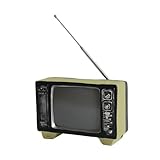
- Classic Retro Television Design - This vintage TV figurine recreates the charm of old-fashioned televisions, making it a nostalgic decorative piece for anyone who loves retro aesthetics
- High-Quality Craftsmanship - Made with resin and detailed with realistic retro elements, this vintage decor adds personality and texture to your home or commercial décor
- Perfect Accent for Any Space - Ideal for living rooms, bookshelves, offices, studios, cafes, bars, and window displays—this vintage home decor enhancing your space with a touch of classic charm
- Lightweight & Easy to Display - Compact and easy to place on desks, shelves, countertops, or display cases, this speakeasy decor stands securely without taking up much space
- Great Gift for Retro Lovers - A thoughtful and unique gift idea for vintage collectors, décor lovers, photographers, designers, or anyone who enjoys nostalgic home décor pieces
The first image transmission
In September 1927, Farnsworth transmitted an electronic television image in his laboratory. The Indiana Historical Bureau reports that he wired his backer George Everson the message, “THE DAMNED THING WORKS!” The phrase is reported in the Bureau’s historical account; it is not presented here as a transcription independently checked against the original telegram.
What was the battle between Farnsworth and RCA about?
RCA wanted a leading position in television as the new technology developed. Its president, David Sarnoff, was interested in Farnsworth’s technology, while Farnsworth held patents central to his system. According to the Indiana Historical Bureau and the U.S. Census Bureau, Farnsworth refused to sell his patents and RCA pursued a challenge to his priority. The conflict unfolded over several years and concerned patent priority and the right to develop commercial television—not a single ruling that settled every question about the medium or the future business.
In 1930, Vladimir Zworykin, who later worked for RCA, visited Farnsworth’s San Francisco laboratory. The Television Academy describes the visit in the context of the technological and patent contest that followed. It is part of the story of competition between Farnsworth’s work and RCA’s ambitions, but the visit alone does not establish that RCA simply “stole” television. Television Academy: Philo T. Farnsworth
Rank #2

- NOSTALGIA IN YOUR HAND: Portable TinyTV 2 features a vibrant 1.14 IPS screen, preloaded video channels, and a retro aesthetic, collectible novelty or desk ornament
- LOAD & STREAM VIDEOS: Easily transfer your own videos using free TinyTV Converter and USB-C, no Wi-Fi required for content playback
- CONTROLS: Adjust settings using vintage-style rotary knobs or the pocket-sized Tiny Remote, for a fun, tactile video experience
- BATTERY & PORTABLE: Includes rechargeable Li-Po battery delivering up to 2 hours of video on one charge; easily recharges via standard USB-C cable
- OVERSIZED CHARM, MINIATURE SIZE: Unique tabletop decor, collectible, or model accessory, excels in dollhouses, dioramas, or as a thoughtful novelty gift
Did Farnsworth win the patent battle against RCA?
Farnsworth prevailed in a key patent-priority ruling described as occurring in 1935. The Indiana Historical Bureau highlights Tolman’s preserved sketch as evidence supporting Farnsworth’s claim that his concept predated competing work. The Census Bureau also describes the 1935 decision as being in Farnsworth’s favor. This was an important result in the priority dispute, not a ruling that gave Farnsworth control of television manufacturing, broadcasting, or every invention used in television. The historical summaries cited here do not substitute for the full patent proceedings or court record. U.S. Census Bureau: Philo Farnsworth and the Invention of Television
Why a patent victory did not make Farnsworth the industry leader
Patent priority, the ability to manufacture and sell equipment, and control of broadcast infrastructure are separate forms of power. Farnsworth’s patents and technical work mattered, and RCA later licensed his technology. But RCA had the scale of an established company, with corporate engineering resources, manufacturing capacity, an existing radio business, and advantages in promoting and building broadcast services. A favorable priority result could recognize Farnsworth’s contribution without giving his independent operation RCA’s commercial reach.
The available institutional accounts do not establish one definitive total for RCA’s payments. The MIT Lemelson Center profile reports $1 million for licenses, while the Indiana Historical Bureau says RCA paid royalties without giving a total and the Census Bureau refers to a licensing fee without setting out the same accounting basis. The $1 million figure is therefore best treated as the Lemelson Center’s reported figure, not an independently reconciled total. MIT Lemelson Center: Philo Farnsworth
Rank #3

- 📺 HD LED Display: Enjoy vibrant visuals and sharp clarity, whether you’re watching your favorite cooking show in the kitchen or catching up on news in the bedroom.【★Check Your Space Size For Fitment Before Purchasing: L 11.8 inch×H 11.8 inch×W 1.18 inch ,Screen Diagonal size:11.6 inch,Perfect for close-range viewing (3-5 feet)】
- 📺 Compact and Portable Design: At just 12 inches, this small flat screen TV fits seamlessly in spaces like a kitchen TV corner, RV shelf, or camping table,making it great as a small TV for kitchens or tight apartment bedrooms.
- 📺 Built-in ATSC Tuner: Comes with a small TV with antenna capability to ensure reliable reception for local channels wherever you go.(NOTE:not compatible with network/satellite/other network providers signal!)
- 📺 Multiple Connectivity Options: Connect gaming consoles, DVD players, or USB drives for versatile entertainment wherever you are.But not compatible with Xfinity/Direct tv/Spectrum/Comcast /Verizon cable tv and so on.
- 📺 Versatile Applications: Ideal as a bedroom TV, travel TV, it’s the ultimate camping TV or travel TV for your outdoor adventures.
How television grew after the dispute
The gap between an invention-era patent contest and a mass medium is visible in later ownership figures. In a 2023 historical feature, the U.S. Census Bureau counted 5 million U.S. television-owning households in 1950 and 60.6 million in 1970. These are historical household figures, not current ownership data; they illustrate the scale of television’s later adoption, rather than measuring Farnsworth’s or RCA’s individual contribution.
RCA’s public promotion of television at the 1939 New York World’s Fair is one marker of the corporate push to bring the technology to audiences. Farnsworth also appeared before the Temporary National Economic Committee on January 19, 1939, as documented in a Library of Congress catalog record. The appearance is an archival trace of Farnsworth’s public role during television’s development, not evidence that he controlled the emerging broadcast business. Library of Congress: Farnsworth before the Temporary National Economic Committee
Quick wins for a faster PC:
Fix the driver behind crashes, sound loss and screen glitchesFind Drivers →Repair Windows errors before they cause bigger problemsFix Now →Scan for outdated or missing drivers - takes under a minuteDriver Scan →What the Farnsworth–RCA conflict means
- Farnsworth’s contribution: He was a central pioneer of all-electronic television, and his early work and patents helped support a successful priority claim.
- The role of evidence: Tolman’s preserved sketch gave the priority dispute a concrete record of Farnsworth’s early idea, but it was not the only possible basis for every finding.
- RCA’s advantage: A company’s ability to engineer, manufacture, promote, and support broadcasting can matter as much as a patent in determining who shapes an industry.
- The historical distinction: Winning recognition for a particular invention is not the same as becoming the dominant commercial force behind the technology.
For broader context on patent history and later portrayals of Farnsworth, the World Intellectual Property Organization published a discussion of the subject in 2008. WIPO Magazine: February 2008
Quick Recap
Product prices and availability are accurate as of the date/time indicated and are subject to change. Any price and availability information displayed on Amazon at the time of purchase will apply.

