
Windows Errors? Fix Them Before They Spread
Repair common Windows errors and clear accumulated junk for a smoother, more stable PC - no reinstall needed.Free scan · no reinstallOutdated Drivers Are Slowing You Down
One free scan finds every outdated or missing driver and matches the right update for your exact hardware.Free scan · exact hardware matchThere is no single winner in the AI model race. The best choice depends on your task, the evaluation used, the model version and date, and the conditions under which it was tested. A model leading a reasoning benchmark may not lead coding, computer use, writing, tool use, cost, speed or reliability.
Why “best AI model” is the wrong starting question
AI comparisons measure different things. A fixed benchmark gives models the same questions and scoring rules. A human-preference leaderboard records which answer users prefer in live comparisons. A product trial measures whether a model completes your workflow with your prompts, tools and data. These results are not interchangeable.
Start with the outcome you need: a code change, factual research, mathematics, drafting, web research, tool calls, computer interaction or another defined job. Then compare models on that outcome rather than treating one overall ranking as a universal championship.
What the latest evidence actually shows
Frontier capability is advancing quickly
Stanford HAI’s 2026 Artificial Intelligence Index Report says frontier models gained 30 percentage points on Humanity’s Last Exam in one year. That is an aggregate report finding; it does not mean every model improved by 30 points or that the test predicts performance on every practical task.
Recommended Free Tools
#1 Best Overall

- Built for Local AI Development: AMD Ryzen AI Halo is designed for local AI development and inference, featuring 128GB unified memory and support for up to 200B parameter models to build and run intensive AI workloads locally.
- 128GB Unified Memory: Features 128GB LPDDR5x unified memory at 8000 MT/s with 256 GB/s memory bandwidth, providing a shared memory pool across the CPU, GPU, and NPU to support larger AI models.
- AMD Ryzen AI Max+ 395 Processor: Features 16 cores, 32 threads, and Zen 5 architecture, paired with AMD Radeon 8060S integrated graphics featuring 40 RDNA 3.5 compute units and an AMD XDNA 2 NPU with up to 50 TOPS.
- Linux AI Developer Platform: Purpose-built for Linux-based AI development with full AMD ROCm software support and preloaded tools, models, and workflows optimized for local AI development.
- Compact, Connected Design: Includes a 2TB M.2 SSD, 10GbE LAN, Wi-Fi 7, Bluetooth 5.4, USB-C connectivity, and HDMI 2.1b.
The leading providers were tightly clustered in March 2026
The same report lists these Arena Elo ratings for March 2026:
| Provider | Arena Elo (March 2026) |
|---|---|
| Anthropic | 1,503 |
| xAI | 1,495 |
| 1,494 | |
| OpenAI | 1,481 |
| Alibaba | 1,449 |
| DeepSeek | 1,424 |
Four companies were within 25 Arena Elo points in that snapshot. Arena Elo reflects human voting in comparative responses, not a complete measure of reasoning, coding, factuality, agent reliability or value. It is also a dated snapshot, not a September 2026 ranking.
Leaderboards now split the race into categories
Arena’s live leaderboard separates overall preference from categories such as agents, coding agents, web development, work agents, text, image and video. Frontier Benchmarks groups evaluations across agentic work, coding, general capability, instruction following, knowledge, mathematics, multilingual tasks and reasoning. Another dashboard lists coding, agents and tool use, computer use, web research, reasoning and domain tasks; its search listing reported an update on September 25, 2026. Check each page’s methodology and update date before quoting an individual score.
Rank #2

- EVOLUTION AMD RYZEN AI MAX+ 395 MINI PC - GMKtec EVO-X2 is the next evolution in AI mini PC Ryzen Strix Halo series. Thanks to AMD Simultaneous Multithreading (SMT) the core-count is effectively doubled, to 32 threads. Ryzen AI Max+ 395 has 64 MB of L3 cache and can boost up to 5.1 GHz, depending on the workload. The Ryzen AI Max+ 395 is currently rated as the "most powerful x86 APU" on the market for AI computing.
- AI NPU with XDNA 2 ARCHITECTURE - Powered by 16 “Zen 5” CPU cores, 50+ peak AI TOPS XDNA 2 NPU and a truly massive integrated GPU driven by 40 AMD RDNA 3.5 CUs, the Ryzen AI MAX+ 395 is a transformative upgrade and delivers a significant performance boost over the competition. The Ryzen AI Max+ 395 excels in consumer AI workloads like the llama.cpp-powered application: LM Studio. Shaping up to be the must-have app for client LLM workloads, LM Studio allows users to locally run the latest language model without any technical knowledge required and unleash their creativity and productivity.
- AMD RADEON 8090S iGPU GAMING PC - The AMD Radeon RX 8060S offers all 40 CUs with up to 2.9 GHz graphics clock and uses the new RDNA 3.5 architecture. The powerful iGPU is positioned between an RTX 4060 and 4070 laptop GPU and therefore enables gaming in FHD at maximum details in most demanding games. The 8060S can also utilize the full 64GB pool, which is perfect for running LLMs such as Deepseek 32B, which runs comfortably on this machine.
- EIGHT CHANNEL LPDDR5X - LPDDR5X is a new ground breaking memory small form factor installed on-board. With blazing speeds up to to 8000MT/s, it runs 1.5x faster than the DDR5 SODIMMs; 90% better performance over DDR5 SODIMMs in video conferencing and photo editing; 30% better performance in productivity apps; 4% better performance in digital content workloads.
- QUAD SCREEN 8K DISPLAY SUPPORT - EVO-X2 AI Mini PC support 4-screen 4K/8K output via HDMI 2.1 (8K@60Hz), DisplayPort 1.4 (4K@60Hz), and dual USB 4 40Gbps Transfer speed (supporting PD3.0/DP1.4/DATA). Ideal for gaming, video editing, and multitasking, it provides expansive and crisp multi-display support.
How to compare models without misleading yourself
1. Define the task and success condition
- For coding, specify the repository, language, tests and whether the model may edit files.
- For research, define required sources, citation accuracy, freshness and acceptable uncertainty.
- For mathematics, decide whether calculator, code execution or scratch tools are allowed.
- For agents, define the tools, permissions, number of steps and what counts as a successful completion.
- For writing, use a representative brief and a human review rubric rather than a generic “quality” judgment.
2. Label the evaluation type
| Evidence type | What it measures | What it cannot establish alone |
|---|---|---|
| Controlled benchmark | Performance on a fixed task set and scoring procedure | How the model behaves in your workflow, with your data and tools |
| Human-preference ranking | Which answer voters prefer in pairwise comparisons | Objective factuality, code correctness, cost or long-run reliability |
| Live product trial | End-to-end results under your prompts, tools and constraints | General superiority outside the tested workflow |
3. Record the model, version and date
Write down the exact model identifier, provider, evaluation date and whether the score was provider-reported or independently collected. Model rosters and rankings change, and an unversioned result may be impossible to reproduce.
4. Match the test conditions
Disclose tools, system instructions, prompt style, reasoning mode, sampling settings, context length and scoring rules when those details are available. Do not compare a tool-enabled agent score with a no-tool score as though they used the same setup.
5. Separate capability from operating trade-offs
The cited evidence does not establish a complete comparison of price, latency, privacy, regional availability or reliability. Those are separate decision criteria that require their own current checks. A high benchmark score does not prove a model is affordable, fast, permitted for your data or consistently available.
Rank #3
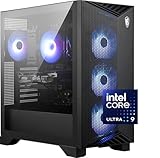
- Intel Core Ultra 9 285 Processor: Newly developed cores deliver ultra-smooth and responsive gameplay. AI accelerators prepare users for the next era of gaming on an AI PC.
- Simplistic Design: Enjoy the latest generation of Windows 11 Home for your everyday needs. *MSI recommends Windows 11 Pro for business use.
- NVIDIA GeForce RTX 5070 Ti GPU
- Cool While Gaming: In conjunction with an RGB CPU Air Cooler, the Aegis RS features four system cooling fans; three in the front and one in the rear to pull in cool air and push heat out of the PC.
- Turn on the Bright Lights: With the built-in RGB lighting, take your gaming experience to the next level by pressing the MSI LED button to cycle through lighting options. Customize lighting even further with MSI Center software.
A practical decision framework
- Choose one representative workload. Use a real but non-sensitive task that resembles what you will do repeatedly.
- Set a pass/fail rubric. Include correctness, completeness, citation quality, code-test results, tool-use success or another observable outcome.
- Test several current model versions. Keep prompts and allowed tools identical where comparison is intended.
- Log failures, not just wins. Record hallucinations, skipped instructions, unsafe actions, excessive retries and formatting errors.
- Measure operating constraints separately. Note latency, usage limits, price, privacy terms and availability for your region and plan.
- Recheck before committing. Live leaderboards and model versions can change, so repeat the comparison when the work is important.
How to read a leaderboard responsibly
- Read the category name before the rank. “Overall” and “coding agents” answer different questions.
- Check whether the result is a score, a rank or a preference rating.
- Look for the evaluation date and model version.
- Inspect the underlying test conditions and sample size when published.
- Treat close results as practically tied unless the difference is larger than normal uncertainty or matters on your own workload.
- Do not turn one benchmark lead into a claim of universal superiority.
What the horse-race metaphor gets right—and wrong
The metaphor is useful because model competition is dynamic: providers improve models, add tools and change product behavior. It is misleading when it implies one finish line. The “winner” can change by task, test design, date, tool access and user preference. A better mental model is a multi-event meet: inspect the event that matches your work, then verify the conditions.
Bottom line
Use the March 2026 Arena figures and Stanford’s reported benchmark gains as dated context, not as a permanent league table. For a sound choice, define your task, distinguish benchmark scores from human preferences, record version and date, match test conditions and measure practical constraints separately. The best AI model is the one that reliably meets your rubric under your actual conditions.
The Tool Desk
Outbyte Driver Updater FREEFix the driver behind crashes, sound loss and screen glitchesFind Drivers →Outbyte PC Repair FREERepair Windows errors before they cause bigger problemsFix Now →Frequently Asked Questions
Are Arena Elo ratings the same as benchmark scores?
No. Arena Elo is derived from human preferences in pairwise comparisons, while a benchmark score comes from a defined test and scoring method. They should be reported and interpreted separately.
How often should I recheck an AI model comparison?
Recheck whenever a provider changes the model or tools, when a leaderboard updates, or before making an important purchasing or deployment decision. Rankings and model rosters are volatile.
Quick Recap
Product prices and availability are accurate as of the date/time indicated and are subject to change. Any price and availability information displayed on Amazon at the time of purchase will apply.

