
Crashes, No Sound, or Screen Glitches?
Random freezes, missing sound and display glitches usually trace back to one bad driver. Find and replace yours safely.Free scan · under a minuteWindows Errors? Fix Them Before They Spread
Repair common Windows errors and clear accumulated junk for a smoother, more stable PC - no reinstall needed.Free scan · no reinstallShort answer: no—not as a general rule. AMD positions its Ryzen X3D desktop CPUs primarily for gaming, while its newest high-cache desktop model also has manufacturer-reported gains in selected creator and memory-intensive tasks. Those results include a few AI-adjacent applications, but they do not show that high-cache desktop CPUs are broadly better for AI than gaming. The right choice depends on what “AI” means for you: running a local model, using AI-assisted creator software, processing data on the CPU, or serving models on a production server.
What does “AI” mean for your CPU choice?
“AI performance” is not one workload. Before comparing AMD and Intel high-cache CPUs, identify what the computer will actually do:
- Local model inference: Running a model on your own PC. The model, precision, software, and available memory matter; many local-AI setups also rely heavily on a GPU.
- AI-assisted creator software: Applications such as ComfyUI or ONNX-based inference may use different combinations of CPU, GPU, and memory. Results from one application do not predict every AI tool.
- CPU-centric data work: Some preparation, retrieval, orchestration, or inference-adjacent stages may place meaningful demands on the CPU and memory system.
- Production model serving: Serving models at scale is a server-platform decision involving more than cache, including compute, memory bandwidth, storage, networking, and software.
For a desktop recommendation, compare results for the exact model, precision, software stack, memory capacity and bandwidth, and batch or concurrency level you expect to use. The available sources do not establish a comprehensive, directly comparable AMD-versus-Intel high-cache desktop AI benchmark set.
Why high-cache Ryzen X3D CPUs are associated with gaming
AMD explicitly positions its Ryzen X3D desktop processors around gaming and has published comparisons with Intel Core Ultra desktop processors. These are AMD lab results, not independent universal rankings. In its October 2025 comparison of the Ryzen 7 9850X3D and Core Ultra 9 285K, AMD disclosed that the systems used different memory data rates: DDR5-6000 and DDR5-7200. AMD’s product-page comparisons published in December 2025 also used different memory speeds for the 9800X3D, 9850X3D, and Core Ultra 9 285K systems. Game selection and test configuration therefore matter when interpreting those results. AMD’s 9850X3D announcement and test details and AMD’s Ryzen desktop product page describe the manufacturer comparisons.
The Tool Desk
Outbyte Driver Updater FREEFix the driver behind crashes, sound loss and screen glitchesFind Drivers →Outbyte PC Repair FREERepair Windows errors before they cause bigger problemsFix Now →#1 Best Overall

- The world's fastest gaming desktop processor and first gaming processor with 3D stacking technology
- 8 Cores and 16 processing threads with AMD 3D V-Cache technology
- 4.5 GHz Max Boost, 100 MB cache, DDR4-3200 support
- For the advanced Socket AM4 platform, can support PCIe 4.0 on X570 and B550 motherboards
- Cooler not included, high-performance cooler recommended
Independent testing also illustrates why a newer X3D model is not automatically a large gaming upgrade. GamersNexus reported that, in its tested gaming results, the Ryzen 7 9850X3D was at most 4% faster than the 9800X3D and sometimes identical. The review listed a $500 original MSRP and a January 29, 2026 release date; that MSRP is not a verified current retail price. GamersNexus’ 9850X3D review provides its test scope.
For gaming, look at independent benchmarks for the games you play and the resolution and graphics card you plan to use. At higher resolutions, a graphics-card bottleneck can narrow CPU differences. Average frame rates are not the only useful measure: frame-time behavior can affect how smooth a game feels.
Rank #2

- ADVANCED FEATURES - With a TDP of 65W and 20MB L3 cache, the Ryzen 7 5700 is created to do big.
- ADVANCED FEATURES - With a TDP of 65W and 20MB L3 cache, the Ryzen 7 5700 is made for great.
- 8 cores and 16 threads - The Ryzen 5 5700 offers excellent clock speeds (base 3.7 GHz / boost 4.6 GHz). Overclocking is of course possible as all cores are unlocked.
- AMD Wraith Spire Cooler Included
What AMD’s 9950X3D2 adds beyond gaming
AMD announced the Ryzen 9 9950X3D2 Dual Edition in 2026 with 208MB of total on-chip cache. AMD positions it for gaming as well as content creation, compilation, simulation, and memory-intensive work. That makes it relevant to some workloads beyond games, but cache capacity alone does not establish performance for every AI task. AMD’s 9950X3D2 announcement gives the model’s stated cache and intended uses.
In tests conducted by AMD and BOXX in February 2026, AMD reported average uplifts of 5% to 8% for selected creator workloads and source-code builds on the 9950X3D2 versus the 9950X3D. The comparison list includes ComfyUI and ONNX inference. Those are specific application results from the named test effort, not evidence that the processor is 5% to 8% faster for AI in general. AMD’s announcement describes the reported comparison.
What’s actually slowing this PC down?
Pick the symptom - the matching free tool is one click away.
Rank #3
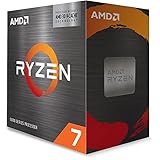
- The world's fastest gaming desktop processor and first gaming processor with 3D stacking technology
- 8 Cores and 16 processing threads with AMD 3D V-Cache technology
- 4.5 GHz Max Boost, 100 MB cache, DDR4-3200 support
- For the advanced Socket AM4 platform, can support PCIe 4.0 on X570 and B550 motherboards
- Cooler not included, high-performance cooler recommended
Why server AI results do not pick a desktop gaming CPU
AMD’s 2026 analysis of agentic AI describes workloads that move among networking, orchestration, retrieval, tool execution, data processing, and inference-adjacent activities. It says performance depends on a combination of compute throughput, memory bandwidth, cache efficiency, storage, synchronization, and vector processing. Its comparisons use server platforms, not consumer gaming CPUs. AMD reported an 82% geomean uplift versus Intel Xeon 6980P for the CPU-centric agentic AI stages it selected; this is a manufacturer comparison of server systems, not an AMD-versus-Intel desktop result. AMD’s agentic AI analysis explains its platform and workload scope.
Similarly, AMD’s PACE article reports a 1.60x geometric mean speedup over vLLM in the article’s autoregressive test configurations. The tests ran on dual-socket EPYC 9755 systems and used named model and serving configurations. That is a result for AMD’s server hardware and software stack; it does not make an EPYC server CPU a general-purpose recommendation for a gaming PC or typical local-AI desktop. AMD’s PACE LLM article sets out the tested setup.
Rank #4

- Processor Manufacturer: AMD
- Processor Core: Octa-core (8 Core)
- Clock Speed: 4.20 GHz
- Overclocking Speed: 5.10 GHz
- L2 Cache: 8 MB
How to choose between high-cache CPUs for gaming or AI
| Decision factor | For gaming | For AI or creator work |
|---|---|---|
| Workload evidence | Compare independent results for your games, resolution, graphics card, and memory configuration. | Find results for the exact model, precision, application, software stack, and batch or concurrency level. |
| Execution hardware | Check whether the game is limited by the CPU or graphics card at your target settings. | Determine whether the task runs on the CPU, GPU, NPU, or a server; a high-cache CPU may not be the main performance constraint. |
| Memory | Compare system memory configuration as well as CPU results. | Check whether memory capacity and bandwidth are sufficient for the model and workload, alongside cache. |
| Whole-system fit | Include CPU, graphics card, memory, motherboard, cooling, and power in the budget. | Include the accelerator, memory, storage, cooling, and software requirements—not just the CPU. |
| Platform compatibility | Verify the exact processor’s socket and motherboard support before buying. | Check the same compatibility and cooling requirements, and confirm that the software stack supports the intended execution path. |
If gaming is the priority, Ryzen X3D’s established desktop positioning makes it a natural family to compare, but select the exact chip using independent game benchmarks and total system cost. If AI is the priority, first identify where the workload executes and seek benchmark results for that specific use. A desktop high-cache CPU may help a CPU-sensitive application; the cited evidence does not establish that it is a better general AI purchase than a gaming CPU, or that it replaces a suitable GPU or server.
Quick Recap
Best Value

- Supports Motherboard Socket: AM4
- Aluminum heatsink - Pre-applied thermal paste
- Direct screw mounting to socket AM4 motherboard
- 3.5-inch 90mm fan
- 4-pin PWM power connector (9-inch length, approximate)
Product prices and availability are accurate as of the date/time indicated and are subject to change. Any price and availability information displayed on Amazon at the time of purchase will apply.

