
Free tools Windows power users keep installed
One-click scans. No signup required.
You can build a 1:10-scale Cray-1 as a physical model, an FPGA recreation of selected Cray-1 behavior, or both. The strongest documented example combines the two: Chris Fenton described a binary-compatible, cycle-accurate recreation running on a Xilinx Spartan-3E 1600 board, alongside a hand-fabricated 1:10 enclosure. Treat those as separate projects with a shared goal: first choose how much of the original machine you want to reproduce, then plan the electronics and case accordingly.
Choose what “build a Cray-1” means for your project
A detailed case does not make a computer functional, and an FPGA that runs Cray-like code does not automatically reproduce the original machine in full. Decide which outcome you want before buying parts or drawing the enclosure.
Display model
Build the C-shaped cabinet, panels, badge, and settee without functional computing hardware. This is the most fabrication-focused route; you can use a simple light or display effect if desired, but that is separate from recreating Cray-1 behavior.
FPGA recreation of selected behavior
Implement and test a defined subset of the architecture on an FPGA. Set an explicit boundary—for example, which instructions and execution units are supported—and describe the result as a subset rather than a complete Cray-1.
The Tool Desk
Outbyte PC Repair FREERepair Windows errors before they cause bigger problemsFix Now →Outbyte Driver Updater FREEScan for outdated or missing drivers - takes under a minuteDriver Scan →#1 Best Overall

- EXACT-MATCH UPGRADE — 1TB kit (16 x 64GB) DDR5-5600 (PC5-44800), 2Rx4 Registered ECC, 1.1V, CL46, 288-pin. Matched set from a single production lot — the precise rank, voltage, and timing your system's memory controller expects, recognized at full capacity and rated speed.
- VERIFIED FITMENT — Compatible with the HPE Cray XD220v Compute Node. The 288-pin Registered (RDIMM) form factor this server requires — not a UDIMM, LRDIMM or SODIMM. Spec-matched to the server's memory-population rules.
- ENTERPRISE STABILITY — Registered (buffered) architecture offloads the memory controller so every slot runs fully populated at full capacity, while ECC catches and corrects single-bit errors on the fly — stopping silent data corruption and unplanned reboots before they reach production.
- CHECK YOUR CONFIG — Server and motherboard memory support varies by model and processor. Consult your system manual for supported capacities, approved DIMM population order, and installation steps before purchase.
- LIFETIME SUPPORT — Backed by a lifetime replacement warranty and free US-based technical support. Researched, matched, and compatibility-tested by NEMIX RAM, a US-based server memory specialist since 1993, and backed by a lifetime warranty.
Software-capable recreation
A broader goal requires more than arithmetic units. Instruction issue, hazards, vector chaining, memory behavior, interfaces, and software support all matter. Fenton’s documented project was described as binary-compatible and cycle-accurate, but it ran at lower clock rates, used much less memory than the original, and omitted several original features. That makes it a valuable reference, not proof that an equivalent result is a quick or turnkey build.
Use the Cray-1 manuals to define the hardware
Start with the Cray hardware reference and related planning documents in the archived Cray document index. Use them to establish instruction behavior, registers, interfaces, and block structure before writing RTL or committing to an FPGA. A block diagram is a starting map, not a complete implementation specification: control timing and interactions between units need to be worked out and tested.
For context, Fenton’s project documentation describes the original Cray-1 as an 80 MHz design with 12 independent pipelined execution units and vector registers holding 64 values. It gives an original-memory range of 256–4096 kilowords and describes the upper figure as 32 megabytes. These are original-machine specifications, not requirements or achieved capacities for a replica.
Build the FPGA recreation incrementally
Do not begin by trying to reproduce every subsystem at once. The EE Times account of the recreation describes an incremental approach and highlights instruction issuing, hazard detection, vector chaining, and memory as substantial reverse-engineering work.
Quick wins for a faster PC:
Fix the driver behind crashes, sound loss and screen glitchesFind Drivers →Clear out junk files and repair common Windows errorsFree Scan →Rank #2

- EXACT-MATCH UPGRADE — 1TB kit (8 x 128GB) DDR5-5600 (PC5-44800), 4Rx4 Registered ECC, 1.1V, CL46, 288-pin. Matched set from a single production lot — the precise rank, voltage, and timing your system's memory controller expects, recognized at full capacity and rated speed.
- VERIFIED FITMENT — Compatible with the HPE Cray XD220v Compute Node. The 288-pin Registered (RDIMM) form factor this server requires — not a UDIMM, LRDIMM or SODIMM. Spec-matched to the server's memory-population rules.
- ENTERPRISE STABILITY — Registered (buffered) architecture offloads the memory controller so every slot runs fully populated at full capacity, while ECC catches and corrects single-bit errors on the fly — stopping silent data corruption and unplanned reboots before they reach production.
- CHECK YOUR CONFIG — Server and motherboard memory support varies by model and processor. Consult your system manual for supported capacities, approved DIMM population order, and installation steps before purchase.
- LIFETIME SUPPORT — Backed by a lifetime replacement warranty and free US-based technical support. Researched, matched, and compatibility-tested by NEMIX RAM, a US-based server memory specialist since 1993, and backed by a lifetime warranty.
-
Define a testable RTL skeleton
Write down the supported instruction and behavior boundaries. Set up a small top-level design and a repeatable way to test each implemented block before adding the next one.
-
Implement address and scalar units
Start with the address and scalar paths, then verify register reads and writes, arithmetic results, and control behavior against the manuals. Keep tests small enough to isolate an error to one unit.
-
Add floating-point and vector units
Introduce floating-point operations and vector execution only after the basic scalar and address paths are dependable. Test vector register behavior and the interactions between pipelined units; vector chaining and hazards can affect whether instructions produce the expected results.
-
Implement register files, issue, and memory behavior
Integrate the register files and instruction issue/control logic, then test memory access and dependencies between operations. These interactions are central to a faithful recreation, not optional polish.
Special offer. See more information about Outbyte and uninstall instructions. Please review EULA and Privacy policy.Rank #3
 DaliCarCare Touch Up Paint - Compatible with Dodge Vehicles (Model: Hornet) - Grey Cray Metallic (581)
- Exact color match compatible with Dodge Vehicles Grey Cray Metallic (581)
- Complete professional kit includes touch up paint, polishing paste, cloth, sponge, applicators, and gloves
- Repairs scratches, chips, and minor paint damage
- Easy DIY application
- Thousands of colors available
-
Add optional I/O and context switching
Begin with a simple interface such as a UART so you can observe or control the system without first recreating original peripherals. Treat original disk channels and context switching as later extensions.
Fenton’s project account reports an initial operating rate of about 33 MHz, later improved to nearly 50 MHz after multiplier improvements, and about 4 kilowords of memory. The same account says several original features remained absent. These figures describe that particular historical prototype, not a performance target guaranteed on other FPGA boards. The EE Times account characterizes the recreation as about 5,600 lines of Verilog; that reported code size is likewise a description of that project, not a reliable estimate for another implementation.
Choose an FPGA by constraints, not by the historical board name
The documented recreation used a Xilinx Spartan-3E 1600 development board. Fenton’s project documentation suggests that board or an equivalent FPGA platform, but the Spartan-3E 1600 is now difficult to source and catalog listings may be obsolete. Do not assume that a historical part number is currently available or that any board advertised as equivalent will run the design unchanged.
- Logic capacity: Check whether the device can accommodate the RTL you intend to implement.
- Block RAM: Compare available on-chip memory with your design’s storage needs; the historical prototype’s reported 4 kilowords is not the same as the original machine’s memory range.
- Clocking and timing: Confirm that the board and toolchain can support your target clock and that the design meets timing after implementation.
- I/O: Check for accessible pins or interfaces for a simple console connection such as UART.
- Toolchain and board support: Verify that the FPGA tools support the exact device and board before purchase. An older design may need adaptation to a newer part or toolchain.
Buy or borrow a board only after you have checked those constraints against the implementation you plan to build. An FPGA development board is the key electronics platform; it does not remove the work of adapting, compiling, timing, and validating the RTL.
PC Slower Than It Used to Be?
A free scan shows the junk files, broken settings and background clutter dragging Windows down - then fixes them in one click.Free scan · Windows 10 & 11Outdated Drivers Are Slowing You Down
One free scan finds every outdated or missing driver and matches the right update for your exact hardware.Free scan · exact hardware matchRank #4

- UNICORN CRAFT SET: Features 2 sets of Stacking Stencils, 4 .5oz Model Magic Packs, 2 Pip-Squeaks Skinnies Markers, and a Play Mat.
- MODEL MAGIC STENCILS: Kids create customized Uni-Creatures with stackable stencils that can be mixed and matched.
- STEP-BY-STEP INSTRUCTIONS: Follow the included instructions to easily create colorful unicorn toys.
- LESS MESS MODELING CLAY: Model Magic is easier to use than traditional modeling clay, and sticks to itself leaving less mess behind.
- STORE & REUSE: Store Model Magic in an airtight container to reuse.
Scale the enclosure from drawings, not from another model
Find an authoritative Cray drawing, choose a consistent reference point, and multiply each real dimension by 0.1 for a 1:10 model. For example, a measured 100 mm feature on the chosen drawing becomes 10 mm in the model. Keep a dimension sheet and apply the same scale to the frame, panels, base, and settee so that separately fabricated parts fit together.
Do not transfer dimensions from a documented 1:8 model directly to a 1:10 build. Its author described a 1 cm wooden base and 5 mm plexiglass panels and framework, but those are construction choices for that model, not scaled 1:10 specifications. Adapt its cutting approach only after recalculating parts from your source drawing.
Select materials and fabrication methods for the parts
| Part or approach | Documented material or method | How to use it in a 1:10 build |
|---|---|---|
| Frame and body | Fenton’s 1:10 case used MDF and balsa wood, with CNC milling, sanding, paint, and glue. | Use the materials and fabrication method that suit your tools; derive dimensions from a Cray drawing at 0.1 scale. |
| Panels and framework | A documented 1:8 replica used 5 mm plexiglass panels and framework. | Use its fabrication concept as a reference, not its panel thickness or dimensions as a 1:10 specification. |
| Base, lower panels, and “pillows” | The 1:8 replica used a 1 cm wooden base and described a cutting scheme for lower panels and pillows. | Redraw these parts at 1:10 and check their fit against the frame before cutting final material. |
| Seat | Fenton’s case used a pleather couch seat; a separate PicoCray enclosure used a 2 mm laser-cut and engraved foam seat. | Choose a treatment that fits the appearance and scale of your model. The PicoCray seat dimension belongs to that separate enclosure, not a 1:10 Cray-1 specification. |
| Small details and badge | The 1:8 replica used 3D-printed joints and badges, painted plastic tiles, foam pillows, glue, screws, and rubber feet. Its badge was printed at 29-micron layers in Shapeways Frosted Ultra Detail material. | Use printed parts or hand-fabricated substitutes for details. The cited layer setting and material describe that badge job, not a requirement for your printer or service. |
| Alternative enclosure panels | A separate PicoCray enclosure used transparent and red acrylic joined with acrylic welding solution. | Consider acrylic if you want a different enclosure treatment; that example is not a dimensioned 1:10 Cray-1 plan. |
Fenton’s case also used a pleather settee, while the 1:8 model and PicoCray examples demonstrate other ways to fabricate small details and panels. Choose a method you can execute accurately: CNC milling can help with repeatable shaped parts, laser cutting suits flat panels, and hand fabrication can work for a one-off model. Make a test piece before committing expensive material or assembling the finished frame.
Independent reader supportYour contribution helps us test, update, and keep practical guides available for everyone.Assemble the project in a sequence that keeps rework manageable
-
Set the fidelity target
Write down whether the deliverable is a display model, an FPGA subset, or a broader software-capable recreation. For an FPGA build, list the supported units and features; for the enclosure, list which external features you will reproduce.
Special offer. See more information about Outbyte and uninstall instructions. Please review EULA and Privacy policy.Best Value
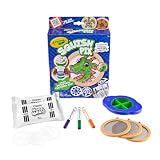 Crayola Squish Pix, Model Magic Art Kit for Kids, Textured Arts & Crafts, Coloring Activity, Gift for Kids, Ages 5+
- CRAYOLA SQUISH PIX: This Crayola Model Magic art kit includes 3 Reusable Frames, 3 Pip-Squeaks Markers, 3 Stencils, 1 Base, and 2 White Model Magic Pouches (1oz each).
- TEXTURED ARTS & CRAFTS FOR KIDS: Transform marker drawings into vibrant, colorful 3D art by coloring flat designs onto Crayola Model Magic, then squishing them into stunning, multi-dimensional masterpieces.
- REUSABLE FRAMES: The 3 reusable frames let kids create, display, and then start all over again, making each new creation as unique as the last.
- CUSTOMIZE YOUR DESIGN: Use the included stencils for guided designs or let creativity run wild with freehand drawing.
- EASY TO USE: The Squish Pix unit is entirely kid-powered, making it easy to use without the need for electronic components.
-
Gather the reference material
Read the Cray hardware-reference and planning documents in the archived Cray document index. For the case, locate an authoritative drawing and create your own scaled dimension sheet.
-
Prototype the electronics path
Build the RTL skeleton and implement address and scalar units first, followed by floating-point and vector units, register files, issue/control, and memory. Validate each stage before integrating it.
-
Verify the FPGA platform
Check logic, block RAM, clocking, I/O, and toolchain compatibility before choosing a board. If the historical Spartan-3E 1600 is unavailable, select another device based on those constraints and expect possible RTL or toolchain adaptation.
-
Fabricate the case separately
Cut and assemble the C-shaped frame, panels, and settee independently of the electronics. Dry-fit parts, sand, paint, and add printed or hand-made details before fitting the hardware inside.
Special offer. See more information about Outbyte and uninstall instructions. Please review EULA and Privacy policy. -
Integrate only after both sides work
Bring the electronics and enclosure together once the board operates reliably and the case dimensions are confirmed. Start external interaction with a simple interface; add harder legacy I/O or software ambitions only when the basic build is stable.
Quick Recap
Bestseller No. 1Bestseller No. 2Bestseller No. 3Bestseller No. 4
Plan around the main limitations
- Functional fidelity takes time: The instruction/control interactions and memory system require careful implementation and testing; treating the project as a marathon rather than a sprint is appropriate.
- FPGA resources shape scope: The historical prototype’s clock and memory figures were far below the original machine’s stated specifications, and some original features were left out.
- Legacy software is a separate challenge: The documented recreation lacked several original features, and compatible legacy software is scarce. A running FPGA design should not be confused with a complete software ecosystem.
- Fabrication dimensions are not interchangeable: The available examples include a 1:10 case, a 1:8 model, and a separate PicoCray enclosure. Their materials and techniques can inform your work, but their dimensions cannot be mixed without recalculation.
Product prices and availability are accurate as of the date/time indicated and are subject to change. Any price and availability information displayed on Amazon at the time of purchase will apply.

