
The Tool Desk
Outbyte PC Repair FREERepair Windows errors before they cause bigger problemsFix Now →Outbyte Driver Updater FREEFix the driver behind crashes, sound loss and screen glitchesFind Drivers →There is no single water-use figure or cooling system that fits every data center. To manage consumption, operators need a consistent water-use baseline, better control of cooling and airflow, and a comparison that includes both onsite water and the water associated with electricity. Water Usage Effectiveness (WUE) is the standard starting metric, but it is not a complete measure of environmental impact.
How much water does a data center use?
Water use varies with cooling design, climate, IT load, operating conditions and what an operator counts within the facility boundary. A useful intensity measure is WUE: annual site water use in liters divided by annual IT-equipment energy in kilowatt-hours.
Natural Resources Canada’s 2024 guide reproduces a U.S. Department of Energy figure of 1.8 L/kWh as the average data-center WUE. Treat it as a reported average, not a target or a prediction for a particular facility. For scale only, applying 1.8 L/kWh to a hypothetical facility using 1 MW of IT power continuously for a year gives about 15.8 million liters of site water: 8.76 million IT kWh multiplied by 1.8 L/kWh. Actual annual water use depends on the facility’s measured WUE and IT energy.
Electricity use matters to the water picture as well as onsite cooling. The United Nations Economic Commission for Europe’s Sustainable Data Centres page reports 415 TWh of global data-center electricity consumption in 2024, about 1.5% of global electricity, and cites a projection of 945 TWh in 2030. Those figures describe electricity, not water use; they underline why a water comparison should account for electricity generation as well as water consumed at the site.
Free tools Windows power users keep installed
One-click scans. No signup required.
#1 Best Overall

- Includes: 1x iCUE LINK XC7 RGB ELITE CPU Block, 1x iCUE LINK XD6 RGB Pump Reservoir Combo, 3x iCUE LINK RX120 RGB fans, 1x XR5 360mm Radiator, 1x iCUE LINK System Hub, XT Hardline Tubing & Fittings
- Gorgeous Hardline Cooling, Made Simple – This complete Hydro X Series custom cooling kit delivers the stunning look that only hardline loops can achieve, with iCUE LINK making the build simpler than ever.
- Dynamic RGB Lighting - Individually addressable RGB LEDs integrated into the CPU water block, pump/reservoir, and cooling fans give your PC a striking look to make it stand out from the crowd.
- Low-Noise Custom Cooling - CORSAIR iCUE software lets you adjust fan and pump settings, monitor temperatures, customize RGB lighting, and synchronize it with all iCUE-compatible products in your setup.
What is WUE, and how do you calculate it?
WUE, or Water Usage Effectiveness, expresses site water use relative to energy consumed by IT equipment. The U.S. Department of Energy’s Federal Energy Management Program describes it as a site-based metric; Natural Resources Canada and ISO/IEC also describe the liters-per-IT-kWh formula.
WUE = annual site water use (liters) ÷ annual IT-equipment energy use (kWh)
For example, if a facility records 9 million liters of site water use and 5 million kWh of IT energy over the same reporting year, its WUE is 1.8 L/kWh. Keep the numerator and denominator aligned to the same facility boundary and reporting period.
WUE is useful for tracking a facility over time or comparing sites only when their boundaries, climates, IT loads, water sources and accounting periods are sufficiently comparable. It is not a stand-alone measure of overall efficiency: because IT energy is the denominator, a higher IT energy figure can lower WUE even when water use has not improved. A low onsite WUE can also coincide with higher electricity use or water impacts from power generation. No universal WUE target is established by the cited sources.
Rank #2

- CONTACT FRAME FOR INTEL LGA1851 | LGA1700: Optimized contact pressure distribution for longer CPU life and better heat dissipation
- ARCTIC's P12 PRO FAN: More power at any speed - more powerful and quieter than the P12, especially at low speeds. Higher maximum speed for optimal cooling performance under high load
- NATIVE OFFSET MOUNTING FOR INTEL AND AMD: Shifting the cold plate center towards the CPU hotspot ensures more efficient heat transfer
- INTEGRATED VRM FAN: PWM-controlled fan that lowers the temperature of the voltage converters and thus ensures reliable performance
- INTEGRATED CABLE MANAGEMENT: The PWM cables of the radiator fans are integrated in the sheathing of the hoses so that only a single visible cable is connected to the motherboard
What should a water-use baseline include?
First establish what enters, circulates through and leaves the site. Include cooling-loop water, cooling-tower makeup and blowdown, onsite evaporation, humidification and material water flows from treatment or other facility uses, as applicable. Record any exclusions rather than leaving the boundary implicit. ISO/IEC 30134-9 and the applicable EN 50600-4-9 categories provide frameworks for consistent measurement and reporting.
Meter material flows
Submeter cooling-tower makeup, blowdown, humidification, reclaimed-water intake, discharge and other significant flows. Record water source and treatment losses where they affect the accounting boundary. A digital water-flow meter or inline flow sensor can help capture these flows; selection and installation require site engineering review. Check that the device suits the pipe diameter, pressure, temperature, conductivity and water chemistry.
Pair water data with operating data
Record IT energy, total facility energy, IT load, weather and operating hours alongside water readings. Calculate monthly and annual WUE, then reconcile meter totals with utility bills and treatment-system records. Investigate unexplained differences before treating a trend as a real operational change.
How can operators reduce water use without major capital work?
Begin with controls, airflow and heat transfer. Avoid cooling or humidifying beyond equipment needs, and review setpoints against manufacturer requirements and the applicable ASHRAE operating envelope.
Rank #3
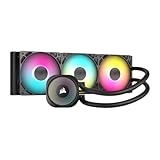
- Simple, High-Performance All-in-One CPU Cooling: Renowned CORSAIR engineering delivers strong, low-noise cooling that helps your CPU reach its full potential
- Efficient, Low-Noise Pump: Keeps your coolant circulating at a high flow rate while generating a whisper-quiet 20 dBA
- Convex Cold Plate with Pre-Applied Thermal Paste: The slightly convex shape ensures maximum contact with your CPU’s integrated heat spreader, with thermal paste applied in an optimised pattern to speed up installation
- RS120 ARGB Fans: RS ARGB fans create strong airflow and high static pressure, with easy ARGB control via a compatible motherboard. CORSAIR AirGuide technology and Magnetic Dome bearings ensure great cooling performance and low noise
- Easy Daisy-Chained Connections: Reduce the wiring in your system by daisy-chaining your RS ARGB fans and connecting them to just one 4-pin PWM fan header and one +5V ARGB header
- Maintain hot-aisle and cold-aisle separation, and seal gaps that allow supply air to bypass IT equipment.
- Clean heat-transfer surfaces and trend supply and return temperatures to identify degraded performance.
- Review chilled-water temperature and airflow settings rather than assuming colder water or more airflow is always better.
- Monitor water meters and investigate unexpected increases in makeup, blowdown, humidification or discharge.
The U.S. Department of Energy Federal Energy Management Program says higher chilled-water temperatures and reduced airflow can produce 20% less chiller energy in relevant applications. This is an application-specific energy finding, not a guaranteed water-saving percentage; lower chiller energy can reduce the heat that must be rejected through evaporative cooling.
Which cooling system uses the least water?
Air-side economization and dry cooling can use little or no onsite process water in suitable climates. Direct-liquid cooling with closed loops can also reduce facility water use, particularly for high-density IT. Neither option should be selected on onsite WUE alone: compare energy demand, indirect electricity-related water impacts, climate limits and operating requirements. The European Commission’s 2026 technical report states that data-center water consumption depends primarily on the cooling technology employed.
The comparison below is qualitative. Water, energy and cost outcomes depend on site design and operation; the cited guidance does not give comparable cost figures or a single numerical ranking across these systems.
| Cooling approach | Onsite water | Energy and indirect water | Climate and drought considerations | Water quality and operating needs | Costs and reporting |
|---|---|---|---|---|---|
| Air-side economization or dry cooling | Little or no process-water use in suitable climates. | Fan or compressor energy may increase; assess electricity-related water alongside onsite use. | Hot-weather limits can constrain suitability; assess performance and peak-day demand for the local climate. | Requirements depend on design; the cited guidance gives no universal specification. | Comparable capital and operating costs are not stated in the cited guidance. Meter any material water use and document the boundary. |
| Evaporative or water-cooled systems | Use makeup water and produce blowdown; water use depends on operation and conditions. | Can be energy-efficient in hot conditions; include electricity-related water in the comparison. | Evaluate peak demand and local drought exposure, not just annual totals. | Require water treatment and management of blowdown and plume. | Comparable capital and operating costs are not stated in the cited guidance. Measure makeup and blowdown as applicable. |
| Direct liquid cooling or closed loops | Can reduce facility water use for high-density IT; closed loops do not by themselves establish zero water impact. | Compare the full system’s energy use and associated electricity water with alternatives. | Assess site-specific peak demand and backup arrangements. | May require heat exchangers, leak detection, water-quality control and compatible servers. | Comparable capital and operating costs are not stated in the cited guidance. Record relevant loop and facility flows within a consistent boundary. |
| Adiabatic systems | May use water intermittently during peak conditions; nameplate information alone does not show annual consumption. | Can reduce energy in peak conditions; compare annual energy and water together. | Assess the frequency and duration of water-using operation during hot or dry periods. | Water quality and maintenance needs depend on system design; the cited guidance gives no universal specification. | Comparable capital and operating costs are not stated in the cited guidance. Measure actual annual water use. |
For each design, compare onsite WUE, indirect water associated with electricity, PUE, carbon, peak-day demand, drought resilience, water quality, maintenance complexity and potential for waste-heat reuse. The cited guidance does not establish comparable values for every factor, so site-specific engineering and operating data are needed rather than a universal winner.
Recommended Free Tools
Rank #4

- CONTACT FRAME FOR INTEL LGA1851 | LGA1700: Optimized contact pressure distribution for longer CPU life and better heat dissipation
- ARCTIC's P12 PRO FAN: More power at any speed - more powerful and quieter than the P12, especially at low speeds. Higher maximum speed for optimal cooling performance under high load
- NATIVE OFFSET MOUNTING FOR INTEL AND AMD: Shifting the cold plate center towards the CPU hotspot ensures more efficient heat transfer
- INTEGRATED VRM FAN: PWM-controlled fan that lowers the temperature of the voltage converters and thus ensures reliable performance
- INTEGRATED CABLE MANAGEMENT: The PWM cables of the radiator fans are integrated in the sheathing of the hoses so that only a single visible cable is connected to the motherboard
Can a data center use reclaimed or other non-potable water?
Potentially. Reclaimed municipal water, rainwater or treated process water may be suitable for cooling makeup where local rules and engineering studies support their use. This can reduce competition with drinking-water and agricultural uses, but it does not make the facility water-neutral or impact-free.
Before switching sources, assess treatment chemistry, scaling and corrosion control, pathogen control, storage, backup supply, discharge limits and the reliability of the supplying utility. Account for treatment energy, process losses and upstream water withdrawals. Whether a source is appropriate depends on local water balance, permits and water quality; “zero potable water” is not equivalent to “zero water impact.”
How should operators report data-center water use?
Publish the WUE formula, reporting period, facility boundary, numerator and denominator, water sources, reclaimed-water share, treatment losses, exclusions and meter uncertainty. Explain how cooling and humidification flows are handled so readers can interpret changes and comparisons. Use a consistent method from period to period, and identify any changes to meters or accounting boundaries.
In the European Union, Delegated Regulation (EU) 2024/1364 points to EN 50600-4-9 WUE categories and requires standardized measurement of water inputs for covered data centers. The requirement applies to facilities within the regulation’s scope, not automatically to every data center everywhere. Auditable meters and clearly documented boundaries help operators produce comparable, supportable figures.
Windows Errors? Fix Them Before They Spread
Repair common Windows errors and clear accumulated junk for a smoother, more stable PC - no reinstall needed.Free scan · no reinstallCrashes, No Sound, or Screen Glitches?
Random freezes, missing sound and display glitches usually trace back to one bad driver. Find and replace yours safely.Free scan · under a minuteQuick Recap
Product prices and availability are accurate as of the date/time indicated and are subject to change. Any price and availability information displayed on Amazon at the time of purchase will apply.

